The Am29000 Challenge
Developing a C compiler and a web browser for an architecture as niche as the Am29000 is not a task for the faint of heart. The Am29000, a 32-bit RISC processor from AMD, enjoyed a brief period of prominence in the late 1980s and early 1990s, primarily in embedded systems and high-performance computing. Today, it is largely a historical footnote, making the feat of building modern software tools for it even more remarkable.
The journey began with the need for a C compiler. Existing toolchains for the Am29000 are scarce, outdated, or proprietary. This scarcity presented a significant barrier for anyone looking to develop or port software to systems based on this architecture. The author's motivation was to overcome this limitation, enabling the development of more complex applications than what was previously feasible with assembly language or limited C subsets.
The process of creating a C compiler is inherently complex. It involves several stages: lexical analysis (tokenizing the source code), parsing (building an abstract syntax tree), semantic analysis (checking for type errors and other language rules), intermediate code generation, optimization, and finally, code generation for the target architecture. Each of these stages requires a deep understanding of compiler theory and the specific instruction set of the Am29000.
Compiler Development: From Theory to Practice
The author details the decision to build the compiler incrementally. Starting with a minimal C subset, the compiler was gradually expanded to support more features. This iterative approach is crucial for managing the complexity of compiler development. Key decisions included the choice of front-end and back-end tools. While not explicitly stated which tools were used for parsing and code generation, common choices involve parser generators like Bison/Yacc for the front-end and custom code generators for the back-end tailored to the Am29000's instruction set architecture (ISA).
The Am29000 ISA is a classic RISC design, featuring a load-store architecture, a large register file, and a relatively simple instruction set. However, optimizing for such an architecture involves understanding its pipeline, branch prediction mechanisms, and register renaming capabilities. Efficiently mapping C constructs like function calls, loops, and complex data structures to these hardware features is paramount for generating performant code.
One of the significant challenges would have been handling the Am29000's specific features, such as its instruction cache, data cache, and memory management unit. Ensuring that the generated code respects memory ordering, cache coherency, and performs efficient data access patterns is critical for correctness and performance, especially in embedded systems where these processors were often deployed.
The Web Browser: A Practical Application
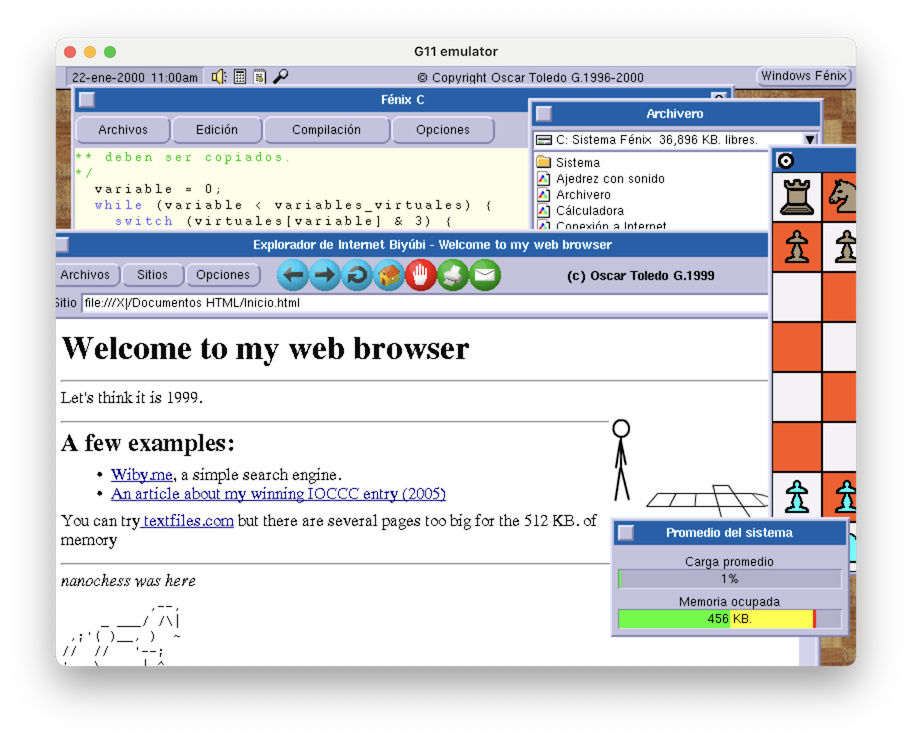
With a functional C compiler in hand, the next ambitious step was to develop a web browser. This is an order of magnitude more complex than a compiler. A web browser needs to:
- Parse HTML and CSS to render pages.
- Execute JavaScript for dynamic content.
- Handle network requests (HTTP/HTTPS).
- Manage cookies, sessions, and security certificates.
- Render complex layouts, including images and media.
Building such a sophisticated piece of software for a resource-constrained or architecturally unusual platform is a testament to the author's dedication and skill. The choice of which web browser to port or build from scratch is also significant. Modern browsers like Chrome or Firefox are enormous codebases, relying on extensive libraries and platform-specific optimizations. A more feasible approach for a custom build would be to target a simpler, lighter-weight browser architecture, or to implement a subset of web standards.
The author's implementation likely focuses on essential web rendering capabilities, perhaps supporting HTML4 or early HTML5 and basic CSS. JavaScript execution would be another major hurdle, potentially requiring a custom JavaScript engine or integration with a minimal existing one. The networking stack, responsible for fetching web pages, also needs careful implementation to be robust and efficient.
Implications and Future Work
The successful development of an Am29000 C compiler and a web browser demonstrates the power of dedicated engineering and the potential for bringing modern software capabilities to legacy or niche hardware. It opens up possibilities for developing more advanced applications on Am29000-based systems, potentially reviving interest in retrocomputing or enabling new uses for existing hardware.
This project highlights the enduring relevance of understanding fundamental computer science principles. Building a compiler and a browser from the ground up requires a deep grasp of computer architecture, operating systems, programming language theory, and software engineering. The author's achievement serves as an inspiration for developers tackling complex, low-level software challenges.
The most surprising aspect here is not the technical difficulty, which is immense, but the sheer dedication required to see such a project through to completion for an architecture that has long been out of the mainstream. It begs the question: what other capabilities could be unlocked for forgotten hardware with similar levels of focused effort?