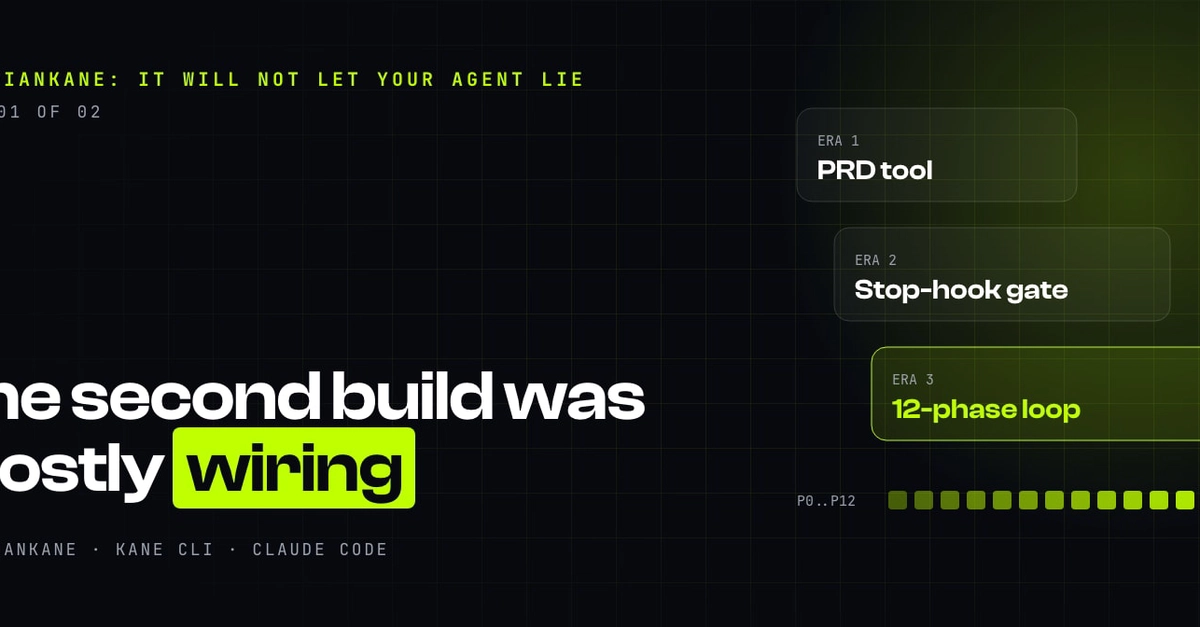
From Hackathon Hook to Integrated System
GuardianKane began as a focused solution for a specific problem: ensuring AI agents completed their tasks correctly. Initially, it was a Claude Code Stop hook, designed to prevent an agent from finishing until its work was verified by the Kane CLI in a real browser. This initial iteration proved its worth, securing second place in the TestMuAI Kane CLI hackathon. The core idea was simple yet powerful: an AI agent shouldn't be allowed to declare victory without external validation.
This foundational hook, however, is only one component of the GuardianKane system as it exists today. The journey from a single-purpose hackathon project to a comprehensive platform involved significant architectural expansion. The current GuardianKane integrates the original hook into a much larger framework. This framework includes a reviewed Product Requirements Document (PRD), a sophisticated phase model for task management, a live scope guard to monitor agent behavior, a file lock mechanism to prevent race conditions, a secret scan for sensitive data exposure, and a robust dashboard. The dashboard provides critical oversight with graph views and a chat panel directly wired into the running Claude Code session.
This evolution was not about reinventing the wheel, but about building a more resilient and feature-rich vehicle around the original engine. The story of GuardianKane's growth is a testament to iterative development, where initial successes pave the way for more ambitious integrations and features. Part two of this exploration will offer a detailed tour of the current GuardianKane system, showcasing its expanded capabilities and user interface.
Three Shapes, One Repo
The development of GuardianKane has seen distinct phases, each representing a different architectural approach or focus. These phases are not isolated but rather represent an organic growth within a single, unified repository. This consolidation allows for seamless integration and management of the evolving system.
Shape 1: The Standalone Hook
The initial concept for GuardianKane was a singular, potent hook. This hook functioned as a gatekeeper, intercepting the AI agent's completion signal. Before the agent could finalize its output, the hook would trigger a verification process via the Kane CLI. This CLI would then execute the agent's proposed code or actions in a simulated, yet realistic, browser environment. If the verification failed, the agent was prevented from completing its task, providing immediate feedback and an opportunity for correction. This shape was the core of the hackathon entry, demonstrating the viability of enforced external validation for AI agent work.
Shape 2: The Integrated Workflow
As GuardianKane matured, the focus shifted from a single hook to embedding this validation mechanism within a broader workflow. This second shape saw the hook become one element in a more complex system. Key additions included a structured approach to project management, akin to a reviewed PRD, which provided clear objectives and constraints for the AI. A phase model was introduced to break down complex tasks into manageable stages, allowing for granular oversight and control. The live scope guard actively monitored the agent's operational boundaries, preventing it from straying into unintended or unauthorized actions. This phase represented a significant step towards a production-ready system, moving beyond a simple proof-of-concept.
Shape 3: The Comprehensive Platform
The most recent evolution, representing the current state of GuardianKane, transforms it into a comprehensive platform. This third shape builds upon the integrated workflow by adding essential infrastructure and user-facing features. A file lock mechanism was implemented to ensure that only one process could modify critical files at a time, preventing data corruption and race conditions. A security-focused secret scan was integrated to automatically detect and flag any hardcoded credentials or sensitive information within the agent's output or code. The development of a dedicated dashboard marked a major leap in usability. This dashboard offers visual representations of the agent's progress through graphs and analytics, alongside an interactive chat panel that allows direct communication and command of the running Claude Code session. This fully integrated platform aims to provide a secure, efficient, and transparent environment for AI agent development and deployment.
Architectural Decisions and Their Impact
The transition from a simple hackathon project to a sophisticated platform involved deliberate architectural choices. Central to this was the decision to house all three 'shapes' of GuardianKane within a single repository. This monolithic approach, while sometimes debated, offered distinct advantages in the context of GuardianKane's development. Firstly, it facilitated rapid iteration. Developers could easily switch between working on the core hook, the workflow integrations, or the dashboard features without the overhead of managing multiple codebases and complex inter-repository dependencies. This allowed the team to quickly test new ideas and incorporate feedback.
Secondly, a single repository simplified dependency management. All components shared a common set of libraries and tools, reducing the likelihood of version conflicts and ensuring consistency across the system. When a bug was found in the core verification logic, for example, the impact on the dashboard or phase model could be immediately assessed and addressed within the same commit. This tight coupling, while requiring careful code organization, accelerated the development cycle significantly.
The inclusion of a 'live scope guard' and 'file lock' mechanisms speaks to a growing awareness of the practical challenges in deploying AI agents. These are not abstract concepts but critical safeguards that address real-world failure modes. The scope guard acts as a digital leash, ensuring the agent operates within its designated parameters. The file lock, a more traditional software engineering tool, prevents data integrity issues that can arise from concurrent agent operations. These additions reflect a mature understanding of the operational requirements for reliable AI systems.
The dashboard, with its graph views and chat panel, represents the final piece of the puzzle in making GuardianKane a usable tool. It transforms the underlying technology from a developer-centric utility into a platform accessible to a wider range of users. The graph views provide visibility into the agent's performance, decision-making process, and potential bottlenecks. The chat panel offers an intuitive interface for human oversight and intervention. This user-centric design ensures that the complex system beneath remains manageable and transparent.
The Future of GuardianKane
GuardianKane's journey from a hackathon entry to a multi-faceted platform highlights a crucial trend in AI development: the increasing need for robust tooling and infrastructure to manage and secure AI agents. As agents become more autonomous and capable, the systems that govern their behavior, validate their outputs, and provide oversight become paramount. The current GuardianKane, with its layered security, structured workflow, and intuitive dashboard, is well-positioned to address these growing demands.
The decision to keep all development within a single repository will likely continue to accelerate innovation. It allows the team to treat the entire system as a cohesive unit, enabling rapid prototyping of new features and integrations. For instance, future iterations could see enhanced secret scanning capabilities, perhaps leveraging more advanced AI models for anomaly detection in agent output, or deeper integration with CI/CD pipelines for automated deployment of verified agent tasks.
The focus on user experience, evident in the dashboard design, suggests that GuardianKane aims to democratize the use of sophisticated AI agents. By providing clear visualizations and interactive controls, the platform lowers the barrier to entry for teams looking to leverage AI agents for complex tasks. The ongoing development will likely see further refinements in these areas, potentially including customizable dashboards, role-based access control, and more sophisticated reporting features.
GuardianKane's evolution is a microcosm of the broader AI tooling landscape. As AI capabilities advance, so too must the tools that enable their safe, efficient, and effective deployment. The system's layered approach, combining validation hooks with workflow management and security scans, offers a compelling model for future AI agent development platforms. The core question remains: how will the integration of such robust validation and oversight tools shape the future capabilities and widespread adoption of autonomous AI agents?