
Grimo AI: Orchestrating Your Digital Life
The modern professional juggles an ever-increasing volume of digital information. Tasks, appointments, and critical notes often reside in disparate applications, demanding constant context-switching and manual organization. Grimo AI emerges with a bold promise: to consolidate these essential functions under a single, intuitive interface, powered by natural language processing. The core idea is simple yet ambitious: speak a command once, and Grimo sorts your tasks, calendar, and notes accordingly.
This approach aims to streamline workflows by reducing the friction associated with managing daily responsibilities. Instead of navigating through multiple apps to create a task, schedule a meeting, and jot down a related idea, users can theoretically issue a single directive to Grimo. The platform is designed to interpret these commands and act upon them across the integrated functionalities of task management, calendar scheduling, and note-taking.
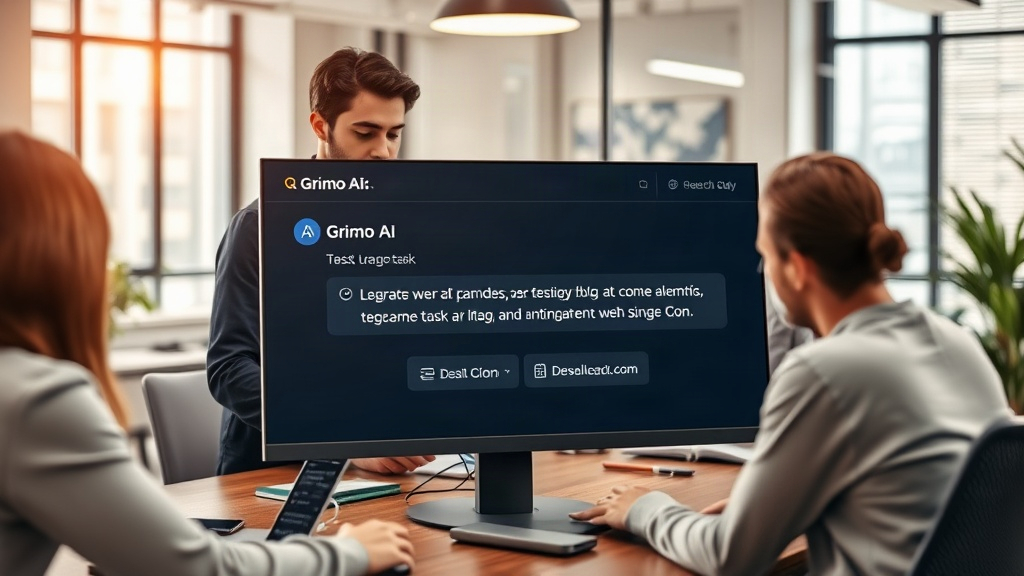
Core Functionality: Task, Calendar, and Notes Integration
Grimo AI's primary value proposition lies in its integrated approach to three fundamental productivity pillars: task management, calendar scheduling, and note-taking. The platform's engine is built to understand natural language input, meaning users can interact with it conversationally rather than through rigid syntax. For instance, a command like "Remind me to follow up with Sarah about the Q3 report next Tuesday at 10 AM and add a note to include the latest sales figures" would ideally be processed by Grimo to create a calendar event, set a reminder, and associate a note with that event, all from one utterance.
This level of integration is crucial for individuals who find themselves constantly moving information between different productivity tools. The inefficiency of this manual transfer can lead to missed deadlines, forgotten appointments, and scattered information. Grimo AI positions itself as a unified command center, capable of parsing complex instructions and distributing the relevant information to the appropriate module. The success of such a system hinges on the accuracy and robustness of its natural language understanding (NLU) capabilities, as well as the seamlessness of its backend integrations.
The Promise of Unified Command
The underlying technology of Grimo AI is its ability to act as a central orchestrator. Imagine an assistant who not only schedules your meetings but also takes notes during those meetings and then automatically creates follow-up tasks based on those notes. Grimo AI aims to replicate this functionality through AI. When a user dictates a task, Grimo can infer deadlines, priorities, and relevant context. When scheduling an event, it can check for conflicts and suggest alternative times. When taking notes, it can identify action items or key decisions that should be translated into tasks.
This unified approach is more than just convenience; it’s about creating a more efficient cognitive load for the user. By offloading the mental overhead of task switching and data entry, Grimo AI allows users to focus more on the actual work rather than the management of it. The system's effectiveness will ultimately depend on its ability to learn user preferences and adapt to individual working styles, making it an indispensable tool rather than just another app to manage.
Potential and Challenges
The potential for Grimo AI is significant, especially in a professional landscape increasingly reliant on digital organization. For freelancers, project managers, and busy executives, a tool that can genuinely simplify task and schedule management could be a game-changer. The ability to interact with a productivity suite via natural language removes a significant barrier to entry and can make complex scheduling and task management accessible to a wider audience.
However, the challenges are equally substantial. The accuracy of NLU is paramount. A misinterpretation of a command could lead to scheduling errors or missed tasks, undermining user trust. Furthermore, deep integration with existing calendar and task management systems (like Google Calendar, Outlook, Todoist, etc.) is essential for adoption. Without this, Grimo AI risks becoming another isolated tool rather than a truly integrated solution. The long-term success will depend on Grimo AI's ability to not only understand commands but to reliably execute them and integrate seamlessly with the tools users already rely on.
What remains to be seen is how Grimo AI handles ambiguity and complex, multi-layered requests that often arise in real-world work scenarios. For example, how does it prioritize when a user issues conflicting instructions or when a calendar event clashes with a high-priority task without explicit instruction?