
GrapheneOS Fortifies Locked Devices Against USB Data Extraction
GrapheneOS, a privacy and security-focused mobile operating system, has implemented a significant new protection against data extraction from locked devices. Starting with its latest release, the OS defaults to disabling USB data access entirely when the device is locked. This change directly targets a common attack vector used by law enforcement and potentially malicious actors to gain access to device contents.
Historically, many smartphones, even when locked, would still allow data transfer over USB connections. This feature, often intended for convenience like file transfers or debugging, created a vulnerability. When a device was connected to a computer via USB, and the computer was trusted or the device was unlocked, it could present itself as a storage device, allowing for direct data access. This bypasses many of the on-device encryption and security measures intended to protect user data.
GrapheneOS has long been at the forefront of mobile security, building upon the Android Open Source Project (AOSP) with numerous hardening features. The decision to disable USB data access by default on locked devices is a logical extension of its security philosophy. It means that simply connecting a GrapheneOS device to a computer via USB will not automatically grant access to its storage or allow for data exfiltration.
How the Protection Works
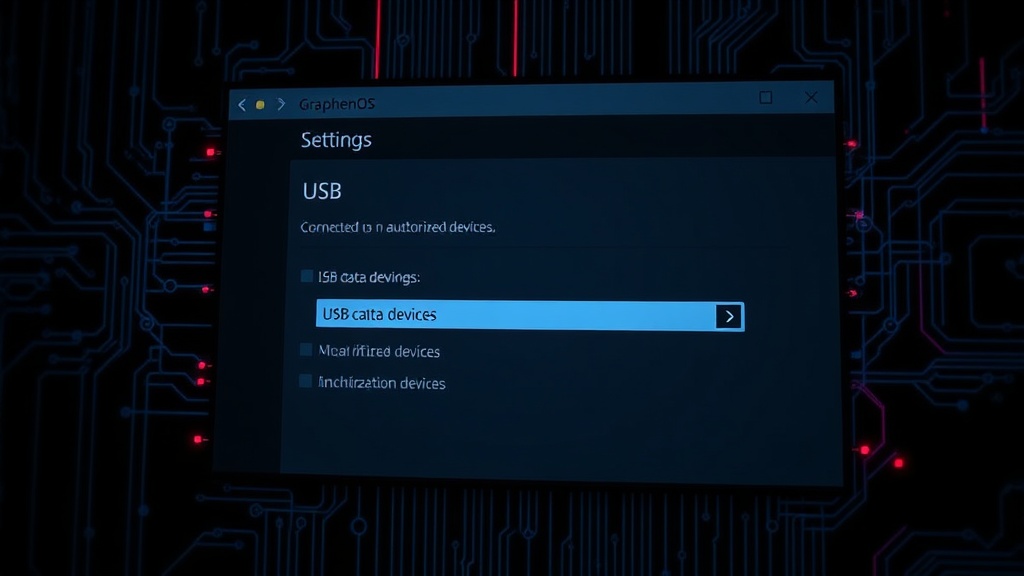
The core of this protection lies in how GrapheneOS modifies the Android framework. When the device is locked, the USB connection is effectively put into a "charge-only" mode by default. This prevents the device from enumerating as a storage device or exposing any file system interfaces to the connected host. To enable data transfer, the user must explicitly unlock the device and then manually authorize the USB connection for file transfer or other data-related protocols. This requires direct, physical interaction with the device while it is unlocked.
This approach is akin to a digital deadbolt on the USB port. Without the key (the device unlock passcode or biometric authentication), the port serves no purpose beyond supplying power. This significantly raises the bar for anyone attempting unauthorized data extraction. Many forensic tools and direct hacking methods rely on the device presenting a data interface when connected, even if it's locked. By removing this interface, GrapheneOS neutralizes these methods by default.
The default setting is crucial. It means users do not need to remember to enable a specific security setting; the most secure configuration is already in place. For users who require USB data transfer capabilities, the option remains available, but it is an intentional, user-initiated action that occurs only when the device is actively being used and unlocked.
Implications for Law Enforcement and Forensics
Law enforcement agencies and digital forensics teams often employ specialized tools and techniques to extract data from seized mobile devices. One common method involves connecting the device to a computer and attempting to exploit vulnerabilities or use brute-force attacks on the unlock mechanism, or leveraging the device's willingness to communicate over USB. By disabling USB data access when locked, GrapheneOS directly thwarts these capabilities.
This protection is particularly relevant in jurisdictions where law enforcement can seize devices without a warrant or compel users to unlock them. Even if a user is forced to unlock their device, the data is still protected by GrapheneOS's robust encryption. The USB port's default disabled state for data transfer adds another layer, preventing the immediate and easy transfer of data that might otherwise be possible.
The surprise element here is not that GrapheneOS is implementing security features – that's its raison d'être. The surprise is how effectively a seemingly simple default setting can nullify a wide array of sophisticated data extraction tools and techniques that have been effective against other operating systems and devices. It highlights that fundamental OS-level design choices can have profound security implications.
Broader Security Landscape and Future Considerations
This move by GrapheneOS underscores a growing trend in the security community: prioritizing user control and explicit consent for data access. While convenience features are often valued, they can become liabilities when security is paramount. GrapheneOS is effectively saying that the risk of unauthorized data access via USB on a locked device outweighs the convenience of automatic connectivity.
What remains to be seen is how other mobile operating systems and manufacturers will respond. Will they adopt similar default-disabled USB data access policies? The pressure from law enforcement and government agencies to maintain access to device data is immense. However, the increasing awareness of privacy and the potential for misuse of such access may push other platforms to reconsider their default security postures. Developers of forensic tools will also need to adapt, potentially focusing on exploits that bypass the OS entirely or finding ways to gain privileged access through other means, though this would likely require physical access to the device's internal hardware.
For users prioritizing maximum security and privacy, GrapheneOS's approach sets a new benchmark. It’s a clear signal that protecting data at rest and in transit, even against state-level adversaries, requires a comprehensive strategy that includes scrutinizing every potential interface, including the humble USB port.