Beyond the Dictionary: Crafting a Nuanced Recommender
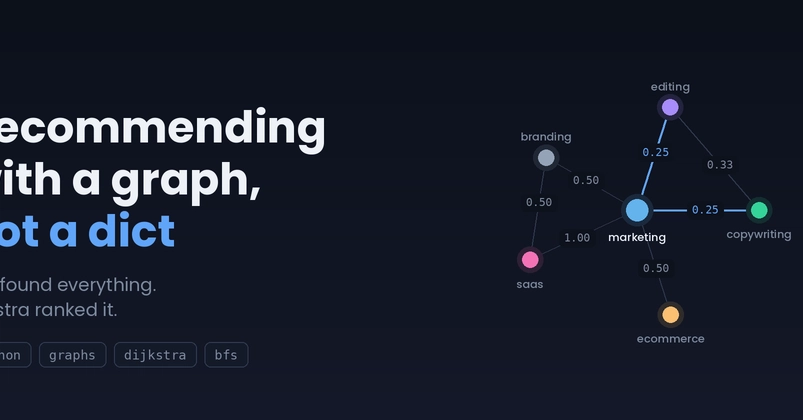
Traditional recommendation engines often function like a dictionary lookup: provide a keyword, receive a list of matching items. While functional for basic needs, this approach misses the subtler relationships that make content discovery truly engaging. A developer, frustrated by this limitation, set out to build a system that could identify not just what is similar, but what is interestingly different. The result is CreatorRoute, a project that models short-form content as a weighted graph, leading to the discovery of unexpected similarities.
The core idea behind CreatorRoute is to move beyond surface-level categorization. Instead of simply tagging content by genre or topic, the system represents each piece of content and its attributes as nodes in a graph. Relationships between these nodes are weighted, reflecting the strength of connection between different attributes, content pieces, and user preferences. This graph-based approach allows the recommender to explore paths and connections that a simple keyword search would never reveal.
The Data and the Graph Model
The project began with a modest dataset: forty short-form videos, each described by five key attributes. This hand-curated data served as the foundation for building the graph. Each video became a node, and its attributes were either directly linked to the video node or used to define the characteristics of the node itself. The crucial step was assigning weights to the relationships within the graph. These weights are not arbitrary; they are derived from the data itself, potentially reflecting factors like co-occurrence of attributes, user interaction patterns (if available), or even semantic similarity between attribute values.
For instance, a video might have attributes like 'title', 'niche', and 'tags'. If two videos share the same niche and similar tags, the edge connecting them in the graph would have a higher weight than two videos that only share a niche. The system then traverses this graph to find related content. When a user inputs a video they like, CreatorRoute doesn't just search for other videos in the same niche. Instead, it explores the graph, identifying nodes that are connected through various paths and weighted relationships. This allows it to surface content that might be in a related but distinct niche, or content that shares certain stylistic elements, even if their primary categories differ.
Discovering Unforeseen Connections
The power of the graph model became apparent when the system started uncovering connections that were not explicitly designed into the initial attributes. For example, the system might find that videos categorized under 'DIY Crafts' and 'ASMR Unboxing' share a surprising number of underlying structural similarities, perhaps due to pacing, visual style, or the presence of specific ambient sounds, even though their stated niches are quite different. These are the 'interestingly different' connections that a dictionary lookup would miss.
This ability to find unexpected similarities is a significant departure from conventional recommendation systems. It moves from a content-based filtering approach that relies on explicit metadata to a more emergent discovery model. The graph acts as a dynamic representation of content relationships, where new insights can arise from the interplay of existing data. The developer's goal was to create a recommender that could surprise users, and the graph structure proved to be the key to unlocking this potential. By treating content as interconnected nodes rather than isolated entries, CreatorRoute can suggest content that broadens horizons rather than merely reinforcing existing preferences.
Implications for Content Discovery
The success of CreatorRoute highlights a broader trend in recommendation systems: the move towards more sophisticated data modeling to achieve deeper insights. Graph databases and graph-based algorithms are increasingly being recognized for their ability to capture complex, multi-faceted relationships that are difficult to represent in traditional relational databases or simple key-value stores. This approach is not limited to short-form video content; it has potential applications across a wide range of domains, including e-commerce, news aggregation, and even scientific research, where understanding the subtle connections between disparate entities can lead to significant discoveries.
For developers and data scientists, this project serves as a compelling case study for the power of graph modeling. It demonstrates that by choosing the right data structure, one can unlock new dimensions of understanding from existing data. The challenge now lies in scaling these models, handling larger and more dynamic datasets, and refining the weighting mechanisms to ensure that the 'outliers' suggested are genuinely interesting and relevant, rather than simply random noise. The frontier of content recommendation is moving from finding what's *like* something, to finding what's *related in an interesting way*.