%22%20%2F%3E%0A%20%20%3C%2Fsvg%3E)
The Agent Discourse: Loops vs. Graphs
The ongoing debate surrounding AI agents has largely centered on two architectural paradigms: loops and graphs. For a significant period, loop-based agent designs have dominated the discourse, primarily due to their relative ease of implementation and deployment. However, this simplicity comes at a steep cost: a profound lack of auditability. When an AI agent operates within a loop, its decision-making process can become opaque, making it exceedingly difficult to trace the exact sequence of actions and reasoning that led to a particular outcome. This is particularly problematic in scenarios requiring accountability, such as investigating incidents, debugging complex behaviors, or ensuring compliance with safety protocols.
Conversely, graph-based architectures offer a clear advantage in terms of auditability. By representing the agent's thought process and actions as a structured graph, developers and users can visually inspect the flow of information, the decisions made at each node, and the overall topology of the agent's operation. This inherent transparency is invaluable for understanding emergent behaviors and for debugging. The challenge, however, has been the practical difficulty of authoring these graphs. Manually defining the intricate topology for a dynamic task, such as investigating a complex system incident, is often infeasible. The precise shape of the graph is typically only discovered through the iterative process of investigation itself, making a pre-authored, static graph impractical.
This fundamental tension between the ease of shipping loop-based agents and the auditability of graph-based systems has created a bottleneck for developing more robust and trustworthy AI agents. The need for a system that combines the flexibility of dynamic discovery with the rigor of auditable structures has been apparent.
Introducing Runtime Graph Generation
This week, a novel solution emerged to bridge this gap: graph engineering, which enables the creation of agent topologies at runtime. The core innovation lies in using a model to author the graph dynamically as the agent operates. Instead of requiring a human to pre-define the entire structure, the AI itself constructs the graph based on the task at hand and the information it encounters. This approach addresses the primary drawback of traditional graph-based systems – the burden of manual authoring – by making the graph generation an emergent property of the agent's execution.
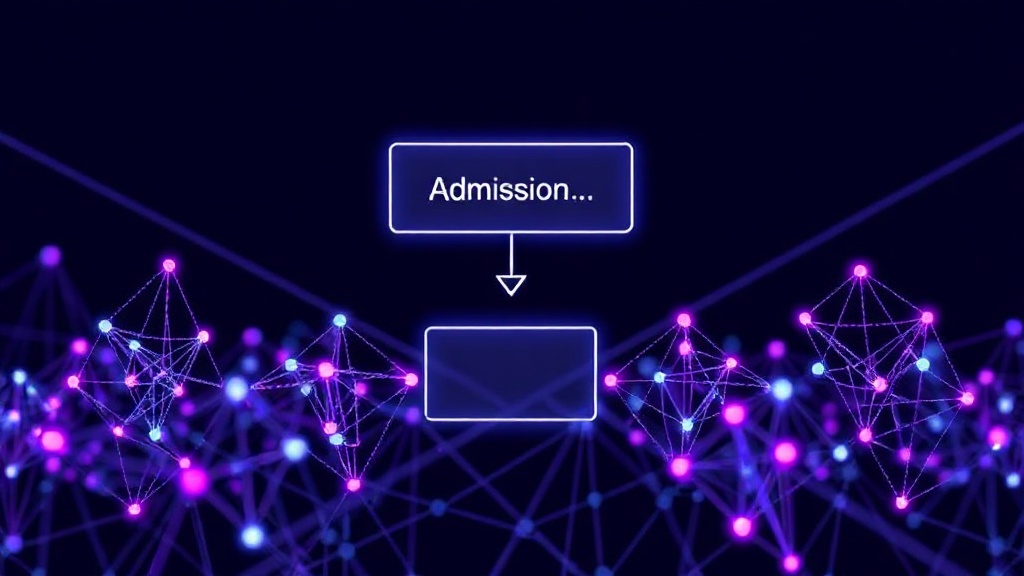
The system introduces a critical control mechanism: a deterministic admission gate positioned between the model's proposed graph structure and its actual execution. This gate acts as a safeguard, ensuring that the generated graph adheres to predefined rules, safety constraints, or structural requirements before it is enacted. This deterministic layer is crucial for maintaining control and predictability, even as the graph is generated dynamically. It provides a level of assurance that the agent's operational structure will not deviate into unsafe or unintended territories.
Think of it less like a rigid, pre-programmed machine and more like an adaptive explorer. The explorer has a set of fundamental safety rules (the admission gate) and a sophisticated internal compass and map-making ability (the model generating the graph). As the explorer encounters new terrain (information and task requirements), it draws new parts of its map in real-time, but only after checking if the new path aligns with its core safety directives. This allows for exploration of complex, unknown territories without getting lost or endangering itself.
Implications for AI Agent Development
The advent of runtime graph engineering represents a significant step forward for AI agent development. It directly tackles the auditability problem that has plagued simpler loop-based architectures, making it possible to deploy agents in more sensitive or critical applications where transparency and accountability are paramount. For instance, in cybersecurity incident response, an agent could dynamically build a graph of the attack path as it investigates, providing a clear, auditable record for post-mortem analysis and threat intelligence. Similarly, in complex scientific research, an agent could construct a graph of experimental pathways and findings, allowing researchers to easily follow its line of reasoning.
Furthermore, this approach has the potential to unlock more sophisticated agent capabilities. By allowing agents to adapt their internal structure on the fly, they can become far more flexible and responsive to novel or unforeseen situations. This moves beyond agents that follow a fixed set of commands or a pre-defined reasoning chain, enabling them to tackle problems that are not fully understood at the outset. The deterministic admission gate ensures that this newfound flexibility does not come at the expense of safety or reliability, a balance that has been notoriously difficult to strike.
The concept of