Visual AI Pipeline Construction
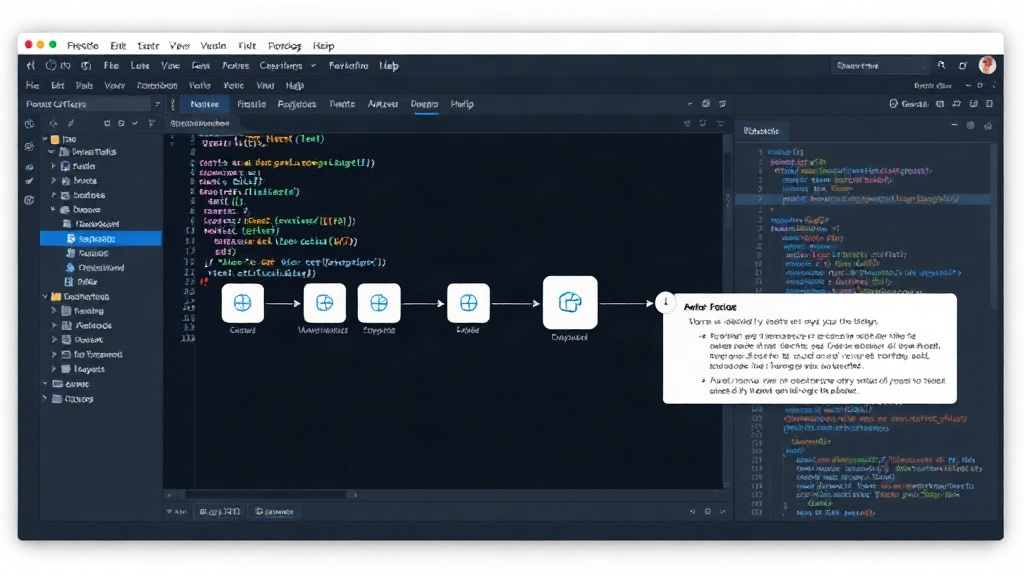
Gradio Workflow emerges as a significant development for AI practitioners, offering a visual interface to construct complex AI pipelines. Unlike its predecessor, which focused on rapidly building interactive demos for individual models, Gradio Workflow shifts the paradigm towards orchestrating multiple AI components into cohesive workflows. This is achieved through a node-based system, where users can connect different AI models, processing steps, and data sources to create sophisticated applications without extensive coding.
The core innovation lies in its ability to abstract away the underlying complexities of model integration. Developers can drag and drop pre-built nodes representing various AI functionalities, such as image recognition, natural language processing, or data generation. These nodes are then linked together to define the flow of data and execution. For instance, a user could connect an image upload node to an object detection model, then pipe the detected objects into a text generation model to describe the scene. This visual approach drastically lowers the barrier to entry for building multi-stage AI systems.
Powered by Hugging Face Ecosystem
A key enabler of Gradio Workflow's power is its deep integration with the Hugging Face ecosystem. Hugging Face's extensive library of pre-trained models and datasets serves as the foundational building blocks for the nodes within Gradio Workflow. This means users can readily access and integrate state-of-the-art AI models for a wide range of tasks directly within the visual builder. The connection is more than just superficial; Gradio Workflow leverages Hugging Face's infrastructure to ensure seamless model loading, inference, and data handling.
This synergy allows developers to experiment with and deploy complex AI solutions that might have previously required significant engineering effort to stitch together. For example, a user could pull a text-to-image model from Hugging Face, connect it to a prompt engineering node, and then link that to an image-to-text model for an iterative creative process. The workflow builder handles the data transformations between these disparate models, a task that typically involves considerable custom scripting.
Beyond Single Model Demos
Gradio Workflow represents a clear evolution from the original Gradio library. While Gradio excelled at creating quick, shareable demos for single machine learning models, it offered limited capabilities for chaining models or managing complex multi-step processes. Gradio Workflow addresses this gap directly. It moves from showcasing a single AI's capability to building end-to-end applications where multiple AI agents or services collaborate.
Consider a customer support chatbot. An older Gradio app might handle text input and provide a canned response from a single LLM. With Gradio Workflow, that same chatbot could first route the user's query through a sentiment analysis model, then to a knowledge base retrieval system, followed by a response generation model, and finally a content moderation filter. Each of these is a distinct node, visually defined and connected. This allows for much richer, context-aware, and robust AI applications. The ability to manage state and pass complex data structures between nodes is fundamental to this enhanced functionality.
Use Cases and Target Audience
The target audience for Gradio Workflow spans a broad spectrum of AI professionals. Researchers can use it to rapidly prototype complex experimental setups involving multiple models. Data scientists can build interactive dashboards that combine data preprocessing, model inference, and visualization steps. AI engineers can construct and deploy more sophisticated production-ready applications that require sequential AI processing. Even frontend developers with limited deep learning expertise can leverage the visual interface to integrate powerful AI capabilities into their projects.
Potential use cases are vast. Imagine an AI-powered content creation suite where a user can combine a text summarizer, a headline generator, and an image creator. Or a medical diagnostic tool that processes an X-ray image, identifies anomalies with one model, and then provides a preliminary report using a specialized medical LLM. The visual, node-based approach makes these complex integrations accessible. The platform's reliance on standard Python and its integration with Hugging Face ensure that it remains flexible and extensible, fitting into existing development environments rather than dictating new ones.
Future Implications
Gradio Workflow has the potential to democratize the creation of complex AI systems further. By abstracting the intricate details of model orchestration, it empowers a wider range of users to build sophisticated AI-powered products and services. This could accelerate innovation by reducing the time and resources required for AI development. The shift from single-model demos to multi-component workflows signals a maturing of the AI development landscape, where integration and orchestration are becoming as critical as the models themselves. The platform's success will likely depend on the breadth of its node library and the ease with which custom nodes can be developed and shared, further expanding the possibilities for AI pipeline construction.