GPUThor: A Novel Rowhammer Attack Targeting GPUs
Researchers at the University of Toronto have unveiled GPUThor, a sophisticated Rowhammer attack specifically engineered to target the memory systems of modern NVIDIA GPUs. Unlike traditional Rowhammer attacks that often target CPU DRAM, GPUThor focuses on the unique memory architecture and access patterns found in Graphics Processing Units. The attack's novelty lies in its ability to bypass Error Correction Code (ECC) protection, a feature typically designed to mitigate the effects of bit flips caused by Rowhammer. This is achieved through a technique called "non-uniform hammering," which exploits the specific way GPUs handle memory requests.
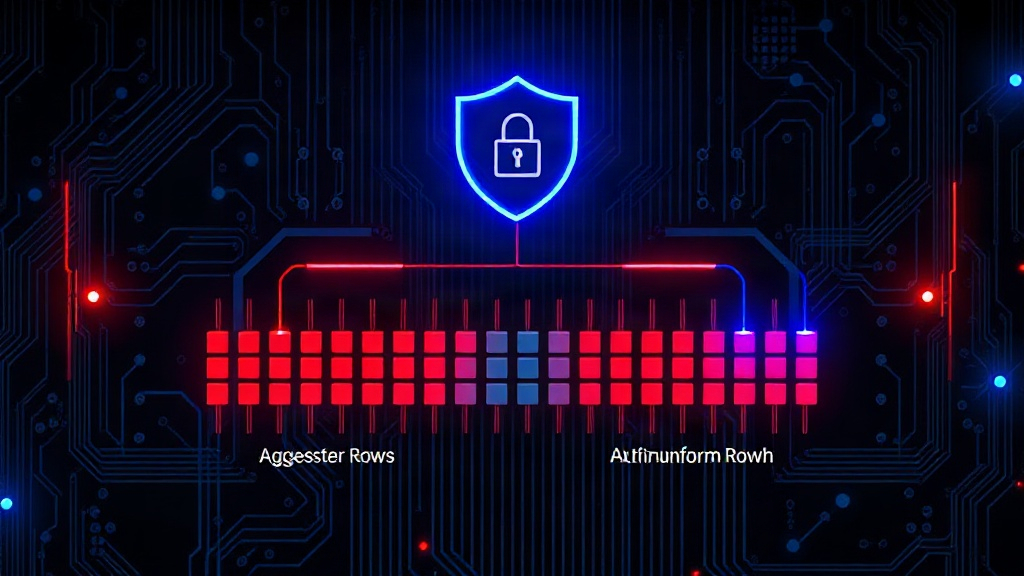
Rowhammer is a physical phenomenon where repeatedly accessing specific memory rows (aggressor rows) can cause data corruption in nearby rows (victim rows) due to electrical interference. Historically, this has been a significant concern for CPU DRAM. However, GPUs, with their high memory bandwidth and complex memory controllers, present a different challenge and opportunity for attackers. The University of Toronto team, led by researchers like Omid Alizada and Sreepathi Pai, reverse-engineered the memory-access coalescing behavior of NVIDIA GPUs to develop GPUThor. This allows them to craft specific hammering patterns that are far more effective at inducing errors than simple, uniform repetition.
The core problem GPUThor addresses is the inherent robustness of GPU memory. High-end GPUs, especially those used in professional and data center environments, often feature ECC memory. ECC detects and corrects single-bit errors and detects double-bit errors, effectively neutralizing the most common forms of Rowhammer-induced bit flips. To overcome this, GPUThor doesn't just hammer rows repeatedly; it does so in a non-uniform, high-intensity manner. This means the pattern of access is not a simple, predictable sequence but one that is carefully designed to maximize the electrical disturbance while simultaneously confusing the ECC mechanisms.
Understanding Non-Uniform Hammering in GPU Memory
The effectiveness of GPUThor hinges on understanding and exploiting GPU memory coalescing. Memory coalescing is a technique where multiple memory requests from different processing units are combined into a single, larger transaction to improve efficiency. This process is highly dependent on the alignment and pattern of the requests. GPUThor's creators reverse-engineered these patterns to identify how to trigger aggressor rows in a way that maximizes the probability of disturbing victim rows, even those protected by ECC.
Instead of a steady, predictable hammering, GPUThor employs dynamic, non-uniform patterns. Imagine repeatedly tapping a specific spot on a drum. That's uniform hammering. Non-uniform hammering is like tapping that spot, then a slightly adjacent spot, then back again, with varying intensity and timing. This complex pattern is designed to create a more potent electrical field disturbance that can overwhelm the ECC's ability to correct errors in real-time. The attack essentially forces the memory controller to access aggressor rows in a sequence that maximizes the chance of adjacent rows experiencing a bit flip, and doing so rapidly enough that ECC cannot always keep up.
The researchers demonstrated that these non-uniform patterns can activate aggressor rows more frequently and with greater impact than traditional methods. This heightened intensity, coupled with the specific timing and placement of the memory accesses, creates an environment where bit flips are not only possible but highly probable, even on ECC-protected memory. This bypasses the fundamental security assumption that ECC memory is immune to Rowhammer-style attacks.
Implications for GPU Security and Reliability
The implications of GPUThor are significant. Firstly, it challenges the perceived security of ECC-protected GPU memory, which is critical for applications demanding high reliability, such as scientific computing, machine learning training, and professional graphics rendering. If sensitive data or critical computations on these platforms can be corrupted by a software-based attack, it opens up new avenues for system compromise and denial-of-service.
Secondly, the attack highlights a gap in current hardware-level mitigations. While CPU manufacturers have implemented various Rowhammer defenses, such as refresh rate adjustments and built-in error detection mechanisms, these may not be directly applicable or sufficient for the unique memory subsystem of GPUs. The GPUThor attack suggests that GPU memory controllers and ECC implementations need to be scrutinized and potentially redesigned to account for these more advanced hammering techniques.
The research also points to the ongoing arms race between hardware security features and sophisticated attack methodologies. As hardware becomes more robust, attackers find more nuanced ways to exploit physical phenomena. This continuous cycle necessitates ongoing research and development in both attack discovery and defense mechanisms. The University of Toronto's work provides a critical benchmark for future GPU memory security research.
Technical Details and Future Directions
The GPUThor paper details the specific techniques used to reverse-engineer NVIDIA's memory access patterns. This involved analyzing the behavior of the GPU's memory coalescing units and identifying specific instruction sequences that could be manipulated to generate the required non-uniform hammering. The researchers implemented their attack using CUDA, NVIDIA's parallel computing platform, demonstrating that it could be launched from user-space, requiring no special privileges beyond the ability to execute code on the GPU.
The success of GPUThor raises several questions about the future of GPU security. Can similar attacks be mounted on GPUs from other manufacturers, such as AMD or Intel? What are the specific architectural differences that might make them more or less vulnerable? Furthermore, what are the practical implications for cloud providers and enterprise users who rely on GPU compute for critical workloads? The potential for data corruption or system instability due to such an attack could have substantial financial and operational consequences.
Moving forward, the research community and GPU manufacturers will need to investigate robust, hardware-level defenses against these advanced Rowhammer variants. This could involve more sophisticated ECC algorithms, hardware-level throttling of memory access patterns that exhibit Rowhammer characteristics, or even architectural changes to memory controllers that isolate aggressor and victim rows more effectively. The GPUThor attack serves as a stark reminder that even systems designed for high reliability are not immune to physical layer vulnerabilities when exploited with sufficient ingenuity.