
The Challenge of Bézier Curves on the GPU
Bézier curves are fundamental to computer graphics, enabling smooth, scalable vector shapes. They are defined by a set of control points, and their evaluation involves complex polynomial calculations. While modern GPUs are powerful parallel processors, efficiently evaluating Bézier curves for rendering—especially when many curves are needed or high precision is required—can still be a bottleneck. Traditional methods often involve tessellation into line segments or polygons, which can be computationally expensive and lead to aliasing artifacts. Direct evaluation on the GPU, while desirable for performance, presents challenges in managing the per-curve state and computation within a parallel architecture.
The core problem lies in distributing the computation of Bézier curve points across thousands of GPU cores. Each core needs to perform the same polynomial evaluation but with different coefficients (the control points). Naively sending control points to each core can be inefficient due to memory bandwidth limitations or the need to replicate data. Existing GPU-based approaches often rely on adaptive subdivision algorithms or specialized hardware features, but these can introduce their own complexities or limitations in terms of precision and performance.
A Novel Texture Lookup Approach
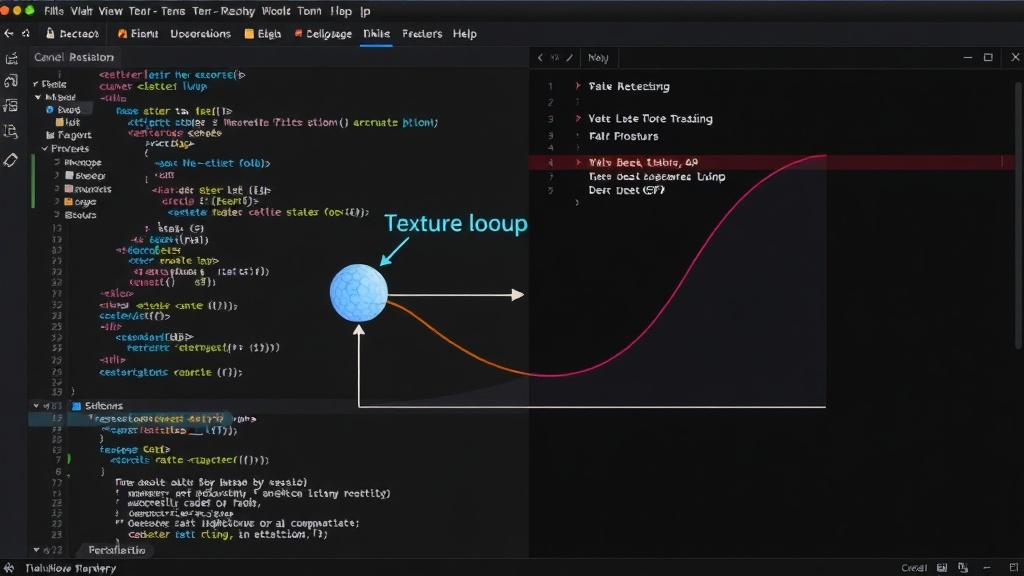
This research introduces a novel technique that leverages GPU texture memory to accelerate Bézier curve evaluation. Instead of directly computing each point on the curve, the method precomputes a set of texture maps. These textures store pre-calculated intermediate values or the final curve points themselves, indexed by parameters derived from the curve's definition and the desired evaluation point. This transforms a computationally intensive, per-pixel or per-vertex calculation into a fast texture lookup operation.
The key insight is that the mathematical structure of Bézier curves allows for a significant portion of the computation to be pre-baked into a lookup table. For a cubic Bézier curve, for instance, defined by P(t) = (1-t)³P₀ + 3(1-t)²tP₁ + 3(1-t)t²P₂ + t³P₃, the polynomial terms can be decomposed and their values sampled at regular intervals. These samples are then stored in texture maps. When the GPU needs to evaluate a point on the curve for a given parameter 't', it uses 't' to sample these textures, effectively retrieving pre-computed results that are then combined to yield the final curve point.
Implementation Details and Advantages
The paper details how to construct these texture maps. For a given curve degree (e.g., cubic), a set of textures can be generated that store coefficients for different parts of the curve's parameter space. The GPU fragment shader, or a similar compute unit, then reads these textures. The parameter 't' is mapped to texture coordinates, allowing for efficient retrieval of the necessary pre-computed data. This data is then combined using a minimal set of arithmetic operations to produce the final vertex or pixel position on the curve.
This texture lookup approach offers several significant advantages:
- Performance Boost: Texture lookups are highly optimized on modern GPUs. By replacing complex polynomial evaluations with fast memory accesses, the rendering pipeline can achieve much higher frame rates, especially when rendering scenes with numerous Bézier curves.
- Reduced Computational Load: The heavy lifting of computation is done offline during texture generation, or as an initial setup phase. The real-time rendering loop is significantly simplified.
- Precision Control: The resolution of the precomputed textures directly influences the precision of the curve evaluation. Higher texture resolutions allow for more accurate curve representation, mitigating aliasing and ensuring smooth rendering.
- Scalability: The method scales well with the number of curves, as each curve can be assigned its own set of texture parameters or sampled from a larger, shared texture atlas. The parallel nature of the GPU means thousands of curves can be processed concurrently.
Potential Applications and Future Work
The implications of this research are broad. It can benefit real-time graphics applications such as game development, UI rendering, CAD software, and scientific visualization. Any application that relies on rendering smooth vector graphics—from animated elements to complex geometric models—could see performance improvements.
The authors suggest that this technique could be extended to higher-degree Bézier curves or other parametric surfaces. Further optimization might involve dynamic texture generation or compression techniques to reduce memory footprint. Investigating the trade-offs between texture resolution, computational cost of texture generation, and final visual quality will be crucial for widespread adoption. The surprising aspect here is not the concept of precomputation, which is common, but its elegant application to Bézier curve evaluation using GPU texture units, a method that was not widely explored for this specific problem.
Ultimately, this texture lookup approach provides a compelling alternative to traditional methods for GPU-accelerated Bézier curve rendering, offering a path to higher performance and visual fidelity.