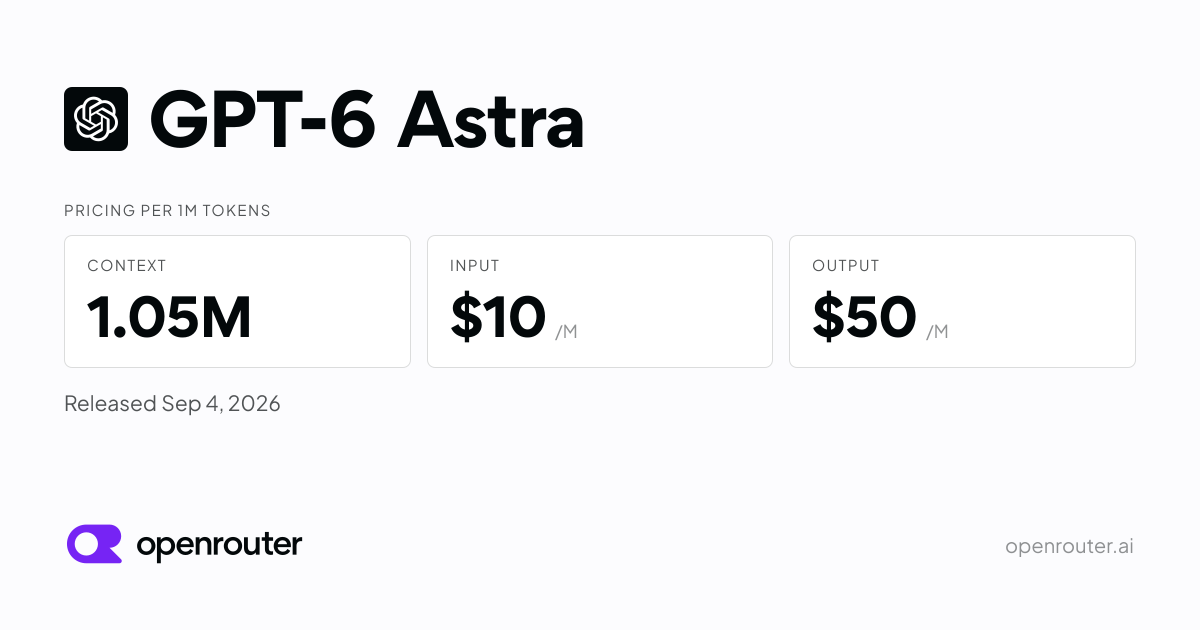
GPT-6 Astra: A New Benchmark in Language Models
OpenAI's GPT-6 Astra has officially landed on OpenRouter, a move that has sent ripples through the AI community. While details are still emerging, the presence of GPT-6 Astra on a third-party platform suggests a significant step in both OpenAI's model deployment strategy and the broader accessibility of cutting-edge AI technology. OpenRouter, known for aggregating various AI models, now lists GPT-6 Astra, a development that promises to offer developers and researchers a new, potentially more powerful, tool for their applications.
The specifics of GPT-6 Astra’s architecture and training data remain largely under wraps, as is typical with OpenAI’s major model releases. However, the nomenclature itself – GPT-6 – implies a substantial leap forward from its predecessors. Early discussions on platforms like Hacker News speculate about enhanced reasoning capabilities, more nuanced understanding of context, and potentially improved efficiency in processing complex prompts. The integration on OpenRouter means that users can access Astra alongside a wide array of other models, allowing for direct comparison and experimentation without needing to manage multiple API keys or infrastructure.
What nobody has addressed yet is the implication for OpenAI's own API access. Will GPT-6 Astra be exclusively available through platforms like OpenRouter, or will it eventually be rolled out to OpenAI's direct customers? This ambiguity leaves many enterprise users and independent developers in a state of watchful waiting, trying to gauge the best strategy for integrating this new model into their workflows.
OpenRouter's Role in Model Distribution
OpenRouter has positioned itself as a crucial intermediary in the AI model ecosystem. By providing a unified API gateway, it simplifies the process for developers to switch between different models from various providers. The addition of GPT-6 Astra to their platform is a significant coup, underscoring OpenRouter's growing influence and its ability to attract the latest and most powerful AI models. This not only benefits end-users by offering choice and flexibility but also provides valuable feedback data for the model providers themselves.
For developers, this means a more streamlined path to exploring the capabilities of GPT-6 Astra. Instead of navigating OpenAI's specific API documentation and potentially dealing with rate limits or access tiers, they can leverage OpenRouter's existing infrastructure. This is particularly advantageous for those building applications that require a diverse set of AI functionalities, as they can now potentially access a broad spectrum of models, including the latest from OpenAI, through a single point of integration. The competitive landscape of AI model providers is intensifying, and OpenRouter’s platform plays a vital role in leveling the playing field, allowing smaller players and specialized models to gain visibility alongside giants like OpenAI.

Potential Capabilities and Performance
While official benchmarks and detailed performance metrics for GPT-6 Astra are not yet public, the expectation is that it will surpass existing models in several key areas. Previous generations of GPT models have shown remarkable progress in natural language understanding, generation, and complex problem-solving. GPT-6 Astra is anticipated to build upon this foundation with advancements in areas such as:
- Contextual Understanding: Deeper comprehension of long and intricate conversations, maintaining coherence and relevance over extended interactions.
- Reasoning and Logic: Improved ability to perform logical deductions, solve complex mathematical and scientific problems, and generate coherent arguments.
- Multimodality: While not explicitly confirmed for Astra on OpenRouter, future GPT-6 iterations are expected to enhance multimodal capabilities, processing and generating content across text, images, and potentially audio.
- Efficiency and Speed: Optimizations in model architecture and inference techniques could lead to faster response times and lower computational costs per token, making it more practical for real-time applications.
The impact of these potential improvements could be far-reaching. For developers, it means the possibility of creating more sophisticated AI-powered tools, from advanced chatbots and content generation platforms to complex data analysis and simulation software. The increased reasoning capabilities could unlock new applications in fields like scientific research, legal analysis, and financial modeling, where nuanced understanding and logical consistency are paramount.
Implications for the AI Landscape
The arrival of GPT-6 Astra on OpenRouter is more than just a new model becoming available; it signals a maturation of the AI model market. Platforms like OpenRouter are becoming indispensable for navigating this rapidly evolving space. For founders, this presents both opportunities and challenges. On one hand, access to powerful models like Astra can accelerate product development and enable the creation of novel AI-driven businesses. On the other hand, reliance on third-party platforms and the constant need to adapt to new model releases require agile development strategies and careful consideration of vendor lock-in.
The competitive dynamic is also shifting. As OpenAI continues to push the boundaries with new model generations, other AI labs and companies are compelled to innovate at an even faster pace. This healthy competition benefits users by driving down costs and improving the quality and diversity of available AI tools. For data scientists and researchers, the availability of GPT-6 Astra on a comparative platform like OpenRouter provides an invaluable resource for benchmarking, experimentation, and pushing the frontiers of AI research. It allows for direct comparisons with other state-of-the-art models, fostering a more empirical and data-driven approach to evaluating AI progress.
The true measure of GPT-6 Astra’s impact will be in how developers integrate it into real-world applications. Its performance, cost, and ease of access through platforms like OpenRouter will ultimately determine its adoption rate and its contribution to the next wave of AI innovation.