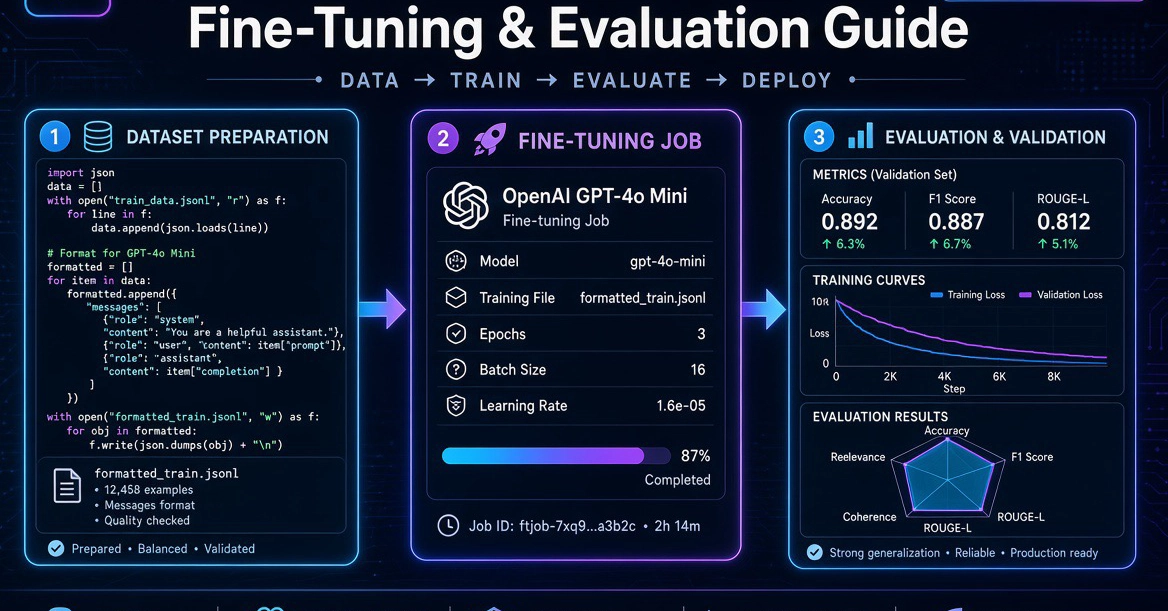
Rethinking GPT-4o Mini Fine-Tuning: The Evidence Gap
The narrative around large language models (LLMs) often positions fine-tuning as the inevitable next step after mastering prompt engineering. However, a critical look at the current landscape reveals that this assumption is not universally supported by available evidence. For tasks requiring a narrowly defined language output, the decision to fine-tune GPT-4o mini—or any similar model—should begin with rigorous evaluation, not immediate data preparation and upload. This approach prioritizes demonstrable performance gains over unverified API capabilities, model snapshots, pricing structures, or deployment features.
The allure of fine-tuning lies in its promise of bespoke model behavior. Developers and businesses envision a model that perfectly mirrors their specific domain language, tone, and task requirements. This is particularly tempting for specialized applications where generic LLM outputs fall short. Yet, the path from a capable base model like GPT-4o mini to a fine-tuned expert is not always a straight line, nor is it always the most efficient one. The decision-making process must be grounded in empirical data, comparing the performance of the base model with well-crafted prompts against the potential—and often unproven—benefits of a fine-tuned variant.

The Case for an Evaluation-First Approach
Before investing time and resources into dataset creation, cleaning, and the fine-tuning process itself, a structured evaluation framework is paramount. This framework should aim to answer a single, critical question: Will fine-tuning GPT-4o mini yield a significant, measurable improvement over prompt engineering for the specific task at hand?
Consider the common scenario of needing a model to extract specific entities from legal documents. A base GPT-4o mini, guided by a detailed prompt specifying the desired entities, formats, and handling of edge cases, might already achieve a high degree of accuracy. The prompt could include few-shot examples, clear instructions on output structure (e.g., JSON), and rules for ambiguity resolution. If this prompt-engineered solution meets or exceeds the required performance threshold (e.g., 95% accuracy, acceptable latency, cost per inference), then the substantial effort of fine-tuning may be unnecessary.
Fine-tuning involves several practical hurdles. It requires curating a high-quality, diverse, and representative dataset that captures the nuances of the target task. This dataset must be large enough to impart meaningful changes to the model's weights without causing catastrophic forgetting of its general capabilities. Furthermore, the actual process of fine-tuning, its associated costs, and the resulting model's deployment and management add layers of complexity. Without a strong a priori reason based on evidence, these complexities can become significant burdens.
Defining Your Evaluation Metrics and Baseline
The cornerstone of an evaluation-first strategy is the establishment of clear, quantifiable metrics and a robust baseline performance. For a narrowly defined language task, these metrics might include:
- Accuracy/Precision/Recall: How often does the model correctly identify or generate the desired output? This is crucial for tasks like entity extraction, classification, or summarization.
- F1 Score: A harmonic mean of precision and recall, useful for imbalanced datasets or when both false positives and false negatives are costly.
- Task-Specific Metrics: For generative tasks like code generation or creative writing, metrics might involve human evaluation of coherence, relevance, or adherence to style guidelines. For dialogue systems, metrics could include dialogue success rate or user satisfaction.
- Latency: The time taken for the model to produce an output. For real-time applications, this is a critical factor.
- Cost Per Inference: The operational cost associated with each model call. Fine-tuned models can sometimes incur different pricing structures or require more powerful (and expensive) hosting.
Once these metrics are defined, the next step is to establish a baseline. This baseline is the performance of the base GPT-4o mini model using a meticulously engineered prompt. This prompt should be the result of significant effort in prompt engineering, incorporating:
- Clear, unambiguous instructions.
- Relevant examples (few-shot learning).
- Contextual information.
- Constraints on output format and style.
- Strategies for handling edge cases and ambiguity.
This baseline serves as the benchmark against which any potential fine-tuned model will be compared. If the prompt-engineered baseline already exceeds the performance requirements for the task, the need for fine-tuning is significantly diminished.
When Fine-Tuning Might Be Justified
Despite the emphasis on evaluation, there are scenarios where fine-tuning GPT-4o mini could provide tangible benefits. These typically arise when prompt engineering alone hits a ceiling:
- Deep Domain Specialization: When the task requires understanding highly specific jargon, proprietary terminology, or complex domain-specific reasoning that is not well-represented in the base model's training data. For instance, a model needing to understand the intricate regulatory language of a niche industry might benefit.
- Consistent Tone and Style: If the application demands a very specific brand voice, persona, or writing style that cannot be reliably achieved through prompting alone, fine-tuning can embed this more deeply. This is akin to teaching the model a permanent accent.
- Complex Reasoning Chains: For tasks that involve multi-step reasoning or require the model to internalize a specific problem-solving methodology not easily described in a prompt.
- Reducing Prompt Complexity: Sometimes, a highly complex prompt with many instructions and examples can become unwieldy and difficult to maintain. Fine-tuning can simplify this by baking some of that logic into the model itself, allowing for shorter, more direct prompts.
- Performance Thresholds: When the prompt-engineered baseline, despite best efforts, falls short of critical performance thresholds for accuracy, latency, or reliability.
In these cases, the evaluation phase should have clearly identified the performance gap. The decision to fine-tune then becomes a calculated risk, aimed at bridging that specific, measured deficit. The process then involves preparing a dataset that directly addresses the identified weaknesses of the base model, iterating on the fine-tuning process, and rigorously re-evaluating against the established baseline and metrics.
The Unanswered Question: Long-Term Cost and Maintenance
What nobody has fully addressed yet is the long-term economic and operational cost of maintaining fine-tuned models at scale. While initial fine-tuning might seem cost-effective compared to extensive prompt engineering for a single task, the reality of managing multiple fine-tuned models, each requiring updates as the base models evolve or task requirements shift, presents a significant challenge. The infrastructure, version control, and continuous evaluation needed for a fleet of fine-tuned models can quickly escalate, potentially outweighing the initial savings. Developers must consider not just the performance uplift, but the entire lifecycle cost and complexity.
Conclusion: A Pragmatic Path Forward
The decision to fine-tune GPT-4o mini should not be a default setting. It requires a deliberate, evidence-based approach. By establishing clear evaluation metrics, building a strong prompt-engineered baseline, and then testing hypotheses about fine-tuning's incremental value, teams can make informed choices. This pragmatic strategy ensures that resources are invested where they yield the greatest return, avoiding the pitfalls of unnecessary complexity and cost. Start with evaluation, prove the need, and then consider the upload.