Google's AI Mode Shifts Citation Focus to Specific Passages
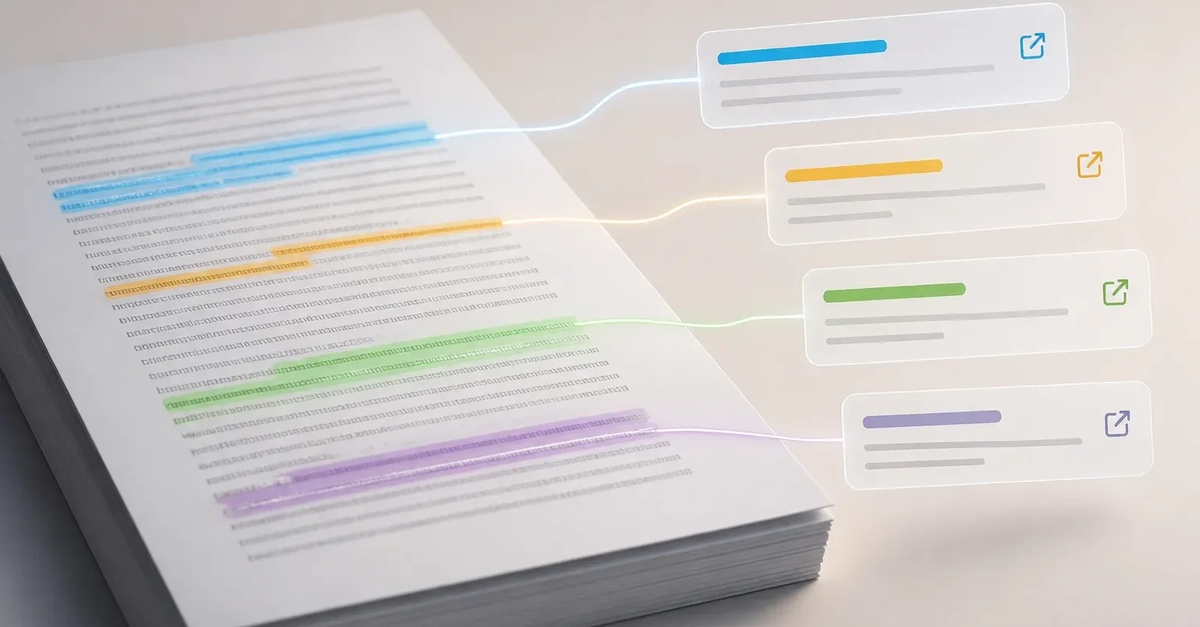
Google's AI Mode is fundamentally altering how web content is attributed in AI-generated answers. A comprehensive year-long analysis by Pillarbase, examining 15.7 million AI Mode citations across 148 industries, has revealed a significant shift: citations are increasingly pointing to specific text passages rather than entire web pages. This passage-centric approach, where nearly half of all citations were identified as scroll-to-text highlights, has profound implications for content creators, SEO professionals, and publishers aiming to be recognized and sourced by Google's AI features.
The study meticulously identified approximately 4.6 million unique highlighted passages originating from 2.7 million distinct web pages. What's particularly striking is the observation that certain passages were heavily reused, appearing across hundreds of different queries. This indicates that Google's AI is not merely linking to a domain but is actively extracting and highlighting precise sentences or short sections as textual evidence to support its generated answers. This granular approach elevates the importance of individual content segments, suggesting that a strong overall page authority may no longer suffice; the clarity, self-containment, and query-specific utility of individual passages are becoming paramount.
It is crucial to note that this analysis does not stem from a formal public disclosure or documented policy change by Google regarding its AI citation methods. Google's own discussions, such as those from May 2023, have hinted at evolving citation strategies for AI-generated content, but the precise mechanisms and their full impact have remained somewhat opaque until now. The Pillarbase study provides concrete, data-driven evidence of how these mechanisms are manifesting in practice.
The Mechanics of Passage-Centric Citations
The core of this shift lies in how Google's AI identifies and presents sources. Traditionally, search engine citations linked to a full URL, implying the entire page contained the relevant information. However, AI Mode's passage-centric citations function more like a direct quote, pinpointing the exact text that informed the AI's response. This is often visualized through scroll-to-text highlighting, a feature that draws a user's attention directly to the relevant snippet on the source page.
Consider this analogy: Imagine a research paper where footnotes traditionally cited the entire book. Now, imagine those footnotes citing the exact sentence or paragraph from which the information was drawn. This is the essence of Google's AI Mode citation evolution. It demands a level of precision that requires content not just to be generally relevant but to contain highly specific, well-articulated points that can stand alone as answers.
The Pillarbase study's finding of heavily reused passages suggests that certain highly informative or exceptionally well-phrased segments are becoming canonical sources for specific types of queries. This creates an opportunity for content creators who can produce such definitive passages, but it also poses a challenge for those whose content is more diffuse or less precisely articulated.
Implications for Publishers and Content Creators
For publishers, the practical implications are significant. A website's overall domain authority or even a single well-ranking page might not be enough to secure a citation in AI Mode answers. Instead, the focus must shift to optimizing individual passages. This means:
- Clarity and Conciseness: Passages need to be clear, unambiguous, and directly answer a potential query.
- Self-Contained Information: Ideally, a highlighted passage should offer a complete thought or answer without requiring extensive context from the surrounding text.
- Query Relevance: Content must be highly attuned to the specific questions users are asking, ensuring that the highlighted text directly addresses those queries.
- Unique Value: Passages that offer unique insights, data, or explanations are more likely to be selected and reused.
This granular focus on passages could lead to a redesign of content strategies. Instead of optimizing entire articles for broad keywords, creators might need to identify and refine specific sentences or paragraphs that are likely to be extracted by AI. This could involve structuring content with distinct, answer-oriented sections, using clear headings and subheadings, and ensuring that key information is presented prominently within these segments.
The Evolving Landscape of Content Attribution
The shift to passage-centric citations by Google's AI Mode represents a deeper evolution in how information is surfaced and attributed online. It moves beyond simple keyword matching or page-level relevance to a more sophisticated understanding of textual content. This could have several downstream effects:
- Increased Value of Authoritative Snippets: Content that provides clear, authoritative answers in a concise format will gain significant visibility.
- Potential for Content Dilution: If AI heavily relies on a few highly reused passages, it might inadvertently reduce the diversity of information presented to users.
- New SEO Strategies: Optimization efforts will need to adapt, focusing on the micro-level of sentence and paragraph construction.
- Publisher Monetization Challenges: If users receive direct answers from highlighted passages without needing to visit the full page, it could impact traffic and ad revenue for publishers.
What remains to be seen is how publishers will adapt their content creation and optimization workflows to this new reality. Will we see a rise in highly optimized, answer-focused micro-content, or will the emphasis on page authority persist in a hybrid model? The data suggests the former is becoming increasingly necessary for visibility within Google's AI-driven search experience.
Ultimately, Google's AI Mode is not just a new feature; it's a significant recalibration of how information is found and credited. For anyone involved in creating or distributing content online, understanding this passage-centric approach is no longer optional—it's essential for staying relevant in the evolving digital information ecosystem.