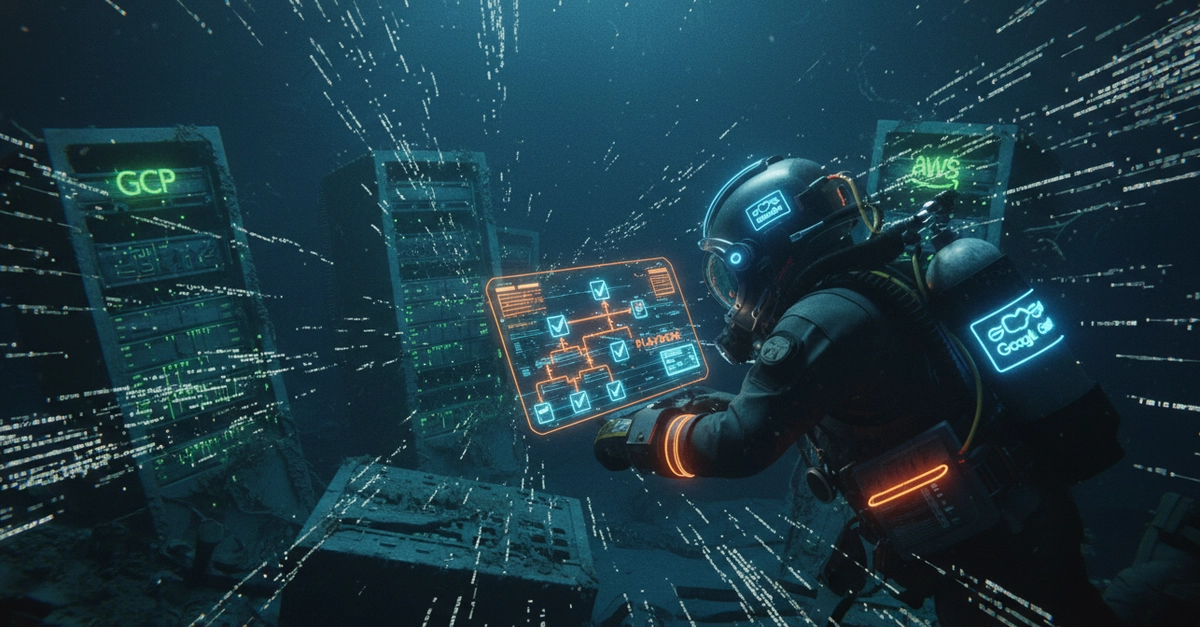
The Telemetry Abyss and the SCUBA of Google SecOps
Information security professionals often find themselves in an environment analogous to deep-sea diving. The modern corporate network generates a constant deluge of telemetry data – petabytes in motion. Without the right tools, security analysts face a risk akin to "data narcosis," becoming overwhelmed and ineffective. Google Security Operations (Google SecOps) emerges as the essential autonomous breathing apparatus, providing the planet-scale visibility needed to safely navigate these depths. It empowers analysts to descend into log data, maintain control under pressure, and identify potential security incidents with clarity.
This article outlines a practical workflow for establishing detection engineering within Google SecOps, leveraging the Model Context Protocol (MCP) and an AI-powered "Buddy System." This approach transforms the overwhelming telemetry abyss into a manageable, actionable environment.

Pre-Dive Checks: Securing the Foundation
Just as a technical diver meticulously checks their equipment before a dive, security operations teams must perform rigorous pre-dive configuration. In the context of SecOps, this translates to setting up the local environment and establishing foundational principles for detection engineering. The Model Context Protocol (MCP) serves as a crucial framework here. MCP is designed to standardize the way security telemetry is structured and contextualized, ensuring consistency and enabling more effective analysis and automation.
The core idea behind MCP is to move beyond raw logs and create enriched, structured data models. These models capture not only the event itself but also its surrounding context – who, what, where, when, and why. This structured data is the bedrock upon which effective detection rules and automated playbooks are built. Without this consistent contextualization, analysts spend an inordinate amount of time piecing together disparate information, a process that is both time-consuming and prone to error.
Structuring Detection Engineering with MCP
Implementing MCP within Google SecOps involves several key steps. First, defining the entities and their relationships is paramount. This means identifying critical assets, users, processes, and network connections, and understanding how they interact. For instance, an alert might involve a specific user account, a particular endpoint, a running process, and a network destination. MCP ensures all these pieces of information are linked cohesibly.
Second, translating security threats into detection logic requires a systematic approach. Instead of writing ad-hoc detection rules, teams can use MCP to define detection patterns based on the structured data models. This allows for more precise and less noisy alerts. For example, a rule might look for a specific sequence of events involving a user account exhibiting unusual behavior, such as accessing sensitive files from an unfamiliar IP address during off-hours. The structured nature of MCP makes it easier to express these complex relationships.
The AI Buddy System: Augmenting Human Analysis
The "Buddy System" concept, traditionally used in diving for mutual safety and support, is reimagined here with artificial intelligence. In Google SecOps, AI acts as an intelligent partner, augmenting the analyst's capabilities. This AI buddy can perform several critical functions:
- Automated Context Enrichment: When an alert fires, the AI can instantly pull in relevant contextual data from various sources – threat intelligence feeds, asset inventories, user directories – and associate it with the alert according to the MCP model. This dramatically reduces the manual effort required for initial investigation.
- Pattern Recognition: AI algorithms can analyze vast datasets to identify subtle patterns and anomalies that might escape human detection. This includes identifying novel attack vectors or insider threats that deviate from established norms.
- Prioritization and Triage: By understanding the context and potential impact of an alert, AI can help prioritize investigations, flagging the most critical incidents for immediate human attention.
- Playbook Suggestion: Based on the nature of the alert and its enriched context, the AI can suggest relevant automated playbooks for response, or even initiate parts of the playbook automatically.
This AI-assisted workflow doesn't replace the human analyst; it empowers them. It frees up valuable cognitive load, allowing analysts to focus on complex problem-solving, threat hunting, and strategic improvements rather than getting bogged down in repetitive data correlation and initial triage.
Automated Playbooks: From Detection to Resolution
The ultimate goal of this structured approach is the creation of robust, automated playbooks. These playbooks are sequences of actions designed to respond to specific types of security incidents. Triggered by alerts that meet predefined criteria within Google SecOps, a playbook can:
- Isolate affected systems: Automatically block an IP address, disable a user account, or segment a network.
- Gather forensic data: Collect logs, memory dumps, or process information from compromised endpoints.
- Notify stakeholders: Alert relevant teams or individuals via email, Slack, or ticketing systems.
- Initiate further investigation: Trigger more in-depth analysis or threat hunting queries.
The effectiveness of these playbooks is directly tied to the quality of the underlying detection logic and the richness of the contextual data provided by MCP. An AI buddy that can reliably suggest or even partially execute these playbooks based on a well-defined MCP model represents a significant leap in operational efficiency and response speed.
The Future of Detection Engineering
This integrated approach – combining the structured data modeling of MCP, the planet-scale visibility of Google SecOps, and the intelligent augmentation of an AI Buddy System – represents a forward-looking strategy for detection engineering. It moves security operations from a reactive, labor-intensive model to a proactive, data-driven, and increasingly automated one. The challenge now is for organizations to embrace these methodologies, standardize their telemetry, and train their teams to effectively leverage these powerful new capabilities. The telemetry abyss remains vast, but with the right gear, security teams can now explore its depths with confidence and emerge victorious.
What nobody has addressed yet is the significant cultural shift required within security teams to fully embrace AI-driven workflows and trust automated playbooks for critical incident response actions.