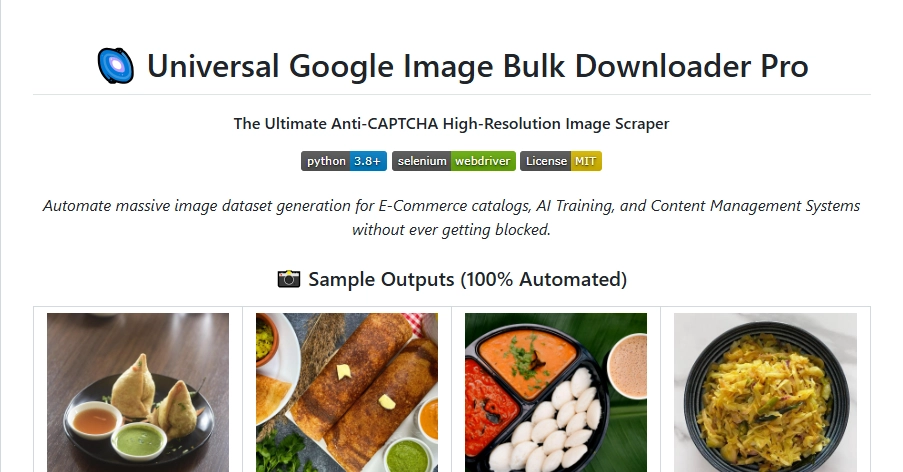
Architectural Choices for Robust Image Scraping
Most custom-built image scrapers face a common downfall: rapid blocking by anti-bot systems, often within dozens of requests. This typically manifests as CAPTCHA walls or a deluge of irrelevant data mixed with the desired images. Universal Google Image Bulk Downloader Pro, an open-source project by hariompatel61, addresses these challenges through several key architectural decisions. Its success hinges on mimicking human browsing behavior more closely than typical headless request libraries.
Undetected ChromeDriver and Persistent Sessions
Instead of relying on standard headless browsers or simple request libraries, the tool employs undetected-chromedriver. This library is specifically designed to drive a real Chrome browser instance while actively masking the fingerprints that anti-bot systems commonly use to identify automated traffic. Standard Selenium or ChromeDriver setups leave tell-tale signs that are quickly flagged, leading to immediate blocks or CAPTCHAs. By using an undetected version, the tool significantly increases its stealth capabilities.
A more critical, and often overlooked, technique employed by the downloader is session persistence. When the script is first executed, if Google's systems present a CAPTCHA, the user is given a brief window to manually solve it. This single manual intervention is crucial. Once the CAPTCHA is cleared, the session's cookies and state are maintained across subsequent automated requests. This persistent session, now marked as 'trusted' by Google, allows the tool to continue scraping without repeatedly encountering CAPTCHAs for a considerable period. It effectively trains Google's bot detection to view the automated session as a legitimate human user, at least temporarily.
Handling Search Results and Data Extraction
Beyond avoiding detection, the tool also tackles the problem of extracting clean, relevant image data. Google's image search results are dynamically loaded and often contain a mix of images, advertisements, and other non-image elements. The downloader navigates these complex search result pages, identifying and extracting the actual image URLs. This process often involves parsing the HTML structure of the search results page, looking for specific tags and attributes that denote image sources. The use of a real browser instance, rather than just making HTTP requests, ensures that JavaScript-rendered content and dynamic loading mechanisms are handled correctly, providing a more accurate representation of what a human user sees.
The architecture is designed to differentiate between actual image results and other content. This prevents the common issue of scrapers returning corrupted files, unrelated images, or even HTML snippets mistaken for images. By focusing on the structured data returned by a live browser session, the tool aims to deliver a cleaner dataset to the user.
User-Friendly Setup and Workflow
Universal Google Image Bulk Downloader Pro is built with developer productivity in mind. The setup process, detailed in step-by-step guides, is designed to be straightforward. It requires Python 3.8 or later and a local installation of Google Chrome. Users clone the GitHub repository, navigate into the directory, and then typically install the necessary Python dependencies using pip. Configuration often involves specifying search queries, desired image formats, and download locations, which can be managed through configuration files or command-line arguments.
The tool's workflow typically involves:
- Defining search terms or providing a list of search terms (e.g., from an Excel file).
- Initiating the scraping process, which launches an undetected Chrome browser.
- Manually solving any initial CAPTCHAs presented by Google.
- Allowing the tool to collect image URLs from search results.
- Downloading the identified images to a specified local directory.
This structured approach ensures that even complex bulk downloading tasks are manageable, reducing the friction typically associated with web scraping and image collection.
The Significance of Open Source in Web Scraping Tools
The decision to make Universal Google Image Bulk Downloader Pro open-source is significant. It allows developers to inspect the code, understand its anti-detection mechanisms, and contribute improvements. This transparency is vital in the often opaque world of web scraping, where tools can be black boxes. For users, it means the underlying logic for avoiding blocks is accessible, fostering trust and enabling customization. Community contributions can lead to faster adaptation to Google's evolving anti-bot strategies, ensuring the tool remains effective over time.
The project by hariompatel61 demonstrates a thoughtful approach to a common developer problem. By combining stealthy browser automation with smart session management, it offers a robust solution for reliable Google Image bulk downloading.