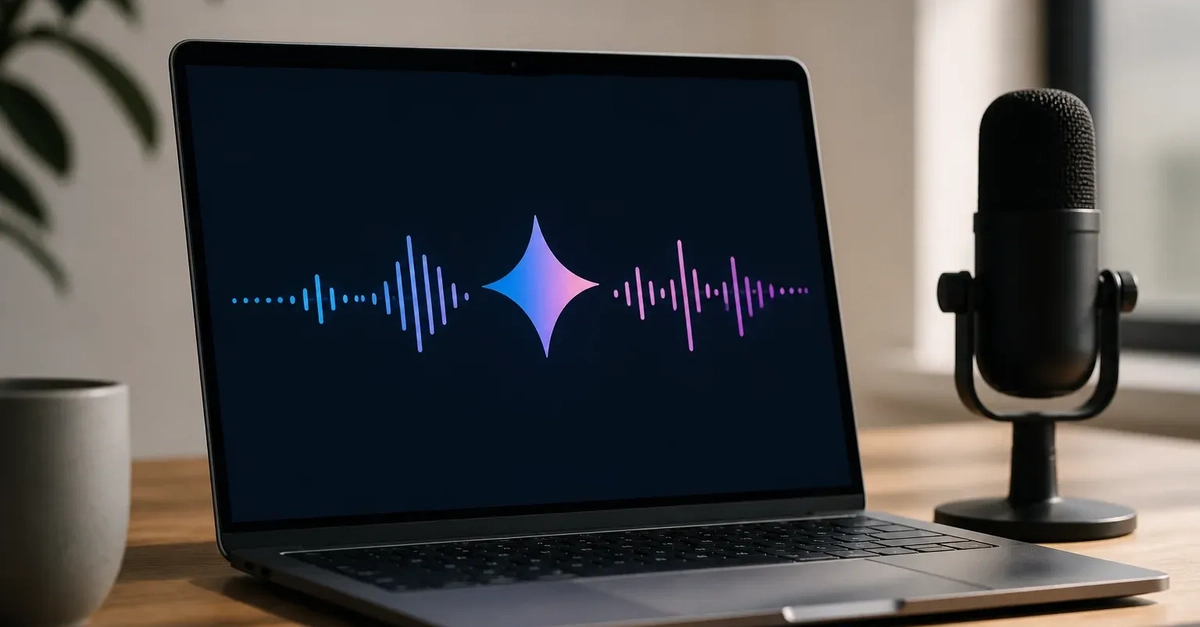
Gemini 3.5 Transcribe: Beyond Basic Dictation
Google has launched Gemini 3.5 Transcribe, a significant advancement in speech-to-text technology that moves beyond simple dictation and aims to redefine voice-driven workflows on macOS. Announced on August 26, 2026, this new model integrates deeply with the Gemini app for macOS, leveraging not only spoken words but also the context of the user's screen to enable a range of sophisticated actions. This positions voice as a primary input layer for tasks that previously required extensive manual interaction with documents, applications, and separate AI tools.
The core innovation of Gemini 3.5 Transcribe lies in its ability to understand and act upon spoken commands in relation to the user's current digital environment. This means users can, for example, ask the model to summarize a document currently open on their screen, extract specific text snippets from various applications, or even generate images directly at the cursor's position. This contextual awareness is a major leap from traditional speech-to-text systems, which are primarily designed for transcription alone.

Key Capabilities and Workflow Integration
Gemini 3.5 Transcribe's capabilities extend across several key areas, promising to streamline common productivity tasks for professionals and creatives alike:
- Contextual Summarization: Users can direct Gemini 3.5 Transcribe to summarize local files or web content displayed on their screen. This eliminates the need to copy and paste text into a separate AI tool for summarization, saving considerable time.
- Cross-Application Text Reuse: The model can intelligently extract and reuse text across different applications. This could involve pulling a quote from an email to paste into a report, or grabbing contact information from a webpage for a new calendar entry, all through voice commands.
- In-Situ Image Generation: A particularly novel feature is the ability to generate images at the cursor's location. This is beneficial for content creators, designers, or anyone needing to quickly visualize concepts or add graphics to documents without leaving their current application context.
- Enhanced Transcription Accuracy: Google touts Gemini 3.5 Transcribe as its most precise speech-to-text model to date. This improved accuracy is foundational, ensuring that the commands and content processed by the model are correctly interpreted, leading to more reliable workflow automation.
The implications for businesses are clear: it's not just about faster transcription, but about fundamentally rethinking how users interact with their digital tools. By treating voice as a command layer that understands the broader digital workspace, Google is enabling a more fluid and efficient way to work. This could significantly reduce task switching and cognitive load, particularly for knowledge workers who spend their days managing multiple applications and information streams.
Developer Access and Future Potential
Beyond end-user productivity, Google has also outlined developer access to Gemini 3.5 Transcribe. This suggests that the underlying technology will be available for integration into third-party applications, potentially leading to a new wave of voice-enabled software. Developers will be able to incorporate the model's advanced speech recognition and contextual understanding capabilities into their own products, creating richer user experiences.
The announcement signifies Google's continued investment in multimodal AI, where models can understand and process information from various sources—text, audio, images, and video. Gemini 3.5 Transcribe represents a concrete application of this multimodal approach, demonstrating how different AI modalities can be orchestrated to perform complex tasks. The potential for further integration with other Gemini models and Google Workspace applications is vast, hinting at a future where AI assistants can proactively manage and execute tasks based on a deep understanding of user intent and digital context.
While the initial release focuses on macOS, the underlying technology is likely to be extended to other platforms. The company's emphasis on precision and contextual awareness suggests a long-term strategy to make AI assistants more capable and seamlessly integrated into daily work, moving from reactive tools to proactive collaborators. The question remains how quickly other operating systems and application ecosystems will adopt similar levels of deep, contextual voice integration.