The Unspoken Toolkit: Essential Prompts for AI Collaboration
In the rapidly evolving landscape of artificial intelligence, the ability to effectively communicate with AI models is becoming a critical skill. While the underlying technology advances at breakneck speed, the art of crafting the perfect prompt remains a cornerstone of unlocking an AI's full potential. Now, a collection of insights from Google engineers sheds light on the prompts they consider indispensable, moving beyond generic commands to reveal the nuanced interactions that drive productivity.
The core of these revelations lies in a simple, yet powerful, question posed to Google's AI engineers: "What prompt do you personally refuse to work without, and why?" The responses, aggregated and analyzed, offer a practical guide for anyone looking to elevate their AI interactions, from seasoned developers to casual users.
Beyond Basic Queries: The Power of Context and Specificity
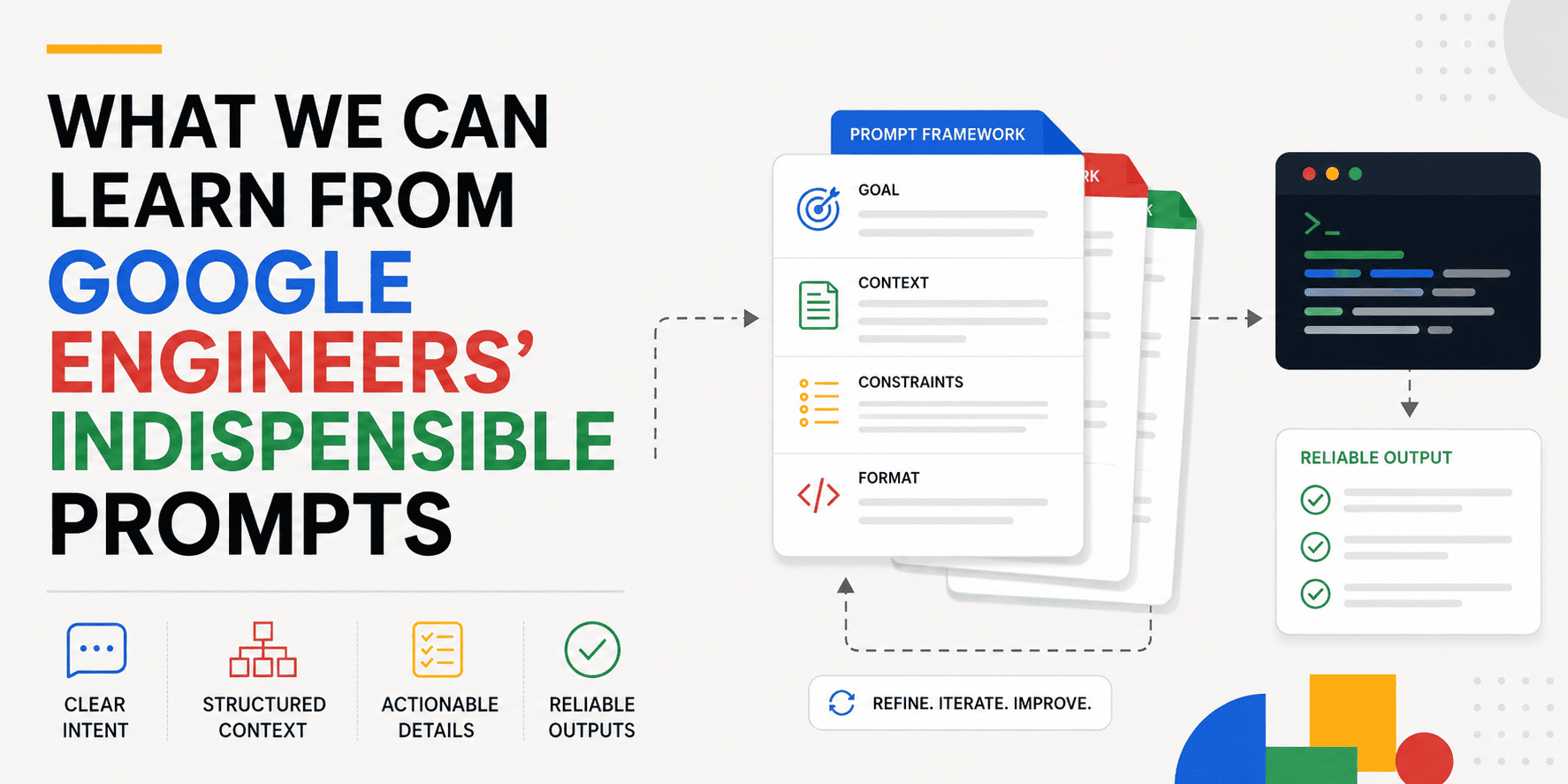
A recurring theme among the engineers' responses is the emphasis on providing rich context and specific instructions. Generic prompts, such as "write code" or "summarize this," often yield superficial or irrelevant results. The engineers highlight that truly effective prompts act as detailed briefs, guiding the AI with clarity and purpose.
For instance, instead of a broad request, an engineer might use a prompt that specifies the programming language, the desired functionality, potential edge cases, and even the coding style. This level of detail ensures the AI understands the constraints and objectives, leading to more accurate and useful output. It's akin to giving a highly skilled intern a fully fleshed-out project plan rather than just a vague assignment. The difference in outcome is profound.
Consider the analogy of directing a film. A director doesn't just tell an actor "act sad." They provide context: the character's backstory, the emotional arc of the scene, the specific motivation for sadness, and the desired tone. Similarly, AI prompts that include background information, desired format, target audience, and specific constraints enable the AI to perform at its best.

The Art of Iteration and Refinement
Another critical takeaway is the iterative nature of prompt engineering. Few engineers rely on a single, perfect prompt. Instead, they engage in a dialogue with the AI, refining their requests based on the initial responses. This process involves identifying where the AI misunderstood or fell short, and then adjusting the prompt accordingly. It's a feedback loop that hones the AI's understanding and steers it toward the desired outcome.
This iterative approach is not just about correcting errors; it's also about exploration. By slightly altering prompts, engineers can uncover new capabilities or different ways the AI can approach a problem. This exploratory prompting can lead to unexpected but valuable insights, much like a scientist adjusting experimental parameters to discover new phenomena.
Specific Prompt Archetypes Revealed
While the exact prompts are often tailored to specific tasks, several archetypes emerged from the engineers' feedback:
- Context-Rich Code Generation: Prompts that specify language, libraries, desired output format (e.g., functions, classes, tests), performance considerations, and even example input/output pairs.
- Structured Data Extraction: Prompts designed to pull specific information from unstructured text, requesting output in a defined format like JSON, CSV, or a table, and clearly delineating the fields to be extracted.
- Persona-Based Response: Prompts that instruct the AI to adopt a specific persona (e.g., "act as a senior software architect," "explain this as if to a marketing manager") to tailor the tone, complexity, and focus of its response.
- Hypothetical Scenario Analysis: Prompts that explore "what-if" scenarios, asking the AI to analyze potential outcomes, risks, or benefits based on given parameters.
- Constraint-Driven Problem Solving: Prompts that lay out strict limitations or requirements, forcing the AI to find solutions within a defined framework.
Why These Prompts Matter: Beyond the Code
The insights from Google engineers underscore a fundamental shift in how we interact with AI. It's moving from a transactional model to a collaborative one. These engineers aren't just asking questions; they are shaping the AI's understanding and output through precise, context-aware instructions. This approach is crucial for tasks ranging from debugging complex code and drafting technical documentation to generating creative content and analyzing large datasets.
The surprising detail here is not that engineers are using sophisticated prompts, but the sheer universality of this need across different disciplines within Google's AI divisions. It suggests that prompt engineering is less of a niche skill and more of a foundational literacy for anyone working with advanced AI models. What nobody has addressed yet is what happens to the millions of users who are still employing rudimentary prompts – are they being left behind in terms of productivity and insight?
Applying the Lessons: What You Can Do
For developers, this means investing time in understanding how to structure prompts that provide sufficient context and constraints for code generation, debugging, and documentation. For researchers, it involves crafting prompts that facilitate nuanced data analysis and hypothesis testing. For creators, it’s about learning to guide AI for specific stylistic and thematic outputs.
The common thread is intentionality. By being deliberate in our prompts, we transform AI from a mere tool into a powerful collaborator. The lessons from Google's engineers offer a clear path forward: be specific, provide context, iterate, and understand the AI's role in your workflow. This isn't just about getting better answers; it's about achieving more complex and valuable outcomes.
If you find yourself frustrated with AI outputs, examine your prompts. Are you providing enough information? Are you clear about the desired format and tone? Are you willing to refine your request based on the AI's response? The answers to these questions will likely unlock a new level of productivity and innovation in your AI-assisted work.