%22%20%2F%3E%0A%20%20%3C%2Fsvg%3E)
AI's Real-World Impact: A Glimpse from Google's Data
The narrative surrounding artificial intelligence often paints a stark picture of mass job displacement. Fears of widespread automation, where AI systems render entire professions obsolete, are pervasive in public discourse and even within industry discussions. However, new data emerging from Google, analyzing an unprecedented 15 million real-world AI interactions, suggests a far more nuanced reality. The findings indicate that, contrary to popular hype, AI is not yet automating away the majority of tasks performed by workers across most jobs. The impact, while present, is significantly less dramatic than often predicted.
This extensive analysis, detailed in a recent report, examined how employees are actually using AI tools in their daily work. Instead of AI taking over core responsibilities, the data points towards a pattern of augmentation and assistance. Employees are leveraging AI for specific, often repetitive or time-consuming tasks, freeing them up for more complex or strategic work. This suggests a future where AI acts as a co-pilot rather than a replacement, fundamentally altering workflows rather than eliminating roles wholesale.
Examining the Data: What 15 Million Interactions Reveal
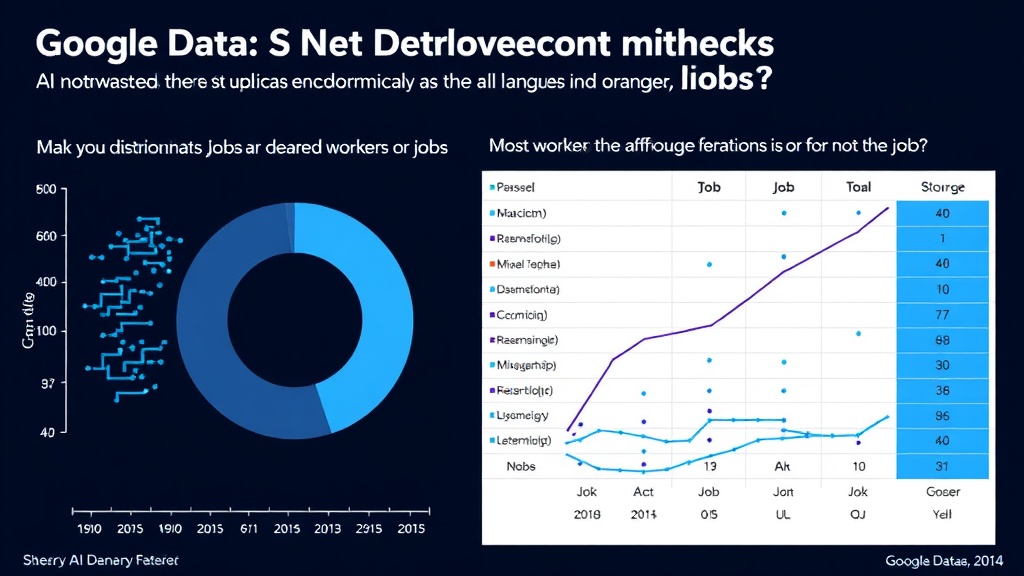
The sheer scale of the dataset is critical to understanding its implications. Google's analysis encompassed 15 million distinct AI interactions, offering a broad and deep look into how AI is being integrated into the modern workplace. The key takeaway is that the vast majority of these interactions did not involve AI taking over an entire job function. Instead, AI was employed for discrete tasks, such as drafting emails, summarizing documents, generating code snippets, or performing data analysis. This granular application means that while individual tasks might be automated, the broader scope of a job, which often involves a complex interplay of skills, judgment, and human interaction, remains largely intact.
For instance, a marketing professional might use AI to generate initial drafts of social media posts, but still needs to apply their strategic understanding of the brand, target audience, and campaign goals to refine and approve the content. Similarly, a software developer might use AI to generate boilerplate code, but the architectural design, complex debugging, and system integration still require human expertise. The data suggests that the current capabilities of AI, while impressive, are better suited to assisting with specific components of a job rather than executing the entire role.
The study also delved into the types of jobs most and least affected. While some roles, particularly those with highly repetitive and data-driven tasks, showed a higher degree of AI integration for specific functions, the overall impact across the spectrum of employment was minimal. This challenges the notion that AI will lead to immediate, widespread unemployment. Instead, it points to a gradual evolution of job roles, where new skills will be required to effectively leverage AI tools, and existing skills will be augmented rather than replaced.
The Nuance of Augmentation vs. Automation
This distinction between augmentation and automation is crucial. Automation implies a system taking over a task entirely, often with the goal of reducing human involvement. Augmentation, on the other hand, involves AI systems enhancing human capabilities, making workers more efficient and productive. Google's findings strongly support the augmentation hypothesis. The data indicates that AI is being used to offload the more tedious aspects of work, allowing humans to focus on higher-value activities that require critical thinking, creativity, emotional intelligence, and complex problem-solving—skills that AI currently struggles to replicate.
Consider the implications for employee training and development. If AI is primarily augmenting jobs, the focus for businesses and educational institutions should shift from fearing mass job losses to equipping the workforce with the skills needed to effectively collaborate with AI. This includes understanding AI's capabilities and limitations, prompt engineering, data interpretation, and the ethical considerations of AI use. The rise of AI necessitates a workforce that is adaptable and capable of integrating these new tools into their existing skill sets.
The surprising detail here is not that AI is having *some* impact, but how limited that impact is on the actual *tasks* that constitute most jobs. The widespread fear of AI automating entire professions seems premature, at least based on this extensive dataset. While AI is undoubtedly a powerful force for change, its current deployment in the workplace is more about enhancing human performance than replacing it.
Broader Implications for the Future of Work
The findings challenge the prevailing doomsday scenarios and offer a more optimistic, albeit still evolving, outlook on the future of work. For founders and business leaders, this data suggests that the immediate priority is not to plan for mass layoffs due to AI, but to strategically integrate AI tools to boost productivity and innovation. It also highlights the importance of fostering a culture of continuous learning and adaptation within their organizations. Companies that successfully empower their employees to use AI effectively will likely gain a significant competitive advantage.
For developers, the takeaway is that the demand for human ingenuity in software development, AI ethics, and the creation of AI systems themselves will likely remain strong. The focus might shift from writing routine code to designing, training, and managing AI models, as well as building the infrastructure that supports them. The need for skilled professionals who can bridge the gap between human needs and AI capabilities will only grow.
What nobody has addressed yet is what happens to the thousands of developers who built their careers on skills that AI is now beginning to automate for specific tasks. Will they reskill, or will this create a new class of displaced workers? The long-term trajectory of AI's impact remains an open question, but for now, the data suggests a path of integration and augmentation rather than outright replacement.
Ultimately, Google's analysis provides a much-needed dose of reality to the AI discourse. It underscores that while AI is a transformative technology, its integration into the workforce is a gradual process, characterized by assistance and enhancement rather than immediate automation. The future of work will likely involve humans and AI collaborating, each playing to their strengths, to achieve outcomes previously unimaginable.