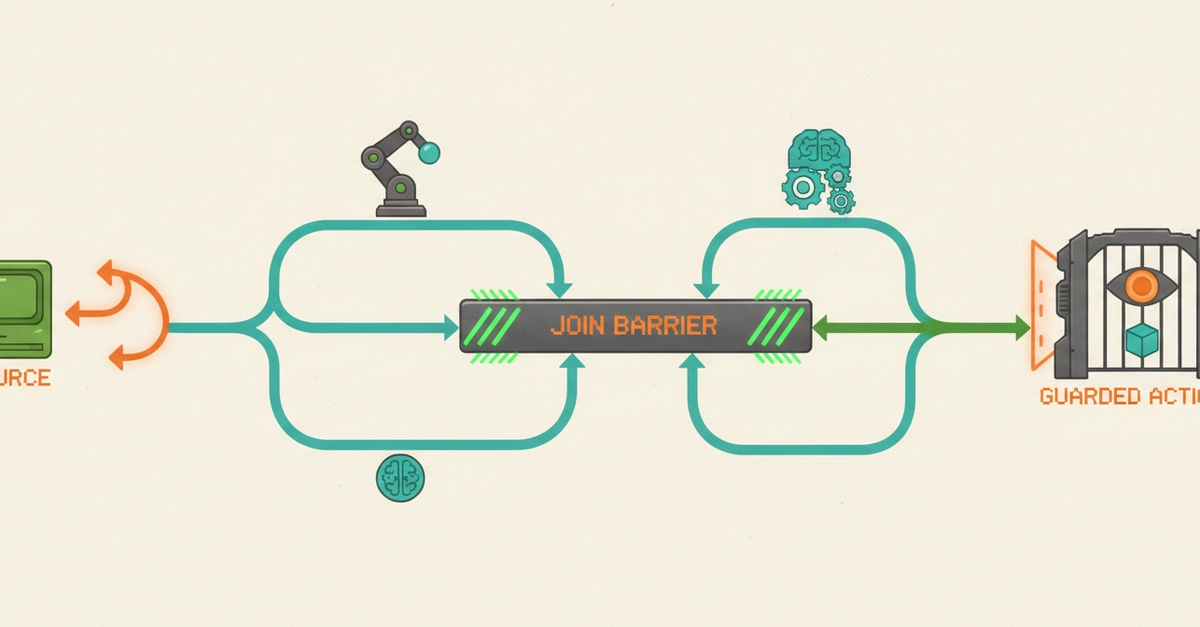
Explicit Workflows Over Implicit Parallelism
The siren song of splitting AI tasks into independent agents is powerful, much like the allure of microservices in software development. While sometimes beneficial, this approach can introduce complexity, state management headaches, and opaque failure modes. A critical danger arises from the assumption that separate agents can or should run in parallel. True parallelism is only safe when agent tasks are genuinely independent. If one agent modifies the environment while another is still evaluating it, even locally rational decisions can lead to globally unsafe outcomes.
Google's ADK 2.0 tackles this challenge head-on by making workflow topology explicit. Instead of relying on supervisor prompts to implicitly define agent interactions, ADK 2.0 uses graph-based Workflow objects. This structural clarity transforms sequences, branches, and joins from mere agreements into concrete, programmable constructs. Developers can now define and visualize the precise flow of execution, ensuring that dependencies and states are managed intentionally, not by accident.
Defining Safe State Transitions
The core problem with unmanaged multi-agent systems is state. When agents operate in parallel without a clear understanding of each other's impact on shared state, race conditions and inconsistent data become inevitable. Imagine a scenario where Agent A is tasked with summarizing a document, while Agent B is responsible for translating it. If Agent B translates the document *while* Agent A is still reading the original, Agent A might be working with outdated or incomplete information. The ADK's explicit workflow definition prevents this. By defining a workflow as a directed acyclic graph (DAG), developers can specify that translation must complete *before* summarization begins, or that summarization should operate on a specific, immutable snapshot of the document state.
This explicit definition means that sequences, conditional branches, and parallel steps (where truly safe and independent) are all encoded within the Workflow object itself. This eliminates the ambiguity that can plague prompt-based agent coordination, where the underlying execution logic can be hidden or misunderstood. The ADK 2.0 approach forces developers to confront and define the exact order and dependencies, leading to more robust and predictable agent behavior.
Beyond Simple Sequential Execution
While sequential execution is the safest default, ADK 2.0 supports more complex, yet still controlled, topologies. For instance, if multiple agents are tasked with fetching independent data points from different sources—like retrieving stock prices for unrelated companies, or fetching user profile information from distinct APIs—these tasks can be safely executed in parallel. The ADK allows developers to define these parallel branches, but crucially, it requires them to be structured such that they do not interfere with each other's state. The system ensures that the results of these parallel operations are then correctly joined or aggregated, maintaining data integrity.
The value here lies in moving from a reactive, often brittle, coordination mechanism to a proactive, declarative one. Developers can reason about their agent systems at a higher level, focusing on the business logic and desired outcomes rather than the minutiae of inter-agent communication and state synchronization. This is particularly crucial for applications where reliability and safety are paramount, such as in financial services, critical infrastructure management, or healthcare applications.
The ADK 2.0 Advantage for Developers
The implications for developers are significant. The ADK 2.0 provides a framework that encourages best practices by design. Instead of needing to build custom synchronization primitives or rely on complex orchestration layers, developers can leverage the ADK's built-in workflow capabilities. This not only speeds up development but also reduces the cognitive load associated with building reliable multi-agent systems. Debugging becomes more straightforward because the execution path is explicit and auditable.
The shift from implicit coordination to explicit workflow definition is more than an architectural change; it's a philosophical one. It acknowledges that while AI agents can be powerful, their interactions must be carefully managed. By providing the tools to define these interactions clearly and safely, Google ADK 2.0 empowers developers to build more sophisticated and dependable AI applications, moving beyond the