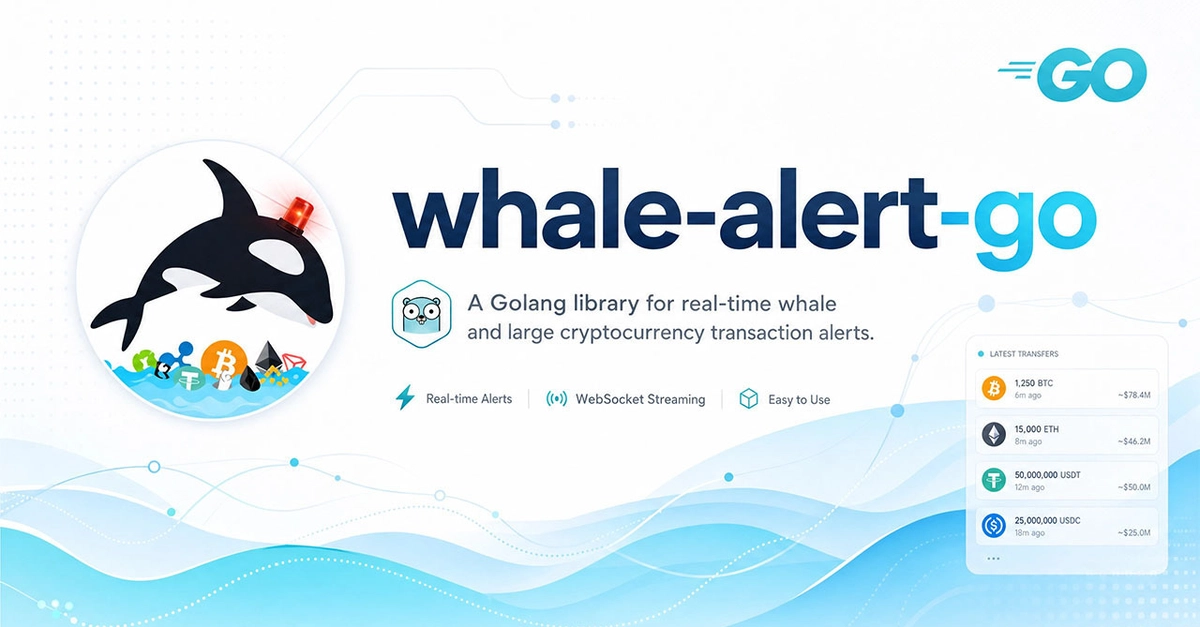
The Need for Real-Time Crypto Transaction Monitoring
Tracking significant cryptocurrency transactions, often termed "whale" movements, is a critical practice for traders, analysts, and blockchain researchers. These large-scale transfers can signal market shifts, potential price movements, or the movement of funds into or out of exchanges. The Whale Alert Enterprise API stands as a prominent data provider in this domain, offering both historical transaction data and real-time alerts. However, integrating such external APIs into Go applications traditionally involves substantial boilerplate code. Developers typically must manually implement robust HTTP clients, manage the complex lifecycle of WebSocket connections for real-time data, meticulously handle API pagination for historical data, and address the intricacies of floating-point precision when dealing with financial data. This overhead can divert valuable engineering time and introduce potential sources of error.
Consider the task of monitoring a single whale transaction. Without an SDK, a developer might need to:
- Configure an HTTP client with appropriate timeouts and retry logic.
- Implement logic to parse JSON responses, ensuring data integrity.
- For real-time alerts, establish and maintain a WebSocket connection, including reconnection strategies upon disconnection.
- Handle API rate limits and potential errors gracefully.
- Convert string representations of large token amounts into precise numerical types, avoiding floating-point inaccuracies.
Each of these steps requires careful implementation to ensure reliability, especially in a fast-moving financial market where timely and accurate data is paramount. The cumulative effort to build these foundational components can be significant, delaying the delivery of core application features.
Introducing the whale-alert-go SDK
To streamline this process, the whale-alert-go SDK has been developed. This unofficial Go library is specifically designed to simplify interaction with the Whale Alert Enterprise API. Its primary goal is to abstract away the routine and often complex networking tasks, allowing Go engineers to concentrate on the business logic and value-added features of their crypto alerting applications. The SDK handles the underlying HTTP requests and WebSocket management, providing a cleaner, more Go-idiomatic interface for developers.
The library aims to provide a set of functions and types that map directly to the Whale Alert API's functionalities. Instead of writing custom code for each API endpoint or connection type, developers can leverage the SDK's pre-built components. This includes mechanisms for fetching historical transactions, subscribing to real-time alerts, and managing API credentials securely. The abstraction layer is key; it means that changes to the underlying API protocol or network management strategies can be handled within the SDK, reducing the maintenance burden on individual applications.
Key Features and Abstractions
The whale-alert-go SDK offers several key abstractions that address the common pain points of API integration:
HTTP Client Abstraction
For historical data or specific transaction lookups, the Whale Alert API uses standard HTTP requests. The SDK encapsulates the creation and management of an HTTP client. This includes setting default headers, handling request timeouts, and implementing basic error checking for HTTP status codes. Developers interact with the SDK's functions, which then internally use this robust HTTP client to communicate with the API. This removes the need for developers to write repetitive HTTP request code for every data retrieval operation.
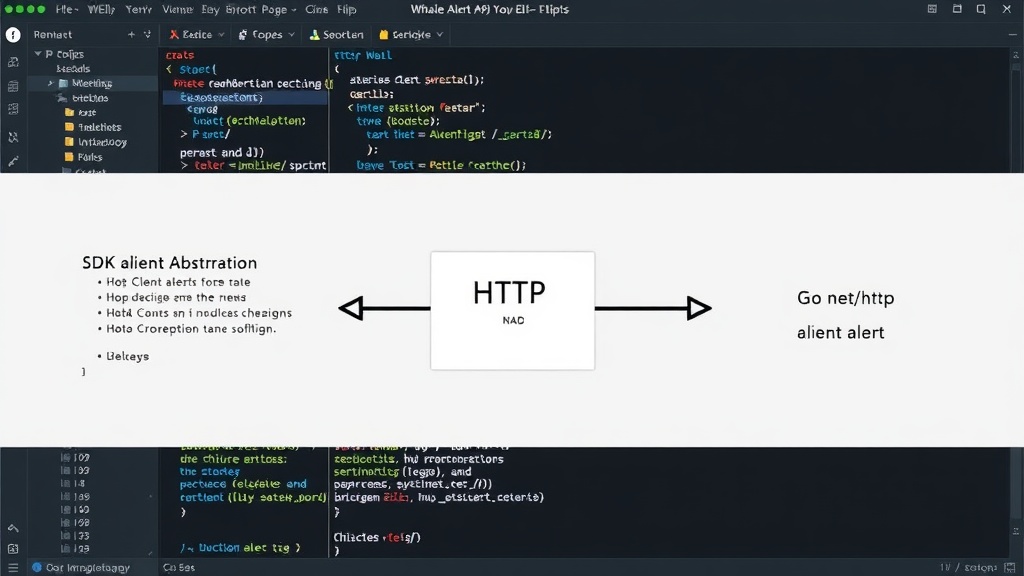
WebSocket Connection Management
Real-time alerts are typically delivered over WebSockets. Managing a persistent WebSocket connection, especially one that needs to be reliable and automatically re-establish itself upon disconnection, is complex. The whale-alert-go SDK provides a higher-level abstraction for WebSocket communication. It handles the initial connection, sends subscription messages to the Whale Alert server, and provides channels or callbacks for receiving incoming alert messages. The SDK's internal logic is responsible for detecting disconnections and attempting to reconnect, ensuring that the application stays updated with the latest whale transactions without constant manual intervention from the developer.
Data Handling and Precision
Cryptocurrency values are often represented as large numbers, sometimes with many decimal places. Standard floating-point types in Go (like float64) can lead to precision errors when performing calculations or comparisons with these values. The SDK addresses this by providing mechanisms to handle these large numerical values accurately. This might involve using types like decimal.Decimal from a popular Go decimal library or ensuring that raw string representations of amounts are passed through to the user without premature conversion to potentially lossy floating-point types. This is crucial for financial applications where even minor discrepancies can have significant consequences.
Error Handling and Retry Logic
Network issues, API rate limits, or temporary server outages are common in distributed systems. The SDK incorporates built-in error handling and retry logic. When an API call fails due to transient network problems or rate limiting, the SDK can be configured to automatically retry the operation after a specified delay. This resilience is vital for building alerting systems that must operate continuously and reliably, ensuring that alerts are not missed due to temporary connectivity problems.
Potential Use Cases
The whale-alert-go SDK empowers developers to build a variety of reliable crypto-focused applications:
- Real-time Trading Bots: Trigger buy or sell orders based on whale transaction alerts.
- Portfolio Trackers: Monitor large inflows/outflows to exchanges that might affect specific assets.
- Market Analysis Tools: Identify patterns and correlations between whale movements and price action.
- Security Monitoring: Detect suspicious large transfers that could indicate a compromise.
- On-chain Forensics: Trace the movement of funds across the blockchain.
By abstracting the complexities of API interaction, the SDK allows developers to focus on the unique logic of these applications, accelerating development cycles and reducing the risk of integration-related bugs. If you're building any application that requires timely and accurate data on large cryptocurrency transactions, this SDK offers a significant shortcut.