The Challenge of Concurrent Resource Contention
In systems where thousands of concurrent requests vie for a limited set of reusable resources, managing access efficiently is paramount. A common, albeit often naive, approach involves a simple mutex protecting a slice of resources. This method, however, quickly becomes a bottleneck under heavy load, leading to performance degradation and potential deadlocks. Recognizing this limitation, the developer behind the Concurrent Resource Scheduler (CRS) opted for a design that prioritizes concurrency from its inception.
The result is CRS, a domain-agnostic Go library engineered to handle the complex task of selecting, prioritizing, routing, and maintaining reusable resources when subjected to intense concurrent traffic. This library aims to provide a more sophisticated and performant alternative to basic locking mechanisms.

Core Architecture: Sharded Priority Heaps
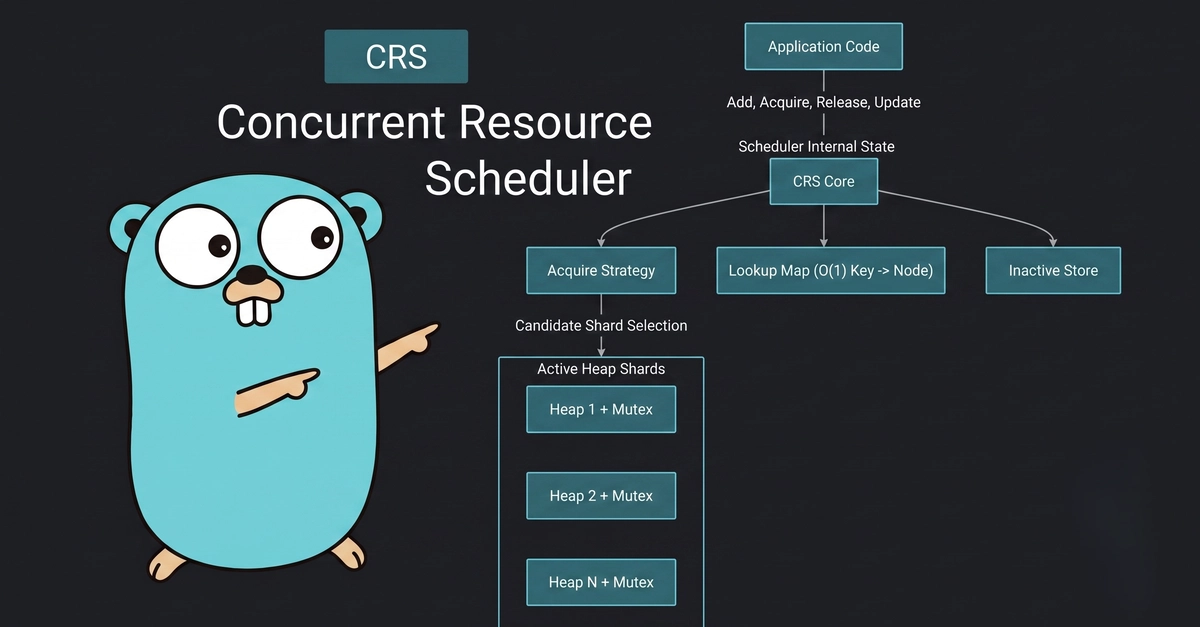
At the heart of CRS lies its innovative use of sharded priority heaps. This data structure is key to achieving high performance and scalability. Instead of a single, monolithic priority queue, CRS distributes resources across multiple independent heaps, or shards. Each shard manages a subset of the available resources, and requests are routed to the appropriate shard.
Priority heaps themselves are efficient for managing ordered collections. They allow for quick retrieval of the highest-priority item (in this case, the most suitable available resource) and efficient insertion of new items. By sharding these heaps, CRS breaks down the contention point. When multiple requests arrive, they are not all trying to access a single data structure. Instead, they contend for individual shards, greatly reducing the probability of blocking.
The sharding strategy can be based on various factors, such as resource type, availability status, or a hashing function applied to the request parameters. This allows the scheduler to distribute the load more evenly. When a request comes in, the scheduler determines which shard is most likely to contain a suitable resource and directs the request there. If a resource is available in that shard, it is immediately allocated. If not, the request might be queued within that shard's heap, or potentially routed to another shard if the strategy allows for cross-shard searching.
Key Features and Functionality
CRS offers a comprehensive set of features designed to manage resources effectively:
- Resource Selection: The library intelligently selects the best available resource based on defined priorities and request requirements.
- Prioritization: It supports dynamic prioritization, allowing different requests or resource types to be treated with varying urgency. This is managed within the priority heaps.
- Routing: CRS can route requests to specific resources or pools of resources, enabling sophisticated load balancing and affinity management.
- Resource Maintenance: The scheduler includes mechanisms for tracking resource health and lifecycle, ensuring that only healthy and available resources are presented for selection. This might involve periodic checks or callbacks upon resource usage.
- Concurrency Management: Built from the ground up for concurrency, it leverages Go's goroutines and channels to manage operations without relying on coarse-grained locks.
- Domain Agnosticism: The library is designed to be general-purpose, meaning it can be applied to a wide range of scenarios, from managing database connections and network sockets to worker pools and cache entries.
Implementation Details and Benefits
The developer has made the CRS library open-source and available on GitHub, complete with Go documentation via pkg.go.dev. This transparency allows developers to inspect the implementation, contribute, and integrate it into their projects.
The primary benefit of using CRS over simpler locking mechanisms is its ability to scale. By sharding the priority heaps, the scheduler can handle a significantly higher volume of concurrent requests without becoming a performance bottleneck. Each shard operates with a reduced scope of contention, and the parallel processing of requests across shards allows for greater throughput. This is analogous to having multiple checkout lines at a supermarket instead of a single, very long one; while each line has its own queue, the overall customer processing rate is much higher.
Furthermore, the built-in prioritization logic ensures that critical tasks are handled promptly, even under heavy load. This fine-grained control over resource allocation can lead to improved application responsiveness and user experience.
When to Consider CRS
If your application or service experiences a high rate of concurrent requests that need to acquire and release a finite pool of shared resources, CRS is worth investigating. Scenarios include:
- Managing a limited number of database connections.
- Distributing tasks across a fixed pool of worker goroutines.
- Allocating network sockets or API rate limits.
- Handling concurrent access to shared memory caches or data structures.
The library's design emphasizes performance and scalability, making it a strong candidate for systems where resource contention is a known or anticipated issue. By providing a structured and efficient way to manage these resources, CRS aims to simplify development and improve the robustness of concurrent applications written in Go.