The Challenge of Modern Grid Monitoring
Modern power distribution networks face increasing demands for enhanced reliability, reduced maintenance expenditures, and streamlined operational safety. A critical component of managing these grids is accurate and continuous monitoring of current flow, particularly on overhead lines. Traditional methods for measuring these currents have relied on contact-based sensors, such as Current Transformers (CTs) and Hall-effect sensors. While these have served their purpose, they present significant drawbacks. Installation is costly and time-consuming, requiring direct connection to live conductors, which inherently carries substantial safety risks for personnel. Furthermore, these contact-based systems can be susceptible to electromagnetic interference (EMI), potentially leading to inaccurate readings and operational disruptions.
Alternative non-contact solutions have been explored, but each comes with its own set of limitations. Rogowski coils, for instance, are known for their flexibility and non-intrusive nature but often suffer from insufficient sensitivity across a broad range of frequencies, limiting their utility in dynamic grid conditions. Other technologies like Tunnel Magneto-Resistance (TMR) and Anisotropic Magneto-Resistance (AMR) sensors have shown promise but can be prone to magnetic saturation under high current loads or remain prohibitively expensive for widespread deployment, thereby hindering their adoption in cost-sensitive utility environments.
Giant Magneto-Resistance (GMR) Sensors Emerge as a Solution
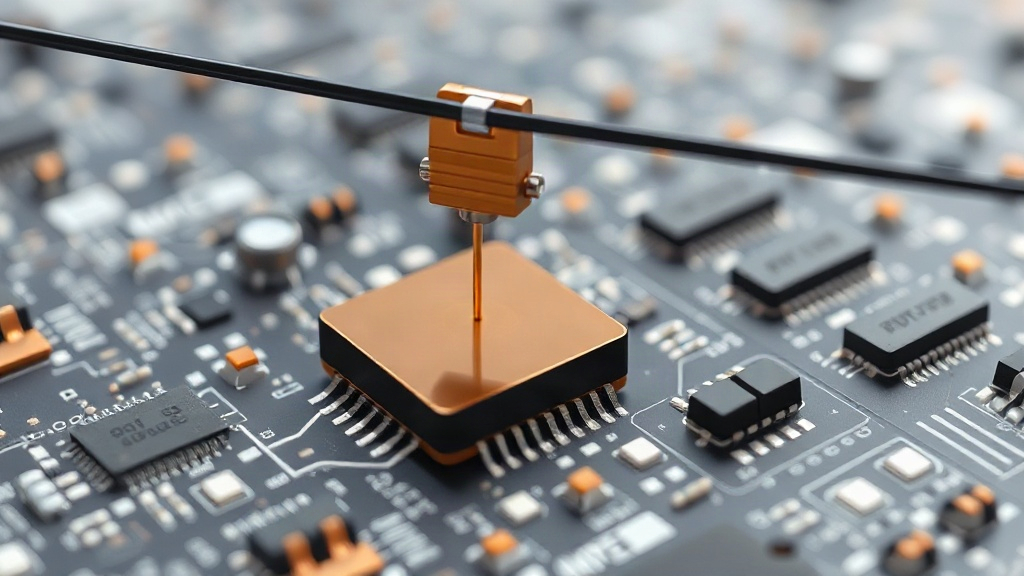
Giant Magneto-Resistance (GMR) sensors are emerging as a compelling non-contact alternative for monitoring overhead line currents in smart grids. These sensors leverage the GMR effect, a quantum mechanical phenomenon where the electrical resistance of a material changes significantly in the presence of a magnetic field. By positioning GMR sensors at a distance beneath overhead distribution lines, they can detect the magnetic field generated by the current flowing through the conductor without any physical contact.
The primary advantage of this non-contact approach is the elimination of installation hazards and costs associated with direct conductor access. This not only improves worker safety but also drastically reduces the time and resources required for deployment and maintenance. The inherent nature of GMR sensors also makes them less susceptible to external EMI compared to some other sensing technologies, potentially leading to more stable and accurate measurements.
Key Performance Insights and Accuracy
Initial performance assessments of GMR non-contact monitoring systems have yielded promising results. One study indicated a relative accuracy ranging from 64.64% to 91.49%. While this range highlights a degree of variability, it represents a significant step forward for non-contact sensing in this domain. The accuracy is directly influenced by factors such as the sensor's proximity to the conductor, the strength of the magnetic field generated by the current, and the environmental conditions, including potential interference from other nearby electrical equipment or external magnetic sources.
The development of GMR-based systems aims to provide grid operators with real-time, actionable data on current flow. This data is crucial for a multitude of grid management functions. It enables proactive identification of potential faults or anomalies, allowing for predictive maintenance rather than reactive repairs. By understanding current loads more precisely, utilities can optimize power distribution, reduce energy losses, and improve overall grid efficiency. Furthermore, accurate current monitoring is fundamental for load balancing, ensuring that power is distributed equitably and preventing overloads on specific sections of the grid, which can lead to outages.
Broader Implications for Smart Grid Development
The successful implementation of non-contact GMR sensors for phase current sensing has far-reaching implications for the evolution of smart grids. As grids become more complex with the integration of distributed energy resources like solar and wind power, and the increasing demand from electric vehicles, the need for granular, real-time monitoring solutions intensifies. GMR sensors offer a scalable and cost-effective way to deploy a dense network of monitoring points across the distribution infrastructure.
This technology has the potential to fundamentally change how utilities manage their assets. Instead of relying on periodic manual inspections or limited fixed monitoring stations, utilities can envision a future where their entire distribution network is continuously observed. This shift from a reactive to a proactive operational model can lead to substantial cost savings in terms of reduced downtime, fewer emergency repairs, and optimized asset utilization. Moreover, the enhanced safety profile, by minimizing human intervention in high-voltage environments, is a critical benefit that cannot be overstated. The ability to gather more precise data also supports advanced analytics and machine learning applications for grid optimization, forecasting, and anomaly detection, paving the way for a more resilient and efficient energy future.
The surprising detail here is not merely the potential for cost savings or improved safety, but the fundamental shift in operational paradigm this technology enables. It moves grid management from a strategy of managing knowns and reacting to unknowns, to one of continuous, data-driven awareness and proactive intervention. This level of insight was previously only achievable with significantly more expensive and intrusive methods.