
The Drive for Bespoke Inference
Large Language Models (LLMs) demand immense computational resources, particularly during inference – the process of generating outputs from a trained model. While cloud providers offer scalable solutions, they often come with limitations in terms of cost, latency, and customization. Recognizing these constraints, GLM, a prominent AI research entity, embarked on a significant undertaking: building its own dedicated inference infrastructure. This move signals a growing trend among advanced AI organizations to gain granular control over their operational stack, moving beyond reliance on generalized cloud services.
The decision to build in-house infrastructure is not a trivial one. It requires substantial investment in hardware, specialized engineering talent, and ongoing maintenance. However, for companies like GLM, the potential benefits—reduced operational costs, lower latency, and the ability to fine-tune hardware and software for specific model architectures—outweigh the challenges. This strategic decision allows GLM to optimize its LLM deployments for peak performance, a critical factor in delivering responsive and efficient AI services.
Architecting for Efficiency and Scale
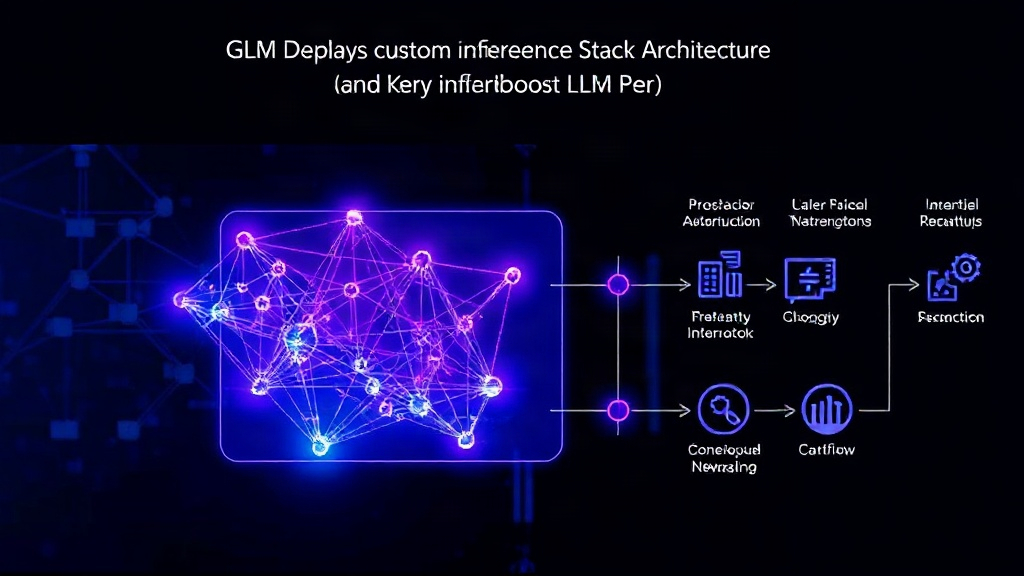
GLM's custom inference infrastructure is designed with a dual focus on efficiency and scalability. The core of their solution involves leveraging specialized hardware, likely including a mix of GPUs and potentially other accelerators, configured to maximize throughput for their particular model families. The software stack is equally crucial, with custom-built components designed to manage model loading, request batching, and efficient execution, all tailored to GLM's proprietary LLM architectures.
A key aspect of their approach is the ability to dynamically manage resources. Unlike off-the-shelf cloud solutions that might offer fixed instance types, GLM's infrastructure can be fine-tuned to match the specific computational demands of their models at any given time. This could involve sophisticated scheduling algorithms that optimize for batch sizes, memory usage, and computational parallelism. Such granular control is essential for handling the diverse and often unpredictable workloads generated by real-world LLM applications.
The development process itself likely involved significant iteration. Building an inference system from the ground up is akin to constructing a high-performance data center optimized for a very specific type of computation. This means not only selecting the right silicon but also developing the networking, storage, and orchestration layers to support it. The engineering team would have faced challenges in areas such as inter-GPU communication, efficient data transfer, and robust error handling, all while striving for maximum uptime and minimal latency.
Bypassing Cloud Bottlenecks
The decision to move away from public cloud inference services is a strategic one driven by several factors. Public cloud offerings, while convenient, can become prohibitively expensive at the scale required for advanced LLM deployments. Furthermore, providers may not always offer the specific hardware configurations or the level of system-level optimization that a dedicated AI research company needs. Latency is another critical concern; long network hops and shared infrastructure can introduce delays that degrade user experience and limit the real-time applicability of LLMs.
By building their own infrastructure, GLM gains direct oversight of the entire inference pipeline. This allows for immediate troubleshooting, rapid deployment of updates, and the ability to experiment with novel hardware and software integrations without vendor lock-in. It’s a commitment to owning the performance characteristics of their models, much like a high-frequency trading firm might build its own data centers to minimize transaction latency.
Implications for the AI Ecosystem
GLM's initiative highlights a broader shift in the AI landscape. As LLMs become more powerful and their applications proliferate, the economics and performance of inference are becoming paramount. Companies that can efficiently serve these models at scale will gain a significant competitive advantage. This could lead to a bifurcation in the market: some companies will continue to rely on cloud providers, seeking ease of use and rapid scalability, while others, particularly those with significant LLM investments and specialized needs, will increasingly explore custom infrastructure solutions.
The engineering expertise required to build and maintain such systems is considerable. This suggests that only well-funded and technically mature organizations will be able to follow GLM's path. However, the potential for cost savings and performance gains is a powerful incentive. We may see a rise in specialized hardware vendors and software frameworks that cater to these in-house inference needs, further democratizing access to high-performance AI deployment capabilities, albeit for those willing to invest the resources.
The surprising detail here is not that GLM built its own infrastructure, but the explicit acknowledgement that they are doing so to achieve performance and cost efficiencies that cloud providers, despite their scale, cannot match for their specific use cases. This suggests that for cutting-edge AI, the era of one-size-fits-all cloud inference may be giving way to bespoke, highly optimized solutions.