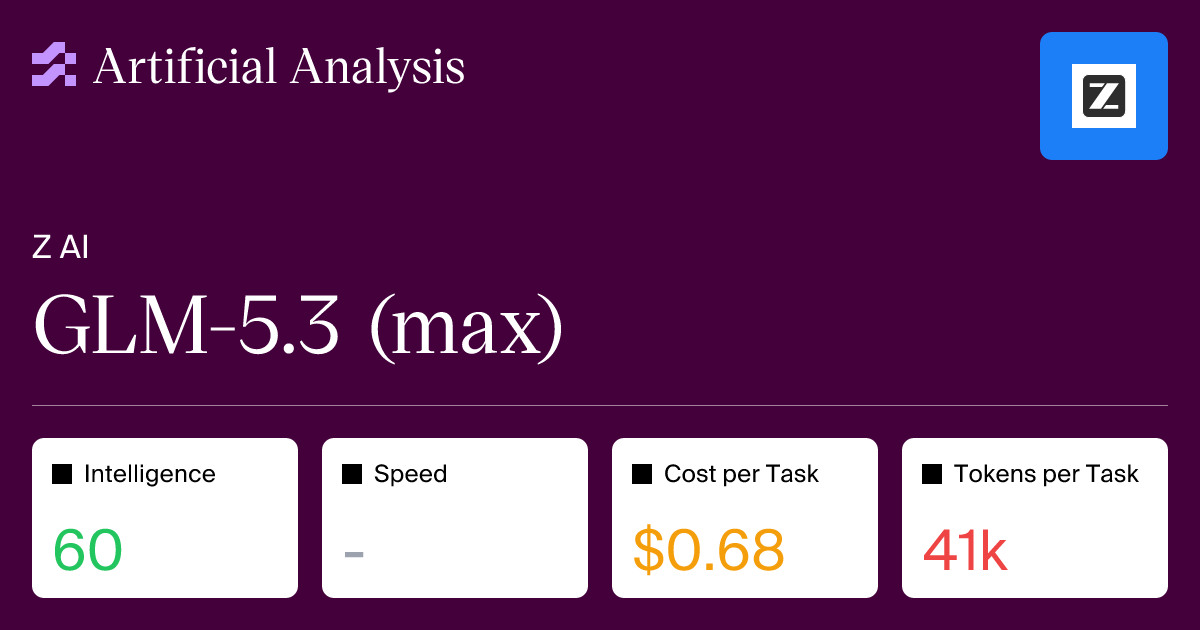
GLM-5.3 Performance Overview
The GLM-5.3 model has emerged as a leading performer in the latest Artificial Analysis benchmarks, showcasing a robust improvement over its predecessors and many contemporary models. The benchmarks, designed to test AI capabilities across a wide array of analytical tasks, reveal GLM-5.3's strong performance in areas such as natural language understanding, code generation, and complex reasoning. This latest iteration appears to have bridged several gaps that previously distinguished top-tier models from the rest.
Artificial Analysis, the entity behind these benchmarks, subjects models to a rigorous set of tests that simulate real-world applications and complex cognitive challenges. The evaluations cover multiple dimensions, including accuracy, efficiency, and robustness. GLM-5.3's success suggests a significant leap in the underlying architecture and training methodologies employed by its developers. The model's ability to excel across such a diverse set of tasks is particularly noteworthy, indicating a versatile and powerful AI system.
Key Benchmark Areas and GLM-5.3's Success
GLM-5.3 has demonstrated particular strength in several key areas. In natural language understanding (NLU), the model achieved near-human level performance on tasks such as sentiment analysis, question answering, and text summarization. Its ability to grasp nuanced meanings and context in lengthy documents is a significant upgrade.
The model also made substantial gains in code generation and analysis. Benchmarks included generating code from natural language prompts, identifying bugs, and optimizing existing code. GLM-5.3's performance here suggests a deep understanding of programming logic and syntax across multiple languages. This is critical for developers who increasingly rely on AI assistants for coding tasks.
Complex reasoning, often a bottleneck for AI models, also saw significant improvement. Tasks involving logical deduction, mathematical problem-solving, and multi-step inference were handled with a higher degree of accuracy than previously observed. This indicates that GLM-5.3 can tackle more intricate problems that require connecting disparate pieces of information and applying logical rules.

Architectural and Training Advancements
While specific details of GLM-5.3's architecture and training regimen are proprietary, its performance suggests a departure from conventional approaches. The gains are likely attributable to a combination of factors, potentially including a larger and more diverse training dataset, novel attention mechanisms, or advanced reinforcement learning techniques that fine-tune the model's reasoning capabilities. The ability to generalize across such varied tasks points to a more holistic and integrated AI design.
The developers have likely focused on improving the model's ability to learn and adapt, rather than simply memorizing patterns. This is crucial for building AI systems that can handle novel situations and unexpected inputs. The consistency of GLM-5.3's high scores across different benchmark categories suggests a robust and well-generalized learning process.
Implications for the AI Landscape
The success of GLM-5.3 in these comprehensive benchmarks has significant implications for the broader AI industry. It sets a new high-water mark for what can be expected from general-purpose AI models. This will likely spur further innovation as other research labs and companies strive to match or surpass these performance levels.
For developers, this means access to increasingly capable tools for a wide range of applications, from advanced chatbots and content generation to sophisticated data analysis and software development assistance. The improved reasoning and understanding capabilities can lead to more intuitive and powerful AI-powered products and services.
The competitive landscape will undoubtedly shift. Companies that have invested heavily in their own large language models will need to evaluate their progress against GLM-5.3's demonstrated capabilities. This could accelerate the pace of development, leading to faster iteration cycles and the introduction of more advanced AI features into the market.
Future Directions and Unanswered Questions
While GLM-5.3's performance is impressive, several questions remain. The long-term cost-effectiveness and scalability of deploying such a powerful model need further investigation. Additionally, the ethical implications of deploying AI with such advanced reasoning and understanding capabilities at scale are paramount. How will these models be governed, and what safeguards will be in place to prevent misuse?
Furthermore, the benchmark results, while comprehensive, represent a curated set of tasks. Real-world deployment often involves unpredictable scenarios and edge cases that are difficult to replicate in controlled testing environments. Understanding GLM-5.3's performance in these less structured, more dynamic situations will be the next critical step.
The focus on general intelligence through broad benchmarks is a clear trend. GLM-5.3's success validates this approach, but it also highlights the ongoing challenge of defining and measuring true artificial general intelligence. The journey towards AGI is complex, and each advancement like GLM-5.3 provides valuable data points and pushes the boundaries of our current understanding.