The Rise of Agentic DevOps
The conversation around AI agents in software development is rapidly evolving. For DevOps engineers, this raises key questions: where can agents effectively integrate into delivery pipelines, what decisions can they support, and where is human oversight still critical? While DevOps already heavily relies on automation for testing, problem detection, and environment transitions, the decision to proceed with a release often requires nuanced context beyond passing tests. This makes the release review process a prime candidate for AI agent augmentation.
The goal is not to replace human judgment entirely, but to empower it. An AI agent can act as an intelligent assistant, sifting through vast amounts of data—test results, monitoring logs, security scan reports, and even past incident data—to synthesize relevant information. It can then highlight potential risks, explain the evidence supporting those concerns, and formulate precise, context-aware questions for the human approver. This transforms the agent from a mere tool into a collaborative partner, akin to a human colleague, capable of providing valuable insights for critical go/no-go decisions.
Building a Proof of Concept
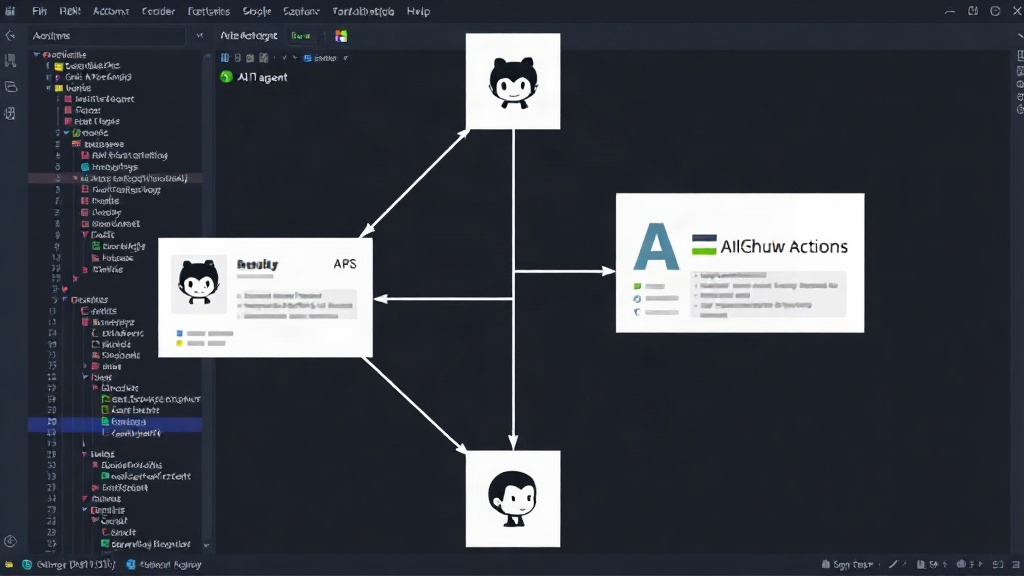
To explore this potential, a proof of concept was developed using GitHub Actions and Microsoft Foundry. GitHub Actions provides the robust framework for defining and executing CI/CD workflows. Its event-driven nature and extensive marketplace of integrations make it an ideal foundation for orchestrating complex automated processes. By leveraging GitHub Actions, developers can define custom workflows that trigger on code commits, pull requests, or scheduled events, enabling granular control over the delivery pipeline.
Microsoft Foundry, a platform designed for building and deploying AI agents, serves as the intelligence layer. Foundry offers tools and services that simplify the development of agents capable of understanding complex instructions, accessing external tools and data, and performing reasoning. Integrating Foundry with GitHub Actions allows the AI agent to tap into the pipeline's execution context, access logs and artifacts, and even trigger subsequent actions based on its analysis. This synergy enables the creation of agentic workflows that go beyond simple scripting, incorporating AI-driven decision support and analysis directly into the DevOps lifecycle.
Agentic Release Review: A Deeper Dive
The core of this agentic approach lies in enhancing the release review process. Traditionally, a human reviewer might spend significant time aggregating and interpreting data from various sources: unit test coverage, integration test results, static analysis reports, security vulnerability scans, performance metrics, and operational logs. This process is time-consuming and prone to human error or oversight, especially with complex systems and frequent releases.
An agentic system, powered by Foundry and orchestrated by GitHub Actions, can automate much of this data aggregation and preliminary analysis. Imagine an agent that:
- Monitors incoming pull requests and associated CI results.
- Correlates test failures with recent code changes, identifying potential root causes.
- Scans code for adherence to security best practices and flags deviations.
- Analyzes performance benchmarks against established baselines, alerting on regressions.
- Reviews deployment logs from previous similar releases, identifying any recurring issues.
Based on this synthesized information, the agent can then present a concise summary to the release approver. This summary would not just state facts but would explain the implications. For example, instead of just saying "Test suite X failed," it might say, "Test suite X failed on the staging environment. Analysis of recent commits indicates a high probability that changes in module Y introduced this regression, impacting feature Z. Recommend rollback or targeted hotfix." This level of detail and explanatory power is what elevates an automated script to an intelligent agent.
Contextual Decision Support
The true value of agentic DevOps emerges in its ability to provide contextual decision support. The agent doesn't just execute pre-defined rules; it reasons. It can learn from past approvals and rejections, understanding the risk tolerance of the team and the business context. If a critical security vulnerability is detected, the agent can immediately escalate, regardless of other test results. Conversely, for minor changes with a long history of uneventful deployments, the agent might recommend a streamlined approval process.
This is where the human remains firmly in control. The agent's role is to augment, not replace, human judgment. It acts as a highly efficient analyst, presenting a distilled view of risks and evidence, thereby allowing the human approver to focus on higher-level strategic decisions and the ultimate accountability for releases. The agent prepares the ground, asking the right questions, so the human can make more informed and confident decisions faster.
Future Implications
The integration of AI agents into DevOps pipelines, as demonstrated by this proof of concept, signals a significant shift. It moves beyond traditional automation towards intelligent augmentation. For organizations adopting this approach, the benefits could include faster release cycles, reduced deployment-related incidents, improved code quality, and enhanced security posture. Developers and operations teams can spend less time on manual data correlation and more time on innovation and strategic problem-solving.
As AI agents become more sophisticated, their capabilities within DevOps will undoubtedly expand. We might see agents proactively identifying potential bottlenecks in the pipeline, automatically optimizing resource allocation, or even suggesting architectural improvements based on observed performance patterns. The challenge will be in defining the boundaries of autonomy and ensuring robust oversight mechanisms are in place. This initial exploration with GitHub Actions and Microsoft Foundry provides a compelling glimpse into a more intelligent, agent-driven future for software delivery.