The Ambiguity of 'PASS' on Empty Sets
A common pattern in development workflows involves pre-commit hooks that run various checks on code before allowing a commit. These tools often output status indicators, with 'PASS' signifying a clean bill of health. However, a recent observation has revealed a critical ambiguity: a tool designed to check a set of files can report 'PASS' even when presented with an empty set, making it indistinguishable from a genuinely clean repository. This issue surfaced with a tool integrated into a journal's development tree, where it prints a verdict into commit messages and pull request bodies.
The tool in question, when run over a `git archive` export of a repository, produced the following output:
set: 0 tracked markdown carriers
...
LINKGATE: PASS
This output, while technically correct according to the tool's logic, presents a problem. A `git archive` export, by definition, does not contain the `.git` directory. Consequently, commands like `git ls-files '*.md'` will traverse up to an enclosing repository to find its index. In this specific scenario, the index held no markdown files under the current directory. The command exited with status 0 and produced no output lines, which the instrument interpreted as a 'PASS'.
The surprising detail here is not the unexpected output itself, but the implication: the 'PASS' for an empty set is identical to the 'PASS' for a repository that has been thoroughly checked and found to have no issues. There is no discernible difference in the output string, the exit code, or any other readily available metric to distinguish between a tree that was never scanned for specific file types and one that was scanned and found to be clean.
The Technical Underpinnings of the Issue
The root cause lies in how the tool interacts with Git and file system states. When a tool operates on a set of files, its expected behavior is to analyze those files and report their status. If no files are provided for analysis – as is the case with an empty set – the tool's logic may default to a neutral or positive outcome. In this instance, the tool interpreted the absence of files as a non-failing condition, equating it to a successful check.
Consider a scenario where a developer uses a custom script to identify specific types of vulnerabilities or code patterns within markdown files. If the repository contains no markdown files, the script would naturally find nothing to report as problematic. If the script is designed to output 'PASS' when no issues are found, it will produce the same 'PASS' output whether there were zero files to check or a million files with no issues. This is analogous to a security guard reporting 'all clear' because there were no people in the building to check, versus reporting 'all clear' after checking every single person and finding no threats.
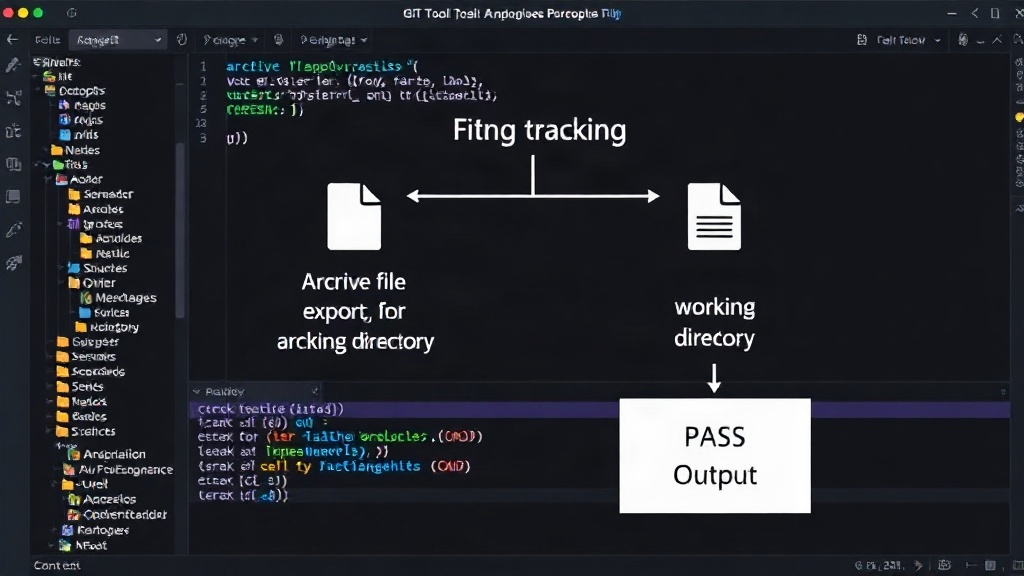
The problem is exacerbated by the fact that `git ls-files '*.md'` itself returns zero lines of output and an exit code of 0 when no matching files are found in the index. The instrument, designed to consume this output, receives nothing and defaults to its 'PASS' state. This means the tool is not actively verifying the *absence* of issues in a scanned set, but rather the *lack of error signals* from the underlying Git commands when no files are present. This can lead to a false sense of security, as developers might assume their code has been vetted when, in reality, a specific check was never truly performed on any files.
Implications for Development Workflows
This subtle but significant ambiguity has several implications for development workflows, particularly those relying on automated checks and commit hooks:
- False Sense of Security: Developers might commit code believing that all checks have passed, when in fact, a critical check was bypassed due to an empty file set. This could lead to vulnerabilities or errors slipping into production that would have been caught if the check had been properly executed.
- Inconsistent Auditing: The commit history and pull request bodies are intended to serve as a reliable record of code quality. When 'PASS' outputs are indistinguishable across different scenarios, this audit trail becomes less trustworthy. It becomes difficult to ascertain whether a 'PASS' signifies a thorough check or a skipped execution.
- Tooling Reliability Concerns: This issue highlights the importance of robust error handling and status reporting in development tools. Tools that interact with version control systems need to be acutely aware of edge cases like empty sets and provide distinct outputs to avoid misinterpretation.
What nobody has addressed yet is the systemic risk introduced when automated checks can silently fail to run by producing the same positive output as a successful execution. This isn't just a bug in a single tool; it's a potential flaw in the trust model of many CI/CD pipelines and pre-commit systems that rely on these status indicators.
Addressing the Issue
To mitigate this problem, developers and tool maintainers should consider the following:
- Distinct Outputs for Edge Cases: Tools should be modified to provide a unique status indicator for situations where no files were checked due to an empty set. This could be a different status string (e.g., 'SKIPPED', 'NO_FILES_TO_CHECK') or a more detailed message in the output.
- Explicit File Count Verification: Before reporting 'PASS', the tool should explicitly verify that it processed a non-zero number of files. If the file count is zero, it should report accordingly, rather than defaulting to 'PASS'.
- Enhanced Logging: More detailed logging within the tool's execution could help diagnose such issues. This would allow developers to trace the tool's activity and understand why a particular output was generated.
- Configuration Review: Teams should regularly review their pre-commit hook configurations and the tools they employ, paying close attention to how edge cases like empty directories or exported archives are handled.
The observation that 'A PASS over an empty set is the same string as a real pass' is a stark reminder that automated systems, while powerful, require careful design and constant vigilance. Without explicit differentiation, the absence of an error can be mistaken for the presence of correctness, undermining the very purpose of automated checks.