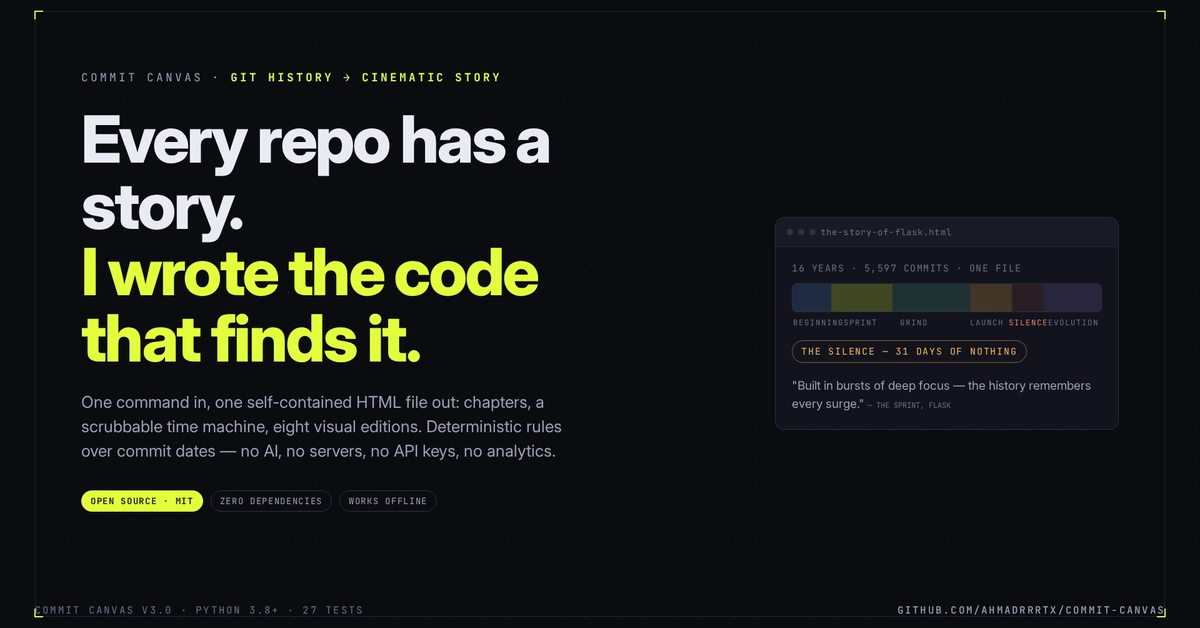
The Unspoken Narrative in Your Git History
Every software project leaves a trail of commits, a digital breadcrumb path charting its evolution. We celebrate the first commit, the triumphant launch, and the intense sprints where teams pushed boundaries. But a new algorithm, dubbed Commit Canvas, developed by Ahmad R., focuses on a different, often overlooked, aspect of project history: the silences. These are the periods of inactivity, the "gap chapters," that are typically treated as mere absences in a changelog but can reveal crucial insights into a project’s lifecycle, momentum, and underlying narrative.
Commit Canvas analyzes the chronological flow of commits, not just their content or frequency, but the rhythm and cadence of development. The algorithm identifies distinct phases within a repository's history, treating development not as a continuous line but as a series of chapters, complete with beats and pauses. This approach reframes the commit graph from a technical artifact to a narrative structure.
The problem this tool addresses is the common tendency to ignore or gloss over periods of stagnation. When a project hits a lull, it's easy to dismiss it as "nothing happened." But these lulls can signify anything from team burnout, shifting priorities, external dependencies, or simply a period of deep, internal refactoring that doesn't yield immediate, visible commits. Commit Canvas aims to bring these periods into focus, allowing developers and project managers to understand the full story, not just the highlights.
For instance, when Commit Canvas was applied to the Flask repository, it identified six distinct chapters. Five were expected, reflecting typical development cycles. The sixth, however, was a stark revelation: a 31-day period of silence between November 28, 2024, and January 1, 2025. This "silent chapter" highlights a significant pause in active development that might otherwise be buried within the commit logs.
Decoding Development Rhythms
The core innovation of Commit Canvas lies in its ability to quantify and contextualize these inactive periods. Instead of viewing a gap as a void, the algorithm interprets it as a narrative beat—a pause before a new development phase, a moment of reflection, or a potential bottleneck. This narrative framing allows for a richer understanding of project dynamics.
Consider the journey of a complex software project. There are intense periods of coding, debugging, and feature implementation. These are often followed by plateaus where progress seems to halt. Traditional Git tools present this as a simple timeline of commits, or a complex graph of branches and merges. They don't inherently tell you *why* a particular period was quiet, or what the significance of that quiet might be. Commit Canvas attempts to bridge this gap by providing a narrative layer over the raw data.
The algorithm's methodology likely involves analyzing commit timestamps, commit message patterns (or lack thereof), and the relationships between commits to identify distinct phases of activity. By segmenting the history, it can highlight periods of high velocity, periods of slow but steady progress, and periods of complete dormancy. This allows teams to look back and ask critical questions: Was the silent period a sign of burnout? Did it precede a major refactor? Was it due to external blockers? Understanding these patterns can inform future project planning and team management.
Beyond the Commit Graph
The implications of framing Git history as a story extend beyond mere curiosity. For project managers, it offers a new lens through which to assess team productivity and project health. Identifying prolonged silences can be an early warning sign for potential issues, such as scope creep, resource contention, or morale problems. Proactively addressing these silent chapters can prevent minor lulls from becoming major roadblocks.
For developers, it provides a more nuanced way to reflect on their work. The commit graph is often seen as a record of tasks completed. Commit Canvas suggests it's also a record of the project's journey—including its moments of rest and reassessment. This can foster a more holistic view of the development process, acknowledging that not all progress is measured in lines of code pushed.
The tool’s ability to dissect history into narrative arcs also has potential applications in code archaeology and forensic analysis. Understanding the ebb and flow of development activity could help in diagnosing the root cause of bugs introduced during quieter periods or understanding the context behind architectural decisions made during intense development bursts.
The Unanswered Question: What Do We Do With These Stories?
While Commit Canvas offers a compelling new way to visualize and interpret Git history, the critical question remains: what actionable insights can we derive from these identified "silent chapters" and "development sprints"? How do we translate this narrative understanding into concrete improvements in workflow, team management, and project execution? The algorithm reveals the story, but the interpretation and application of that story to optimize future development cycles are still largely up to the teams using it.
The challenge now is to build frameworks and best practices around this new perspective. Developers and project leads must learn to ask the right questions when confronted with these identified narrative beats. Was the silence a planned phase for documentation or testing, or an unintended consequence of resource constraints? Was the sprint truly productive, or did it lead to burnout that precipitated the subsequent silence? These are the questions that will unlock the true value of treating Git history as a story.
Commit Canvas is more than just a visualization tool; it’s a conceptual shift. It encourages a move from a purely transactional view of commits to a more holistic, narrative understanding of software development. By highlighting the pauses as much as the progress, it offers a more complete, and perhaps more human, picture of how software is built.