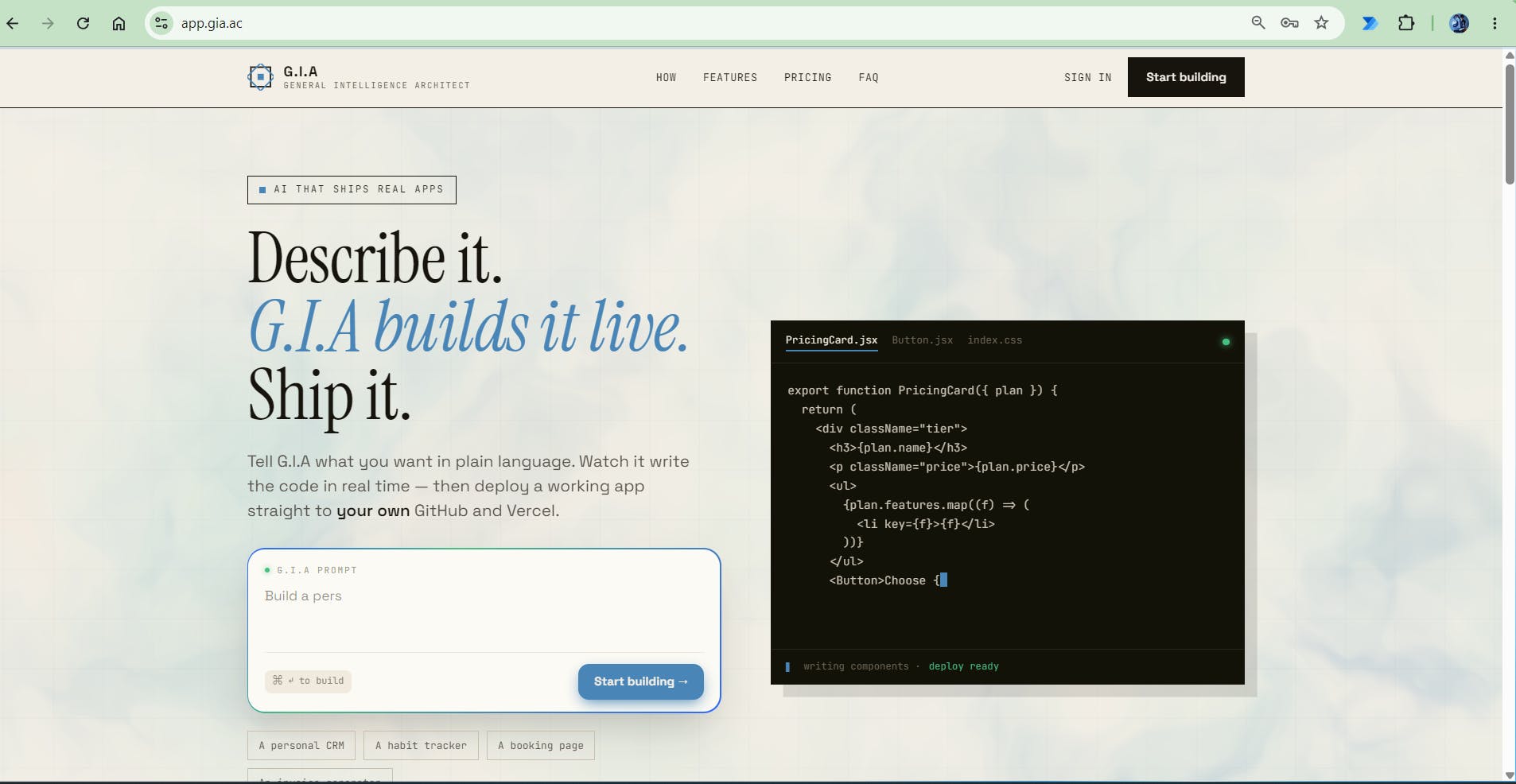
The Promise: From Natural Language to Working Code
G.I.A.ac enters the burgeoning field of AI-powered code generation with an ambitious claim: to build real, working applications from a single sentence. This is not about generating snippets or suggesting lines of code. The product, recently featured on Product Hunt, positions itself as a complete application development platform driven by natural language input.
The core proposition is straightforward: a user describes the app they want in plain English, and G.I.A.ac translates that description into a functional piece of software. This approach, if successful, could dramatically lower the barrier to entry for software creation, enabling individuals with ideas but without coding expertise to bring their concepts to life.
Imagine a small business owner needing a custom inventory management system. Instead of hiring developers or grappling with complex spreadsheets, they could theoretically describe their needs to G.I.A.ac: “Create a web app to track product stock, record sales, and generate low-stock alerts for items below 10 units.” The tool would then be expected to produce the application, complete with a user interface and backend logic to fulfill these requirements.
The implications of such a tool are vast. For solo entrepreneurs and startups, it could accelerate the prototyping phase, allowing for rapid iteration of ideas before committing significant development resources. For larger organizations, it might empower non-technical departments to build internal tools or automate workflows without relying on IT backlogs.
Under the Hood: How G.I.A.ac Might Work
While the exact architecture of G.I.A.ac is not publicly detailed, its functionality suggests a sophisticated interplay of several advanced AI technologies. At its heart would likely be a powerful Large Language Model (LLM) trained on an enormous dataset of code and natural language instructions. This LLM would need to understand the user’s intent, deconstruct it into discrete functional requirements, and then translate those requirements into specific programming language constructs.
This process would involve several key stages:
- Intent Recognition: The AI must accurately interpret the user's sentence, identifying the core purpose of the application and its key features. This involves understanding verbs, nouns, and modifiers that define functionality, data structures, and user interactions.
- Feature Decomposition: A complex request needs to be broken down into smaller, manageable components. For instance, “track product stock” implies data models for products, a mechanism for updating quantities, and potentially a user interface for manual input or automated updates.
- Code Generation: The AI must then generate code in a chosen programming language (or potentially multiple languages for frontend and backend). This code needs to be syntactically correct, logically sound, and adhere to best practices for maintainability and efficiency.
- Application Assembly: Beyond just code, the tool must integrate various components – database setup, API endpoints, user interface elements, and deployment configurations – into a cohesive, runnable application.
- Testing and Refinement: Ideally, the system would include some form of automated testing to verify functionality and allow for user feedback to refine the generated application.
The challenge lies not just in generating code, but in generating *correct*, *secure*, and *usable* code that forms a complete application. This requires the AI to possess a deep understanding of software architecture, database design, UI/UX principles, and even deployment considerations.
The Competitive Landscape and Future Outlook
G.I.A.ac is not the first to explore AI-driven application development. Platforms like GitHub Copilot, Amazon CodeWhisperer, and various low-code/no-code solutions have been paving the way. However, G.I.A.ac’s unique selling proposition is its focus on generating entire applications from a single, high-level instruction, rather than assisting developers with code completion or generating individual functions.
The success of G.I.A.ac will hinge on several factors. Firstly, the accuracy and reliability of its code generation. Can it consistently produce functional applications that meet user expectations without significant manual debugging? Secondly, the scope of applications it can handle. Is it limited to simple CRUD (Create, Read, Update, Delete) applications, or can it tackle more complex logic and integrations?
The broader impact could be profound. If tools like G.I.A.ac mature, they could democratize technology creation to an unprecedented degree. Individuals could become creators of digital tools, not just consumers. This would undoubtedly reshape the software development industry, shifting the focus from manual coding to prompt engineering, AI supervision, and complex system design.
What remains unanswered is the level of abstraction G.I.A.ac operates at. Is it generating code that a developer can easily inspect, modify, and deploy, or is it producing a black-box application? The former offers immense value for extending developer capabilities; the latter raises concerns about transparency, security, and long-term maintainability. The true test will be whether G.I.A.ac can deliver on its promise of building “real, working apps” that are not just functional, but also robust and adaptable.