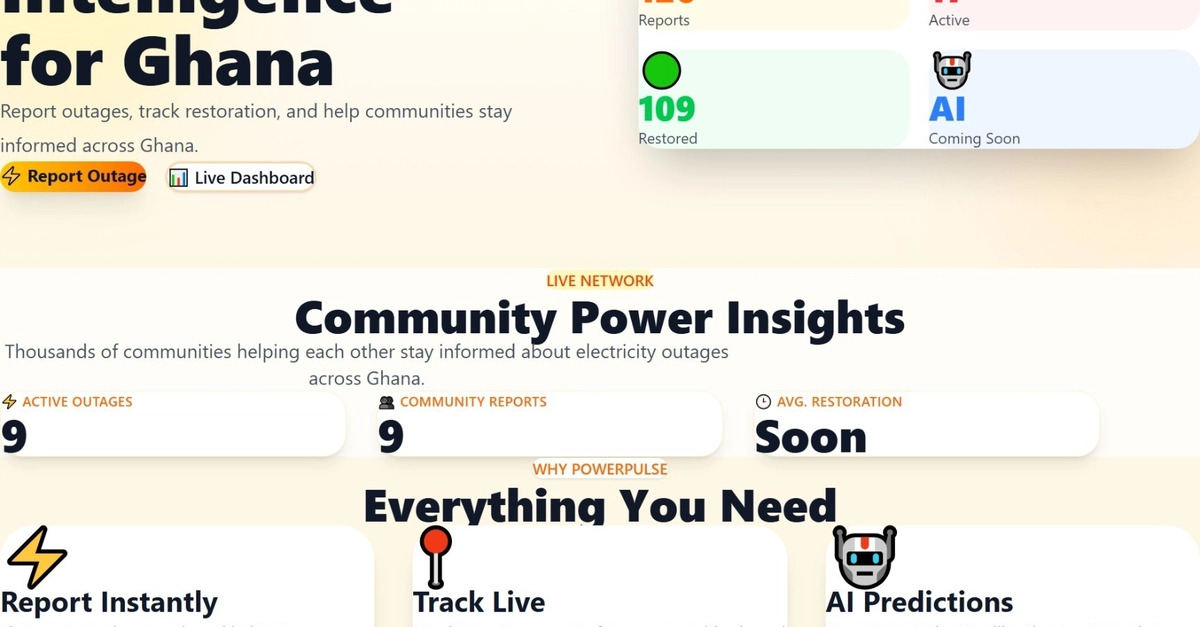
The Problem: Unpredictable Power in Ghana
For residents of Ghana, the ubiquitous group chat serves as an informal outage notification system. When the lights go out, messages fly: "Is it just us, or is the whole area affected?" This question stems from a persistent lack of clear information regarding power disruptions. Whether it's a localized transformer failure, scheduled load-shedding, or a larger grid issue, pinpointing the cause and expected restoration time is largely guesswork. This information vacuum is precisely what Suzanne Nhyira set out to address with PowerPulse.
PowerPulse: A Crowd-Sourced Solution
PowerPulse aims to be Ghana's go-to application for reporting and tracking electricity outages. The core concept is simple yet powerful: users report outages as they experience them. The application then aggregates this data, plotting reported incidents on a live map that spans all 16 regions of Ghana. Over time, the aggregated data is intended to reveal patterns, identify areas with higher outage frequency, and provide users with an estimated timeframe for power restoration.
The project began as a modest, self-contained HTML prototype, a testament to the iterative development process. The ambition, however, was to build a robust platform capable of handling real-time user-generated data and presenting it in an easily digestible format.

AI as a Co-Pilot, Not a Crutch
A notable aspect of PowerPulse's development is the significant role AI played in its creation. Nhyira openly discloses that both the initial draft of her post and substantial portions of the PowerPulse codebase were assisted by AI tools. This approach is not about replacing human ingenuity but augmenting it. For developers, particularly those working on personal projects or with limited resources, AI can accelerate the initial phases of coding, generate boilerplate, and even suggest architectural patterns. However, as Nhyira discovered, relying too heavily on AI without deep understanding can lead to unforeseen complications.
The Stack's Rebellion: When AI-Assisted Code Fights Back
Despite the AI's assistance in building the codebase, the project encountered significant hurdles, metaphorically described as "losing a fight with my own stack." This suggests that the underlying technologies and their integration, perhaps influenced by AI-generated code or architectural decisions, became a source of friction. Common issues in such scenarios include:
- Integration Complexity: AI might generate individual components effectively, but ensuring they work seamlessly together, especially under load, requires meticulous integration and testing.
- Scalability Issues: Code generated without a deep understanding of the application's future scaling needs can perform adequately in early stages but falter as user numbers and data volume increase.
- Debugging Challenges: When an AI-generated piece of code behaves unexpectedly, debugging can be more time-consuming than with human-written code, as the developer may not have an intuitive grasp of its logic or potential edge cases.
- Dependency Management: AI might introduce dependencies or specific library versions that, over time, become difficult to manage or conflict with other parts of the stack.
The struggle implies that while AI can be a powerful tool for rapid prototyping and development, the critical human element of architectural oversight, rigorous testing, and deep system understanding remains indispensable. Nhyira's experience underscores that even with AI's help, building a reliable application demands careful attention to the fundamentals of software engineering.
Broader Implications for Infrastructure and Development
PowerPulse's journey is more than just a story about a single app. It highlights the critical need for better infrastructure monitoring and citizen-centric data platforms in regions like Ghana, where reliable power is not a given. The success of such a crowd-sourced model relies on user adoption, data integrity, and a resilient technological backbone.
The challenges encountered also serve as a valuable lesson for developers leveraging AI. It's a reminder that AI is a tool to enhance, not replace, the core skills of problem-solving, system design, and debugging. The ultimate responsibility for a stable and functional application rests with the human developers who guide and validate the AI's output. For PowerPulse to succeed, Nhyira and her team must overcome the internal technical hurdles, ensuring the platform is as reliable as the information it aims to provide.