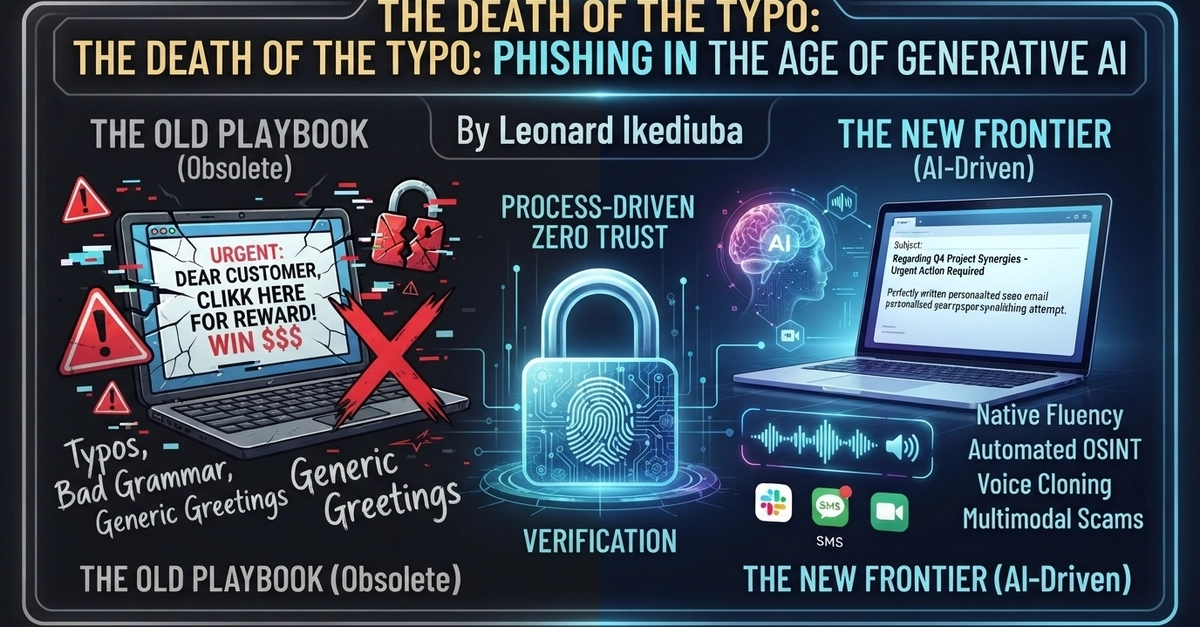
The End of the Obvious Red Flag
For years, spotting a phishing email felt like a game of imperfect detection. Cybersecurity awareness training hammered home the basics: watch for poor grammar, awkward phrasing, generic greetings like "Dear Customer," and sender addresses that looked like random character strings. These were the low-hanging fruit, the digital equivalent of a poorly disguised robber wearing a ski mask. We built a collective intuition around these digital hygiene failures.
That playbook is now officially obsolete. Generative artificial intelligence and large language models (LLMs) have fundamentally rewritten the rules of social engineering. The era of the typo-ridden phishing attempt is over. Bad grammar has been replaced by flawless prose. Hyper-personalization, once a manual and time-consuming effort for attackers, is now automated at scale. Threat actors are no longer just typing; they are cloning voices, automating open-source intelligence (OSINT) gathering, and orchestrating multi-channel attacks that appear breathtakingly real.
The primary bottleneck for high-volume phishing attacks in the pre-AI era was the sheer human effort required to craft convincing lures. Each email needed careful writing and often manual targeting to achieve even a modest success rate. LLMs have obliterated this bottleneck, democratizing the creation of sophisticated, personalized attacks. This means an individual with malicious intent can now generate hundreds or thousands of highly convincing, tailored phishing messages in minutes, not days.
The impact is profound. What was once a clear differentiator between legitimate communication and a scam – the quality of the language – is now gone. Attackers can leverage models like GPT-4, Claude, or Llama to produce text that is indistinguishable from human-written content. This extends beyond simple email to SMS phishing (smishing) and even social media direct messages. The ease with which these models can adapt tone, style, and content to mimic trusted entities or individuals makes them incredibly potent weapons.
Automated OSINT and Hyper-Personalization
Beyond text generation, LLMs are turbocharging OSINT. Attackers can now use AI to rapidly scan and analyze vast amounts of public data from social media, company websites, and other online sources. This allows them to build detailed profiles of potential targets, identifying key relationships, recent activities, interests, and even emotional states. This granular information is then fed back into LLMs to craft messages that resonate deeply with the individual, exploiting personal context and psychological triggers.
Imagine an attacker learning about a recent promotion, a new project a colleague is working on, or even a family vacation from a target's LinkedIn or Facebook profile. An LLM can then weave this information into a phishing email that appears to be from a trusted source, perhaps referencing the promotion in a congratulatory tone before pivoting to a request for sensitive information, or mentioning the new project to create a sense of urgency or shared context.
This level of personalization is no longer the domain of highly skilled, state-sponsored actors. It's becoming accessible to a much wider range of threat actors, lowering the barrier to entry for highly effective social engineering campaigns. The ability to automate the identification and exploitation of personal details means that even individuals with limited technical skills can launch sophisticated attacks.
Multi-Channel Orchestration and Voice Cloning
The attack surface has also expanded. Phishing is no longer confined to email. LLMs are enabling multi-channel attacks that combine email, SMS, social media, and even voice calls. A phishing campaign might start with a seemingly legitimate email, followed by a convincing text message referencing the email, and then a phone call from a cloned voice of a colleague or manager. This creates a layered approach that overwhelms the target's defenses and makes it exponentially harder to identify the scam.
Voice cloning technology, powered by AI, can replicate a person's voice from a small audio sample. This allows attackers to impersonate executives, IT support, or trusted contacts with uncanny accuracy. A phone call from what sounds exactly like your CEO asking for an urgent wire transfer, or a familiar-sounding colleague requesting credentials to access a shared document, can be incredibly persuasive, especially when combined with other elements of a phishing campaign.
The surprising detail here is not just the sophistication of the AI, but how quickly these tools are becoming commoditized. What was once cutting-edge research is now available through accessible APIs and easy-to-use platforms, putting powerful attack vectors into the hands of anyone willing to pay. This rapid proliferation means that defenses need to evolve at an equally accelerated pace.
The New Defense: Beyond Typo Detection
Given this shift, cybersecurity awareness training must evolve dramatically. Relying on spotting grammatical errors or suspicious sender names is no longer sufficient. The focus must shift to critical thinking and behavioral analysis. Users need to be trained to question the context, verify requests through independent channels (even if the communication appears to come from a trusted source), and understand that sophisticated impersonation is now the norm, not the exception.
This means teaching users to ask: Does this request make sense? Is this the usual way I communicate with this person or organization? Is there an alternative, secure channel I can use to verify this information? For instance, if an email from HR asks for updated personal details, the user should be trained to go directly to the HR portal or call the known HR phone number, rather than clicking links or replying to the email.
Technical defenses also need to adapt. Email filters must move beyond simple signature-based detection and leverage AI to analyze content, sender reputation, and behavioral patterns. Advanced threat detection systems capable of identifying anomalies in communication flows and user behavior will become critical. The challenge is that the same AI that powers these defenses can also be used by attackers to create more evasive threats. It’s a continuous arms race, but one where the stakes have never been higher.
What nobody has addressed yet is the long-term psychological impact on users constantly being on high alert for AI-generated deception. Can humans maintain this level of vigilance indefinitely without succumbing to fatigue or becoming overly distrustful, hindering legitimate collaboration?