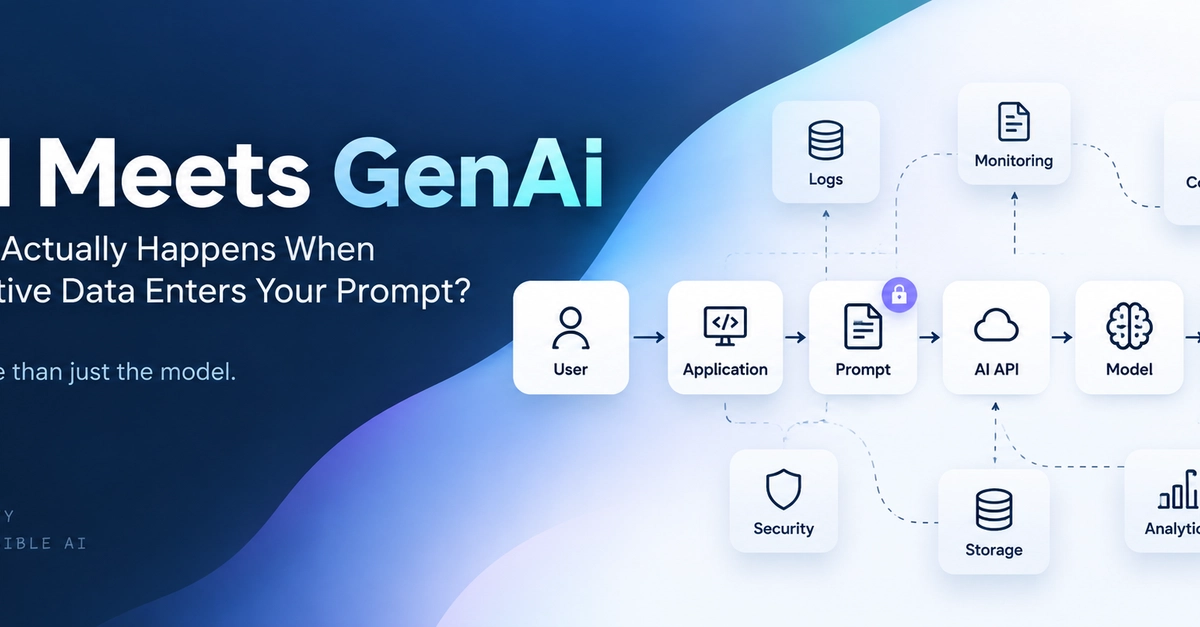
The Oversimplification of PII in GenAI Prompts
The prevailing advice for handling Personally Identifiable Information (PII) with Generative AI is simple: "Don’t put sensitive data into an AI prompt." While this directive is well-intentioned, it vastly oversimplifies the complex reality of how AI models process and retain data. As GenAI becomes integrated into everyday applications for tasks like document summarization, customer support, and internal knowledge management, sensitive information is increasingly finding its way into these interactions. The critical question isn't just *if* sensitive data enters a prompt, but *what actually happens to it* once it does.
Consider a typical customer support scenario. An application might use a Large Language Model (LLM) to summarize customer complaints. A request could look like this:
Summarize this customer complaint:

Customer: Sarah Williams
Email: sarah.williams@example.com
Account: 839274
Complaint: I was charged twice for my subscription this month. My account number is 839274 and my email is sarah.williams@example.com. Please investigate and refund the duplicate charge.
This prompt contains multiple pieces of PII: name, email address, and account number. The LLM's task is to distill the core issue: a duplicate subscription charge. However, the model's internal processing is far more nuanced than simply outputting a summary. It first tokenizes the input, breaking down the text into smaller units. These tokens are then processed through the neural network. During this process, the model doesn't just 'understand' the complaint; it implicitly learns patterns, relationships, and potentially, the specific data points themselves.
How GenAI Models Process and Potentially Retain PII
When sensitive data enters an LLM prompt, several things can happen, depending on the model's architecture, training, and deployment context:
1. In-Context Learning and Context Windows
Modern LLMs operate with a concept called a "context window." This is the amount of text the model can consider at any one time. When you submit a prompt, the PII within it becomes part of this immediate context. The model uses this context to generate its response. For stateless models, the PII is theoretically discarded after the response is generated. However, the model has still 'seen' and processed this data to produce the output. This processing phase itself can leave subtle traces or influence subsequent internal states, even if the explicit data isn't stored long-term.
2. Model Fine-Tuning and Retraining
A significant risk arises when the data submitted through prompts is used to further train or fine-tune the model. Many organizations, especially those developing proprietary AI solutions or seeking to improve off-the-shelf models, collect prompt-response pairs. If PII is present in these prompts and the data collection is not meticulously anonymized, that PII can be incorporated into the model's weights during retraining. This means the model could later generate responses that inadvertently reveal or are influenced by previously submitted sensitive information, even to unrelated users.
3. Logging and Auditing
For debugging, security, and operational purposes, AI service providers and application developers often log the prompts and responses. These logs can serve as an audit trail. However, if PII is present in the prompts, it will also be present in these logs. The security of these logs becomes paramount. If not properly secured, encrypted, and access-controlled, these logs represent a direct and accessible repository of sensitive user data. This is akin to storing customer support transcripts in a plain text file on an unencrypted server.
4. Data Leakage Through Adversarial Prompts
Sophisticated users or attackers might employ adversarial prompting techniques to try and extract information the model has been trained on or has processed. While models are increasingly trained to resist such attacks, they are not infallible. PII included in prompts, especially if it's part of repeated interactions or training data, could potentially be coaxed out through cleverly crafted follow-up prompts. This is less about the model 'remembering' in a human sense and more about its statistical patterns being exploited.
5. Vector Databases and Embeddings
Many GenAI applications employ Retrieval-Augmented Generation (RAG), which often involves storing data in vector databases. When a prompt is submitted, the system might retrieve relevant information from this database to inform the LLM. If PII was part of the initial data ingested into the vector database (e.g., customer records, internal documents), and not properly scrubbed, then queries that trigger retrieval of these specific data chunks could expose PII. The embeddings themselves, while not directly readable PII, represent the data's semantic meaning and could potentially be reverse-engineered or used to infer sensitive details under specific conditions.
Mitigation Strategies: Beyond the Simple Ban
Given these complexities, a more robust strategy is needed. Relying solely on the "don't put it in" rule is insufficient when PII can inadvertently enter the system or when applications are designed to process such data.
- Data Anonymization and Pseudonymization: Implement robust pre-processing pipelines that automatically detect and replace PII with generic placeholders or pseudonyms before the data even reaches the prompt. This is akin to redacting sensitive information from a document before sharing it.
- Contextual Data Masking: Develop systems that understand the *purpose* of the prompt. If the LLM only needs to know *that* a customer has an issue, not their specific account number, mask or remove the account number from the prompt.
- Secure Logging and Data Retention Policies: If logging is essential, ensure logs are encrypted, access-controlled, and subject to strict retention policies. Regularly audit logs for PII and purge them according to policy.
- Model Sandboxing and Isolation: For sensitive applications, consider using models that are isolated from any external network or training data, or deploy models specifically fine-tuned on anonymized data.
- Client-Side Processing: Where feasible, perform PII detection and masking on the client-side before data is sent to the LLM API.
- User Education and Consent: Clearly inform users when their data might be processed by AI and obtain explicit consent. Provide clear opt-out mechanisms.
The Unanswered Question: What is the True Cost of a Leak?
What remains largely unaddressed is the precise quantification of risk for different types of PII and different LLM deployment scenarios. We know a PII leak is bad, but what is the differential impact of an email address being exposed versus a Social Security Number? How does the risk profile change when using a general-purpose API versus a fine-tuned, on-premise model? Establishing clear benchmarks and risk assessment frameworks tailored to GenAI interactions is the next crucial step for organizations serious about responsible AI deployment.