Quantized Gemma 4 Outperforms Full Precision on SageMaker
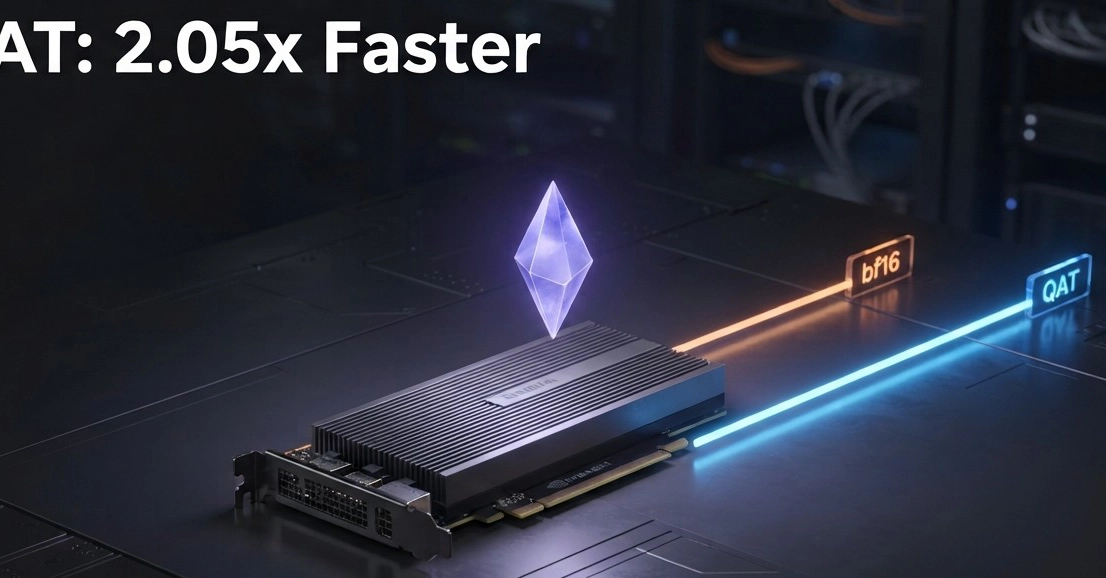
Deploying large language models (LLMs) efficiently on cloud infrastructure is a critical challenge for developers and businesses. Amazon SageMaker offers a managed service for real-time inference endpoints, simplifying deployment and scaling. A recent benchmark on the SageMaker platform pitted the full-precision (bf16) version of Google's Gemma 4 E2B-it model against its quantization-aware trained (QAT) counterpart, specifically a 4-bit weight quantized version. The results, conducted on a single NVIDIA L4 GPU within an ml.g6.xlarge instance in the us-east-2 region using the AWS vLLM SageMaker container (vLLM 0.30.0), show a substantial performance uplift for the quantized model.
The QAT Gemma 4 model achieved a decoding speed of 105.1 tokens per second (tok/s). In contrast, the full-size bf16 model managed only 51.3 tok/s on the same hardware. This translates to a 2.05x speed improvement for the quantized weights, demonstrating the efficacy of QAT in reducing model size and accelerating inference without a proportional loss in performance for this specific workload.
Technical Setup and Methodology
The project, available on GitHub under the xbill9/sagemaker-gemma repository, focuses on serving Gemma 4 E2B from a SageMaker real-time endpoint. The core infrastructure utilizes one NVIDIA L4 GPU with 24 GB of VRAM, a configuration commonly found in SageMaker's g6 instance family.
AWS provides a vLLM container specifically for SageMaker, which streamlines the deployment of LLMs. vLLM is an open-source library designed for high-throughput LLM inference and serving. By leveraging the AWS-published vLLM container, the deployment benefits from optimized CUDA kernels, efficient memory management (PagedAttention), and continuous batching, all managed within SageMaker's robust inference service.
The deployment process is designed to be accessible, with all AWS interactions performed via plain aws CLI commands. This approach allows for easy scripting, reproducibility, and manual verification of each step. SageMaker real-time endpoints abstract away much of the operational overhead: the service handles provisioning the GPU instance, health-checking the deployed container, routing incoming inference requests, and consolidating logs to AWS CloudWatch. Users are freed from managing instance patching, opening security groups, or building custom load balancers.
Understanding Quantization-Aware Training (QAT)
Quantization is a technique used to reduce the precision of numerical representations within a neural network, typically from 32-bit floating-point numbers (like bf16 or fp32) down to lower bit-widths such as 8-bit integers or even 4-bit weights. This reduction in precision can lead to several benefits:
- Reduced Model Size: Lower precision means fewer bits per parameter, directly decreasing the memory footprint of the model. This is crucial for deploying large models on memory-constrained hardware.
- Faster Inference: Operations on lower-precision numbers are often computationally less intensive and can be executed faster on specialized hardware.
- Lower Power Consumption: Reduced computation often translates to less energy usage.
However, simply quantizing a pre-trained model (post-training quantization or PTQ) can sometimes lead to a significant drop in accuracy. Quantization-Aware Training (QAT) addresses this by simulating the effects of quantization during the model's training process. By introducing quantization nodes into the model graph during training, the model learns to adapt to the reduced precision, often mitigating the accuracy degradation associated with PTQ. In this case, the Gemma 4 E2B-it-qat-w4a16-ct model has undergone QAT, specifically targeting 4-bit weights and 16-bit activations, to preserve performance while gaining efficiency.
Implications for LLM Deployment
The benchmark results highlight a critical trend in LLM deployment: the increasing viability and performance of quantized models. For organizations operating on cloud platforms like AWS SageMaker, this offers a direct path to cost optimization and performance enhancement.
Using the QAT Gemma 4 model can lead to:
- Reduced Instance Costs: Faster inference means higher throughput per instance. This could allow businesses to serve more users with fewer or smaller GPU instances, directly cutting cloud spend. Alternatively, it allows for serving more complex queries or a higher volume of requests on existing hardware.
- Lower Latency: The 2.05x speedup directly translates to lower latency for end-users, improving the user experience for applications built on Gemma 4.
- Broader Accessibility: Smaller, faster models are easier to deploy on a wider range of hardware, potentially opening up new use cases or enabling edge deployments where previously only smaller, less capable models were feasible.
The success of QAT on Gemma 4 within the SageMaker environment suggests that similar optimization strategies will become increasingly important for other LLMs. Developers building applications that require real-time LLM inference should closely evaluate the performance characteristics of quantized models. The trade-off between precision and performance is becoming more favorable for quantized alternatives, making them a compelling choice for production deployments.
The project's use of plain AWS CLI commands and a managed SageMaker endpoint also points to a broader shift towards Infrastructure as Code (IaC) and managed cloud services for AI/ML deployments. This simplifies operations, enhances security, and accelerates the time-to-market for AI-powered applications.