Performance Gains with Quantized Gemma 4 on SageMaker
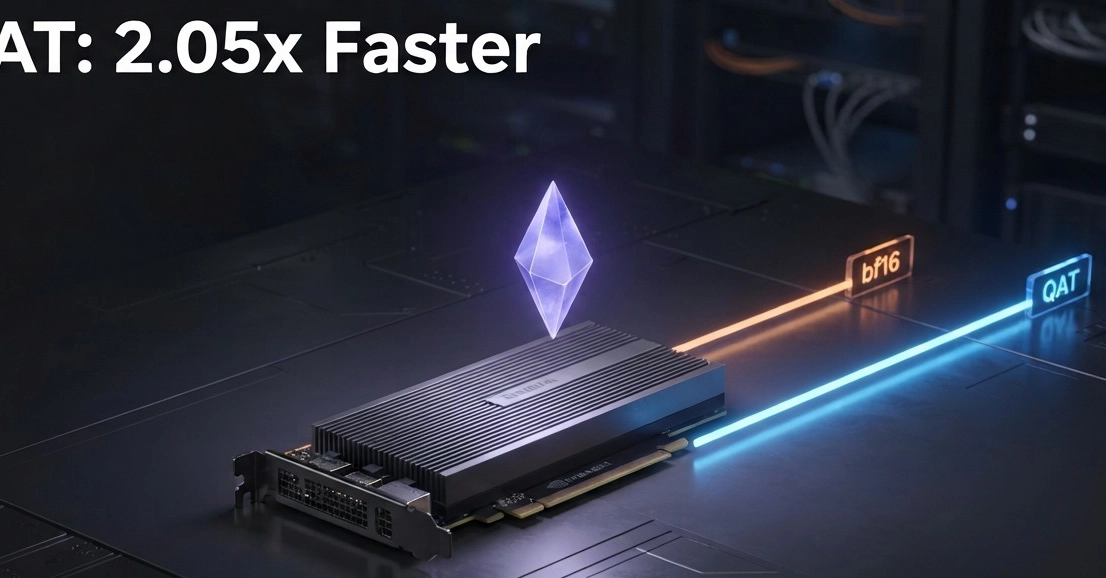
Deploying large language models (LLMs) efficiently on cloud infrastructure is a critical challenge for developers and businesses. Amazon SageMaker, a fully managed machine learning service, offers real-time endpoints for streamlined inference. A recent evaluation on SageMaker's NVIDIA L4 instance demonstrates a substantial performance improvement when using quantization-aware trained (QAT) weights for Google's Gemma 4 E2B model compared to its full-precision bf16 counterpart. The QAT version achieved a decoding speed of 105.1 tokens per second, outperforming the bf16 model by a factor of 2.05x.
The test specifically compared two Gemma 4 E2B variants: google/gemma-4-E2B-it (bf16) and google/gemma-4-E2B-it-qat-w4a16-ct (QAT, 4-bit weights). Both models were deployed on the same SageMaker ml.g6.xlarge instance, which features a single NVIDIA L4 GPU with 24 GB of VRAM, running in the us-east-2 region. The inference was handled by the AWS vLLM SageMaker container, specifically version 0.30.0. This setup highlights the tangible benefits of model quantization for inference speed without requiring custom hardware or complex infrastructure management.
Understanding Quantization-Aware Training (QAT)
Quantization is a technique used to reduce the memory footprint and computational cost of deep learning models by representing weights and activations with lower precision data types, such as 4-bit integers instead of 16-bit floating-point numbers. Traditional post-training quantization (PTQ) applies quantization after the model has been fully trained, which can sometimes lead to a noticeable drop in accuracy. Quantization-Aware Training (QAT), however, simulates the effects of quantization during the training process itself. This allows the model to adapt to the reduced precision, often preserving accuracy while significantly improving inference efficiency.
In the case of Gemma 4 E2B, the QAT checkpoint (google/gemma-4-E2B-it-qat-w4a16-ct) was trained with the awareness that its weights would be stored and processed using 4-bit precision (w4a16 indicates 4-bit weights and 16-bit activations, though the inference here likely leverages 4-bit activations as well for maximum benefit). This proactive approach to quantization is key to achieving the observed performance gains. The result is a model that requires less memory and performs computations faster, making it more suitable for real-time inference scenarios where low latency is paramount.
SageMaker Real-Time Endpoints and vLLM Integration
Amazon SageMaker real-time endpoints provide a managed service for hosting machine learning models, abstracting away much of the operational overhead. SageMaker handles tasks such as provisioning GPU instances, scaling inference capacity, routing traffic, and logging. This allows developers to focus on model performance and application logic rather than infrastructure management.
The deployment in this evaluation leverages the vLLM library, an open-source high-throughput and low-latency LLM inference engine. vLLM is known for its efficient attention mechanism (PagedAttention) that optimizes memory usage and throughput. AWS provides a dedicated vLLM container for SageMaker, simplifying the integration of vLLM's performance benefits into the SageMaker ecosystem. This combination of SageMaker's managed infrastructure and vLLM's optimized inference engine creates a powerful platform for deploying LLMs like Gemma 4.
The project also introduces a suite of Python MCP (Machine Control Plane) tools to simplify the management of these vLLM-hosted deployments. These tools, available on GitHub, allow for easier deployment configuration, monitoring, and scaling. The article emphasizes that all AWS calls are plain aws CLI commands, making the process transparent and scriptable, whether run by hand or via an automated MCP server. This approach democratizes the deployment of advanced LLMs, making them accessible to a wider range of users, including those who prefer manual control or automated workflows.
Implications for LLM Deployment
The findings from this experiment have significant implications for how LLMs are deployed in production environments. For developers building applications that rely on real-time LLM inference, such as chatbots, code generation tools, or content creation assistants, the ability to achieve higher throughput and lower latency is crucial. The 2.05x speedup observed with QAT Gemma 4 on an NVIDIA L4 instance means that more requests can be processed with the same hardware, or that an application can achieve lower latency with fewer resources.
This performance boost is particularly relevant for cost-sensitive applications or those requiring very fast responses. By opting for QAT models, organizations can potentially reduce their cloud inference costs or improve the user experience by delivering faster results. The availability of such optimized models and deployment strategies on managed platforms like SageMaker lowers the barrier to entry for adopting cutting-edge LLM technology. The success of QAT techniques on models like Gemma 4 suggests a broader trend towards more efficient LLM architectures and deployment methods, pushing the boundaries of what is possible with AI-powered applications.
What remains to be seen is how this performance advantage translates across different LLM sizes and architectures, and whether similar gains can be achieved with even lower precision quantization (e.g., 3-bit or 2-bit) without significant accuracy degradation. The ongoing research in quantization techniques and their integration into managed cloud services will continue to shape the future of AI deployment.