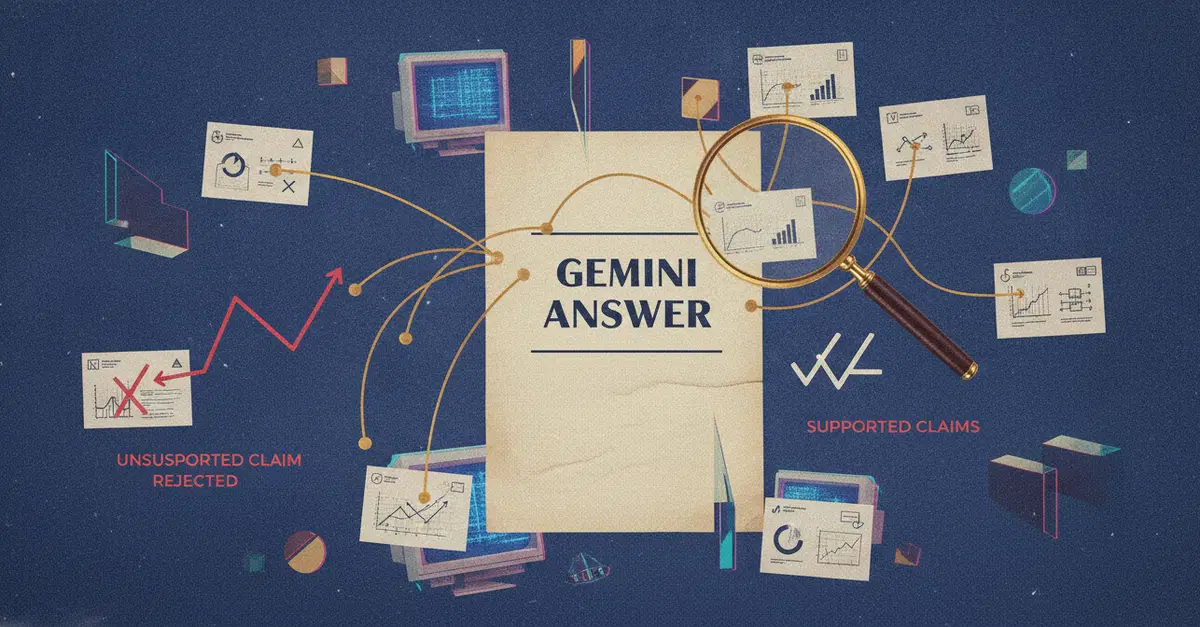
The Promise of Cited AI Answers
When an AI model like Google's Gemini begins to provide citations alongside its answers, it feels like a significant step towards trustworthiness. The responses appear to be researched, with source links presented next to the text. This suggests the model is no longer solely relying on its vast training data but is actively consulting external, verifiable information. This capability promises a more reliable and transparent interaction, allowing users to cross-reference information and understand the basis of the AI's conclusions.
The ability to cite sources can transform AI from a sophisticated text generator into a research assistant. Users can follow the links to explore the original content, verify facts, and gain deeper context. For professionals in fields requiring accuracy and verifiable information, such as legal, medical, or academic research, this feature is crucial. It moves AI closer to being a tool that can be depended upon for factual accuracy, rather than just a fluent conversationalist.
Where Citations Fall Short
However, the presence of citations does not automatically equate to accuracy or trustworthiness. A cited answer can still be fundamentally wrong. The mechanism of citation itself can be misleading.
A citation might be placed next to a sentence, but it may not genuinely support the specific claim the user is interested in. The AI could retrieve a passage that only tangentially relates to the user's query, or it might misinterpret the content of the source document. Furthermore, even if the source document is authoritative, the retrieved passage could be outdated. Information changes, and a model citing a stale source might provide irrelevant or incorrect data. File Search, a common component of these systems, can also be a point of failure. It might query the wrong data store, access an incorrect version of a document, or fail to find the most relevant information entirely.
The most insidious failure mode is when the model retrieves good, relevant evidence but then extrapolates beyond it. It might connect dots that aren't there, draw conclusions that are not supported by the cited material, or introduce biases not present in the original sources. This creates an answer that looks authoritative due to the citations but is factually unsound.
Understanding Grounding vs. Trust
The capability of an AI model to cite sources is often referred to as 'grounding.' Grounding means the AI's responses are tethered to specific external information, rather than being purely generative based on its training data. This is a critical technical capability. However, grounding is not the same as trust. Trust is a user-centric attribute that encompasses accuracy, reliability, safety, and ethical considerations.
A system can be well-grounded but still fail to be trustworthy. For instance, if the grounding mechanism consistently retrieves irrelevant information, or if the model's reasoning process based on that information is flawed, the user's trust will erode. Conversely, a system with limited grounding might still be perceived as trustworthy if its responses are consistently accurate and helpful within its defined operational scope.
The distinction is important for developers building AI applications. They must understand that simply integrating a citation feature does not absolve them of the responsibility to ensure the overall quality and accuracy of the AI's output. The application contract—the terms of service, disclaimers, and user experience design—plays a vital role in managing user expectations and defining the scope of reliability.
Application-Level Contracts for Trust
For AI applications to be genuinely trustworthy, grounding must be complemented by robust application-level design. This means clearly defining what the AI can and cannot do, setting appropriate safety guardrails, and providing users with mechanisms to report errors or provide feedback.
Consider the user experience. If an AI presents a citation, what is the expected behavior? Does clicking the citation take the user to the exact snippet, or just the document? Is the retrieved snippet highlighted? These details matter. If the user is expected to manually sift through a lengthy document to find the supporting evidence, the perceived value of the citation diminishes significantly.
Furthermore, developers must implement checks and balances. This could involve using multiple sources for critical information, evaluating the recency and authority of sources, and employing secondary AI models to review the primary model's output for factual consistency and adherence to the cited evidence. The AI's confidence score, if available, should also be factored into how the information is presented to the user.
The Path Forward: Grounding Plus Vigilance
The journey towards truly reliable AI agents is ongoing. Gemini's inclusion of citations is a positive development, pushing the field toward greater transparency. However, it is essential to remember that technology alone does not create trust. It is the thoughtful implementation, rigorous testing, and clear communication from developers that build user confidence.
If you are building with AI, especially with APIs like Google's Interactions API (currently in beta and subject to change), pin your SDK versions and retest frequently. The landscape is evolving rapidly. A citation is a signpost, not a destination. It points towards evidence, but the user—or the application developer—must still do the work of verifying that the destination is sound.
The critical question remains: how much effort should users be expected to expend to verify AI-generated information, even when citations are provided? The answer likely depends on the application's domain and the stakes involved. For now, assume that every cited answer requires a degree of user vigilance.