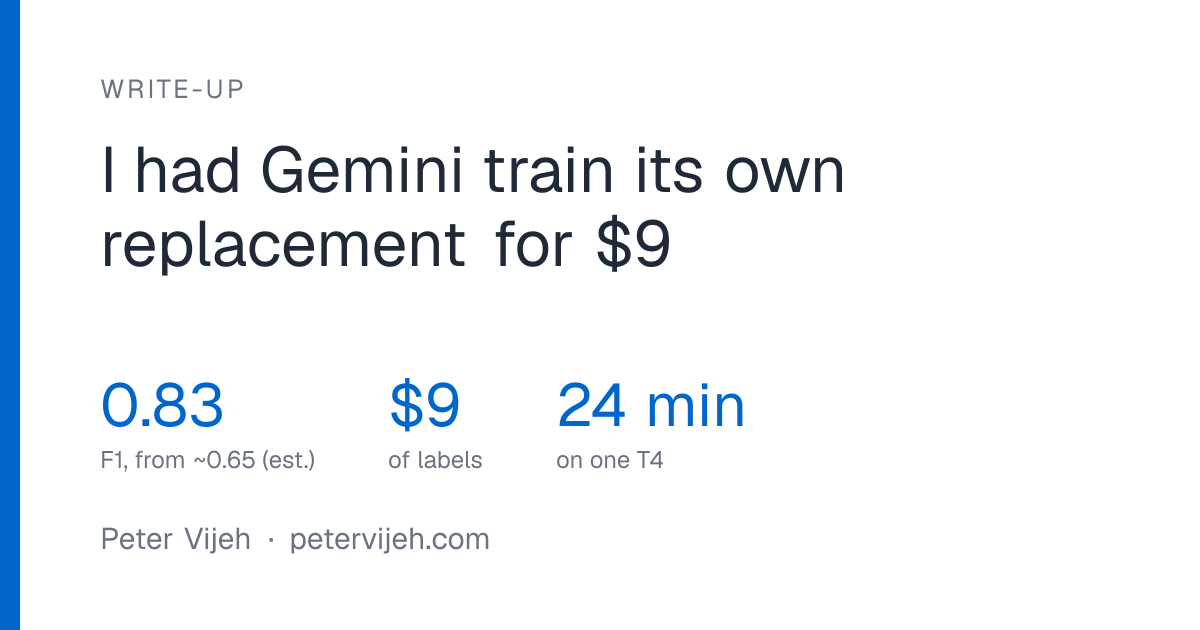
The Experiment: Training a Replacement for Less Than a Coffee
In a striking demonstration of AI efficiency and cost-effectiveness, developer Peter Vijeh successfully trained a smaller language model to replicate the core functionalities of Google's Gemini AI, all for an astonishingly low price of under $9. The project, detailed on his personal blog and gaining traction on Hacker News, showcases how large language models (LLMs) can be leveraged not only for complex tasks but also for bootstrapping more economical and specialized AI solutions.
Vijeh's goal was ambitious yet simple: to create an AI that could perform the same tasks as Gemini, specifically for the purpose of summarizing Reddit threads, but at a dramatically reduced operational cost. The original project, which he dubbed 'Reddit NER' (Named Entity Recognition), aimed to extract key information from Reddit discussions. However, utilizing Gemini for this task, while effective, came with an associated API cost that Vijeh sought to minimize.
The core of the experiment involved using Gemini's advanced capabilities to generate a high-quality dataset. This dataset then served as the training material for a smaller, open-source model. This approach is akin to a seasoned chef meticulously preparing a complex sauce, which is then used to elevate a simpler, more accessible dish. The chef's expertise (Gemini's power) is distilled into the sauce (the dataset), making the final product (the smaller model) significantly more refined than it would be without that initial high-level input.
The process began with identifying the specific tasks the new model needed to perform. For the Reddit summarization use case, this meant understanding context, identifying key entities, and generating concise, informative summaries. Vijeh fed Gemini numerous Reddit threads, prompting it to extract the necessary information and format it according to his specifications. This step was crucial, as the quality of the training data directly dictates the performance of the resulting model.
The surprising detail here is not just the low cost, but the efficiency with which Gemini, a large and powerful model, could be used to create a 'teacher' for a 'student' model. This meta-learning capability, where an AI assists in creating or improving other AIs, is a significant trend in the field. It suggests a future where AI development becomes increasingly democratized, with powerful foundational models enabling the creation of tailored, cost-effective solutions for specific niches.

The Technicals: Dataset Generation and Model Training
The key to Vijeh's success lay in the meticulous creation of the training dataset. He leveraged Gemini's API to process a substantial volume of Reddit data. Each Reddit thread was fed into Gemini with specific instructions to identify and extract named entities (people, organizations, locations, etc.) and to generate a concise summary of the discussion. This generated data, essentially a curated set of question-answer pairs or input-output examples, formed the backbone of the training set for the smaller model.
For the student model, Vijeh opted for an open-source solution, likely a smaller transformer-based architecture that is known for its efficiency and adaptability. The choice of model is critical; larger models are more capable but also more resource-intensive to train and run. By selecting a smaller model, Vijeh aimed to achieve a balance between performance and cost. The training process involved feeding the Gemini-generated dataset into this smaller model, allowing it to learn the patterns and relationships present in the data.
The cost of $9 is remarkably low, especially when considering the typical expenses associated with training AI models, which can run into thousands or even millions of dollars for state-of-the-art LLMs. This low cost was primarily achieved by several factors. Firstly, the use of an open-source model significantly reduced licensing fees. Secondly, the training itself was relatively brief, as the model was not being trained from scratch but rather fine-tuned on a specific task using high-quality, pre-generated data. The primary cost incurred was likely for the API calls to Gemini to generate this dataset, and potentially some cloud computing resources for the fine-tuning process itself.
This approach highlights a paradigm shift in AI development. Instead of solely relying on massive, proprietary models for every task, developers can now use these powerful models as intelligent tools to create more specialized, cost-efficient AIs. It's like using a high-end industrial 3D printer to create the molds for a smaller, more affordable injection molding machine that can then produce thousands of identical parts cheaply.
Implications for the AI Landscape
Vijeh's experiment carries significant implications for the broader AI ecosystem. For developers, it offers a tangible path toward building custom AI solutions without incurring prohibitive costs. This democratizes AI development, enabling smaller teams and individual creators to compete with larger organizations by leveraging existing powerful models as development accelerators.
For businesses, this means that specialized AI functionalities, previously only accessible through expensive enterprise-grade APIs, could soon be replicated and deployed at a fraction of the cost. This could lead to a proliferation of highly tailored AI applications across various industries, from customer service chatbots that understand niche product lines to data analysis tools optimized for specific scientific research domains.
The trend also raises questions about the future of large, general-purpose AI models. While they will undoubtedly remain at the forefront of research and development, their role might evolve. They could become the 'AI universities,' producing highly skilled graduates (datasets and specialized models) that then go on to perform specific, cost-effective tasks in the real world. This layered approach to AI development could lead to a more efficient and sustainable AI infrastructure.
What remains to be seen is how the performance of these smaller, trained models will hold up against the original large models over time, especially as the original models continue to be updated and improved. Will the gap in capabilities widen, or will the fine-tuning process become so sophisticated that the smaller models remain competitive for their intended use cases?