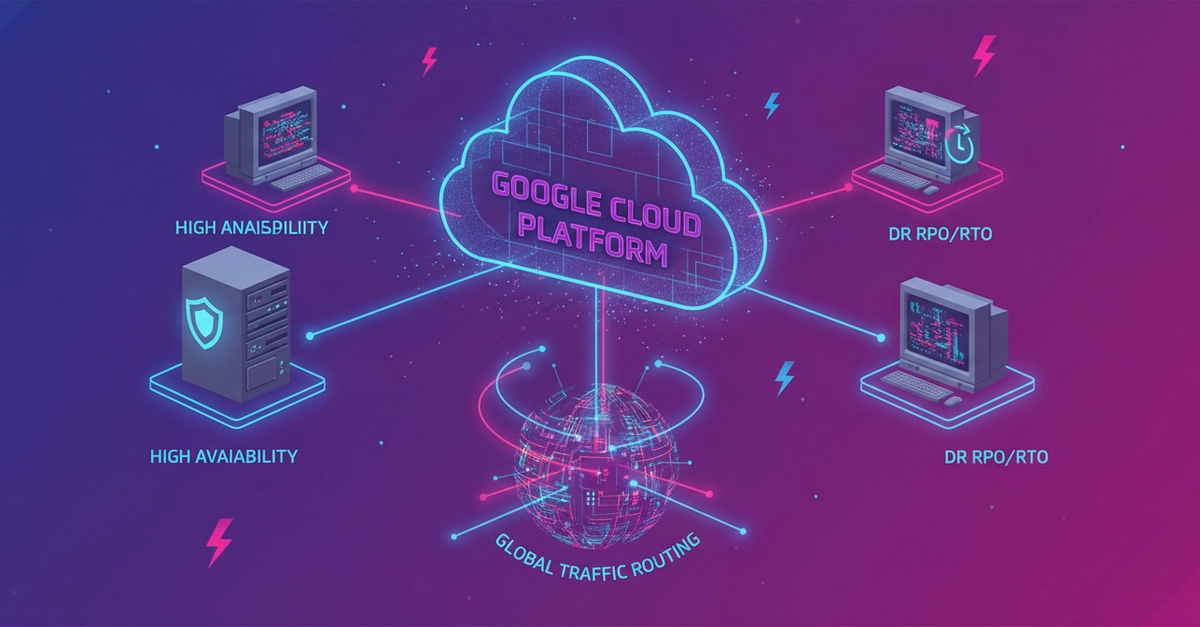
Designing for Zero Regional Single Points of Failure
Building enterprise applications on Google Cloud Platform (GCP) demands a shift from theoretical product capabilities to practical operational realities. High availability, stringent Recovery Point Objectives (RPOs) and Recovery Time Objectives (RTOs), and efficient global traffic routing are not afterthoughts; they are foundational requirements. This guide delves into core GCP architectural principles by examining the construction of a globally scalable, fault-tolerant e-commerce platform.
Consider the scenario of architecting a web application designed to serve millions of users across North America and Europe. The objectives are clear and non-negotiable:
- Eliminate Regional Single Points of Failure: The system must remain operational and gracefully handle a complete regional outage without data loss or significant downtime.
- Low Latency Routing: User traffic must be intelligently directed to the nearest available and healthy deployment, minimizing response times.
- Database Consistency: Crucial financial transactions and user data must maintain strict consistency across distributed deployments, even during failover events.
- Global Scalability: The platform must scale dynamically to accommodate fluctuating user loads, especially during peak shopping seasons or promotional events.
Core GCP Services for High Availability
Achieving high availability on GCP hinges on leveraging a combination of managed services designed for resilience and intelligent traffic management. The key is to architect for failure from the outset, assuming components will fail and designing systems that can recover automatically or with minimal human intervention.
Global Load Balancing with Cloud Load Balancing
Cloud Load Balancing is the linchpin for global traffic distribution. It provides a single anycast IP address that distributes traffic across multiple regions and continents. For an e-commerce platform, this means users are automatically directed to the closest healthy backend service, ensuring low latency and optimal performance. Its health check mechanisms continuously monitor backend instances, automatically removing unhealthy ones from rotation. This service is critical for meeting the low-latency routing requirement and acting as the first line of defense against regional failures.
Compute Options for Resilience
When selecting compute resources, the choice between Compute Engine, Google Kubernetes Engine (GKE), and App Engine impacts how availability is managed. For highly available applications, deploying across multiple zones within a region, and ideally across multiple regions, is paramount. Compute Engine instances can be managed with Instance Groups, which provide auto-scaling and self-healing capabilities. GKE, with its built-in orchestration, offers sophisticated deployment strategies like rolling updates and multi-cluster deployments, abstracting away much of the complexity of managing availability. App Engine's Standard environment offers inherent multi-tenancy and automatic scaling, simplifying availability management for stateless applications.
Database Strategies for Fault Tolerance
Database availability is often the most challenging aspect. For applications demanding strict consistency and high availability, GCP offers several robust solutions:
- Cloud Spanner: This globally distributed, strongly consistent, relational database service is designed for mission-critical applications. It provides horizontal scalability, automatic replication across regions, and high availability with minimal RPO/RTO. Its synchronous replication ensures transactional integrity, making it ideal for financial data.
- Cloud SQL with High Availability: For MySQL, PostgreSQL, and SQL Server workloads, Cloud SQL offers a regional high-availability configuration. This setup maintains a synchronous standby instance in a different zone within the same region. In case of primary instance failure, Cloud SQL automatically fails over to the standby with minimal downtime. For multi-region disaster recovery, read replicas can be configured in other regions.
- Firestore/Datastore: These NoSQL document databases offer built-in multi-region replication and automatic failover, providing high availability for applications that can leverage their data models.
The choice depends on the application's specific data consistency needs and scaling requirements. For an e-commerce platform handling financial transactions, Cloud Spanner or a properly configured Cloud SQL HA setup are strong contenders.
Disaster Recovery and Business Continuity
Beyond high availability within a region, a robust disaster recovery (DR) strategy is essential to meet stringent RPO/RTO requirements. This involves planning for catastrophic events that could affect an entire region.
Multi-Region Deployments
The most effective DR strategy for global applications involves deploying critical components across multiple GCP regions. Cloud Load Balancing facilitates this by directing traffic to the nearest healthy region. Databases like Cloud Spanner are inherently multi-region. For Cloud SQL, a common pattern is to have a primary HA instance in one region and a cross-region read replica that can be promoted to primary in the event of a regional outage. This promotion process needs to be automated or have a well-defined, tested runbook.
Backup and Restore Strategies
Regular, automated backups are a non-negotiable part of any DR plan. GCP services like Cloud SQL, Firestore, and GKE offer automated backup solutions. It is crucial to test the restore process regularly to ensure that RTOs can be met. Storing backups in a separate region from the primary deployment adds an extra layer of protection against regional disasters.
Chaos Engineering and Testing
Architecting for resilience is only effective if it is validated. Practices like chaos engineering, where controlled failures are injected into the system to test its response, are vital. Regularly performing DR drills and failover tests ensures that the automated systems work as expected and that the operational team is prepared to handle manual interventions if necessary. This proactive testing reveals weaknesses before they manifest during a real incident.
Operational Considerations for Enterprise GCP Architecture
Implementing a high-availability architecture involves more than just selecting the right services. Operational excellence, monitoring, and security are integral.
Monitoring and Alerting
Comprehensive monitoring is essential to detect issues before they impact users. GCP's Cloud Monitoring (formerly Stackdriver) provides tools to collect metrics, logs, and traces from all GCP services. Setting up detailed health checks, performance thresholds, and proactive alerts for potential failures—such as high error rates, latency spikes, or resource exhaustion—is critical. Alerts should be routed to the appropriate teams for swift action.
Infrastructure as Code (IaC)
Managing complex, multi-region, highly available infrastructure becomes significantly more manageable with Infrastructure as Code tools like Terraform or Cloud Deployment Manager. IaC ensures consistency, repeatability, and version control for your entire infrastructure, making it easier to deploy, update, and recover environments. This is especially important when setting up identical environments across multiple regions for DR purposes.
Security Best Practices
High availability and disaster recovery must be designed with security in mind. This includes implementing robust Identity and Access Management (IAM) policies, network security controls (VPCs, firewalls, Private Google Access), and encryption for data at rest and in transit. Ensuring that DR environments meet the same security standards as primary environments is crucial to avoid introducing new vulnerabilities during a failover.
By carefully integrating these GCP services and operational practices, enterprises can build robust, fault-tolerant, and globally scalable applications that meet the demanding requirements of modern e-commerce.