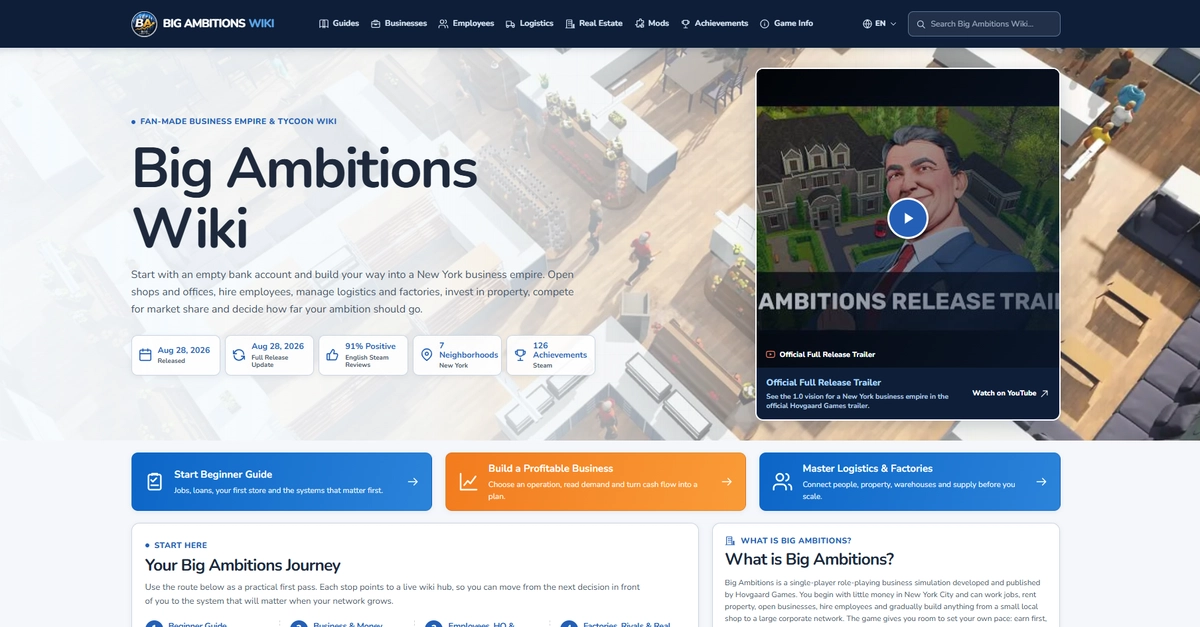
The Problem: Information Overload, Decision Paralysis
A player opens a guide on a game wiki. They're facing a specific problem – deliveries aren't working in the game Big Ambitions. They click on the 'Warehouse' page. The page dutifully explains what warehouses are, lists the types of equipment you can install, and mentions the importance of staffing. Yet, the player is still left hanging. They don't know which of these factors to check first. They still have to figure out the core issue themselves, turning a quick wiki lookup into a detective mission.
This is a common pitfall in game documentation and, by extension, technical documentation in general. The information is present, but it's not structured to guide the user toward a solution. The gap isn't a lack of data; it's a lack of actionable pathways through that data. For developers building and maintaining these wikis, this is a critical design challenge worth addressing.
Solution: Structure Guides Around Reader Questions
The core principle for improving game wiki design is to start with the question the reader is trying to answer. Instead of organizing content by game mechanic (e.g., 'Warehouses,' 'Staffing,' 'Deliveries'), organize it by the player's goal or problem. A player isn't searching for 'warehouse mechanics'; they're searching for 'why are my deliveries failing?' or 'how do I set up a profitable warehouse?'
This shift in perspective transforms a static information dump into an interactive troubleshooting tool. Each page should aim to resolve a specific reader need, leading them to a decision or action. For the warehouse example, the page wouldn't just describe warehouses; it would start with common delivery problems and guide the player through a diagnostic process.
Applying the Principle: A Big Ambitions Example
Let's take the Big Ambitions warehouse example further. A player struggling with deliveries might be experiencing one of several issues:
- Incorrect Staffing: The warehouse doesn't have enough staff, or the right kind of staff, to handle incoming or outgoing goods.
- Equipment Malfunctions/Misconfiguration: Conveyor belts are not connected properly, or storage slots are full and not being managed.
- Supply Chain Issues: Suppliers aren't delivering, or the player hasn't set up the necessary routes or orders.
- Storage Capacity: The warehouse is simply full.
A wiki guide designed around these dependencies would present these potential causes upfront. Instead of a dense block of text about warehouse features, the page could begin with a diagnostic flowchart:
Are deliveries failing?
- Yes:
- Check Staffing: Are there enough employees assigned to logistics? [Go to Staffing Guide]
- Check Equipment: Are all conveyor belts connected and functional? Is storage space available? [Go to Equipment Guide]
- Check Suppliers: Are you receiving goods as expected? [Go to Supplier Guide]
- Is the warehouse full? [Go to Capacity Guide]
- No: Proceed with your original task.
Each of these linked sections would then provide the detailed information, but framed within the context of solving that specific problem. The 'Staffing' section wouldn't just list job roles; it would explain which roles are critical for efficient inbound and outbound logistics and what the minimum staffing levels are for different warehouse sizes.
Beyond Troubleshooting: Enhancing Player Experience
This dependency-driven approach isn't just for troubleshooting. It can enhance the entire player experience by making information more intuitive and less overwhelming. When a player is trying to achieve a new goal, such as maximizing profit from a warehouse, the guide can be structured to highlight the key decisions they need to make:
- Location: Proximity to suppliers and customers.
- Size and Layout: Optimizing for flow and capacity.
- Staffing Strategy: Hiring for specialized roles vs. generalists.
- Equipment Investment: Balancing automation costs with labor savings.
- Pricing and Contracts: Negotiating favorable terms with suppliers and buyers.
By presenting these as decision points, the wiki empowers the player to make informed choices. It moves from being a reference manual to being a strategic advisor. This is especially valuable in complex simulation games like Big Ambitions, where interdependencies between systems can be opaque.
The Unanswered Question: Scalability and Maintenance
While this user-centric, question-driven approach offers clear benefits, a significant challenge remains unaddressed: how to scale and maintain such a structure for very large and complex games. As games grow, with new mechanics, items, and systems added regularly, mapping out every possible player question and its corresponding dependency chain becomes an enormous undertaking. What is the most efficient way for wiki maintainers to identify these critical dependencies and structure content accordingly without it becoming an insurmountable task? Tools or methodologies to automatically detect or suggest these connections could be invaluable, but none are widely established.
Conclusion: A More Empathetic Approach to Game Documentation
Designing game wikis around player dependencies means shifting focus from what the game *is* to what the player *needs*. By anticipating the questions players ask and the problems they encounter, and then structuring information to directly address those needs, developers can create wikis that are not just informative, but truly helpful. This empathetic approach transforms a passive repository of facts into an active guide, empowering players to overcome obstacles and achieve their in-game goals more effectively. It's a design philosophy that serves both the player and the longevity of the game's community.