No Build Step, No Framework Lock-in: Fylgja UI Offers Universal Components
Fylgja CSS has long operated at the foundational layer of web development: providing robust defaults, comprehensive design tokens, and flexible utilities. This approach empowers developers to construct virtually any interface from the ground up. However, a persistent question from the community emerged: how does one actually assemble common UI elements like modals, carousels, or pagination bars using these building blocks?
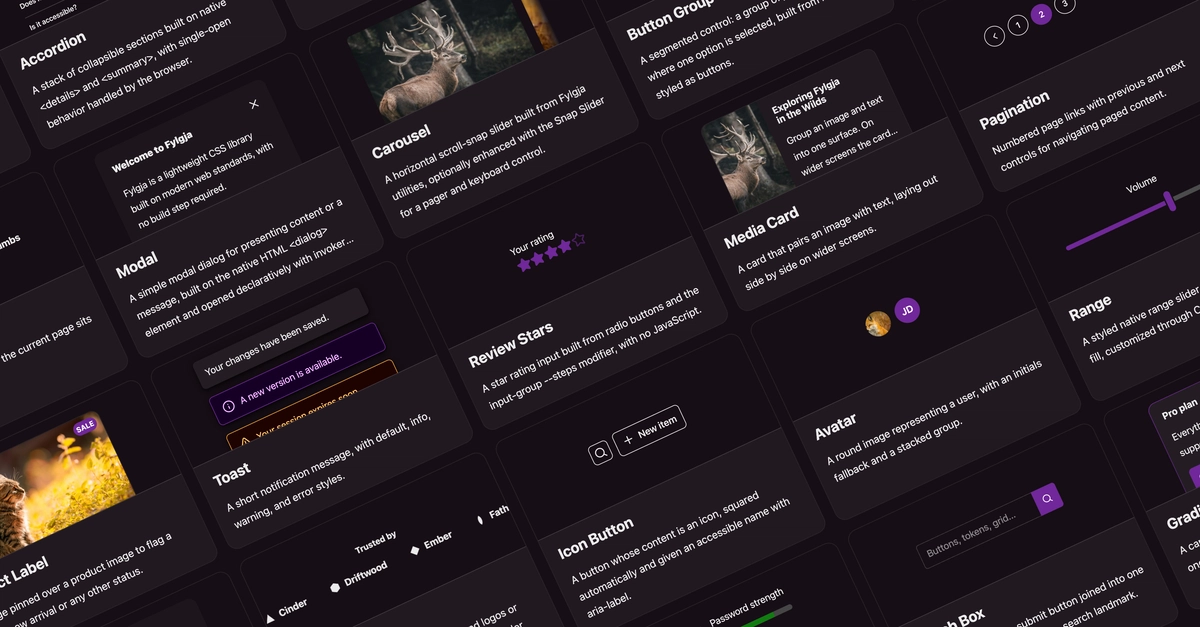
Fylgja UI is the direct answer to this demand. It is a curated and expanding collection of ready-to-use web components. Developers can freely read, inspect, copy, and paste these components directly into their projects, regardless of the underlying technology stack.
Crucially, Fylgja UI is not another framework-specific UI library. There is no package to install, no complex component API to learn, and no mandatory build step to integrate. The core offering is pure markup. This design choice ensures that Fylgja UI components function seamlessly within diverse environments such as Astro, Laravel, Svelte, Rails, or even a single, standalone HTML file. For developers working within React, the components are equally compatible.
The entire Fylgja UI collection is available completely free of charge. In an ecosystem where premium features, tiered licenses, or subscription models are common for advanced component sets, Fylgja UI maintains a commitment to accessibility. There is no paid version, nor are there any plans to introduce one. Access requires no account creation and imposes no restrictive licenses, ensuring developers can use the components without legal or financial barriers.
Design Philosophy: Utility-First Meets Component Reusability
The philosophy behind Fylgja UI stems from its parent, Fylgja CSS. While Fylgja CSS provides the underlying styling primitives and utility classes, Fylgja UI offers pre-packaged solutions for common user interface patterns. This means developers don't have to reinvent the wheel for standard elements. Instead of piecing together dozens of utility classes to form a functional modal, they can leverage the Fylgja UI modal component directly.
This approach offers several advantages. Firstly, it significantly accelerates development. By providing ready-made, well-tested components, developers can focus on unique application logic rather than boilerplate UI construction. Secondly, it promotes consistency. Using standardized components ensures a cohesive user experience across the application, which is vital for professional software.
The components are built with accessibility in mind. Developers can expect semantic HTML, appropriate ARIA attributes, and keyboard navigation support baked into the components. This adherence to accessibility standards means that applications built with Fylgja UI are more inclusive and compliant with web standards from the outset.
The markup provided is designed to be as framework-agnostic as possible. This means that while the components are styled using CSS (provided by Fylgja CSS), their structure is plain HTML. This allows them to be easily integrated into server-rendered applications, static site generators, and client-side rendered JavaScript frameworks alike. For instance, a developer using a PHP framework like Laravel could embed the HTML directly into their Blade templates. A Svelte developer could use the markup within their Svelte components. Even in a React project, the HTML can be rendered within JSX, often with minimal adaptation.
Interoperability and Future Growth
The decision to distribute components as raw markup is a deliberate strategy to counter the fragmentation and vendor lock-in often associated with UI libraries. Many UI kits are tied to specific JavaScript frameworks, forcing developers to either adopt that framework or find workarounds. Fylgja UI sidesteps this issue entirely by focusing on the universal language of the web: HTML and CSS.
This approach also simplifies maintenance. When Fylgja CSS is updated with new design tokens or utility classes, the underlying styles for Fylgja UI components can benefit implicitly. Developers using the UI components benefit from improvements to the core design system without needing to update their component implementations, as long as they are using the compatible version of Fylgja CSS.
The collection is described as 'growing.' This implies a roadmap for future component additions. Developers can expect to see more complex UI elements and patterns being added over time, further enhancing the utility of the Fylgja ecosystem. The open and free nature of the project encourages community contribution, potentially accelerating its growth and diversification.
One of the key benefits for developers is the transparency. Because the markup is directly available, developers can easily understand how each component is constructed. This is invaluable for debugging, customization, and learning. Unlike closed-source component libraries, Fylgja UI allows for complete inspection and modification, empowering developers to tailor components precisely to their project's needs.
The project's commitment to being entirely free and open-source without any tiered offerings positions it as a compelling alternative for projects with budget constraints or a strong preference for open software. It removes the financial and licensing hurdles that often prevent smaller teams or individual developers from accessing high-quality UI components.
What nobody has addressed yet is what happens when a component needs complex, framework-specific interactivity. While Fylgja UI provides the markup and styling, developers will still need to write their own JavaScript or use a framework's features to add dynamic behavior. The project currently offers no JavaScript solutions, leaving that entirely to the end-user. This is a deliberate choice to maintain framework agnosticism, but it means developers must be prepared to implement interactivity themselves.