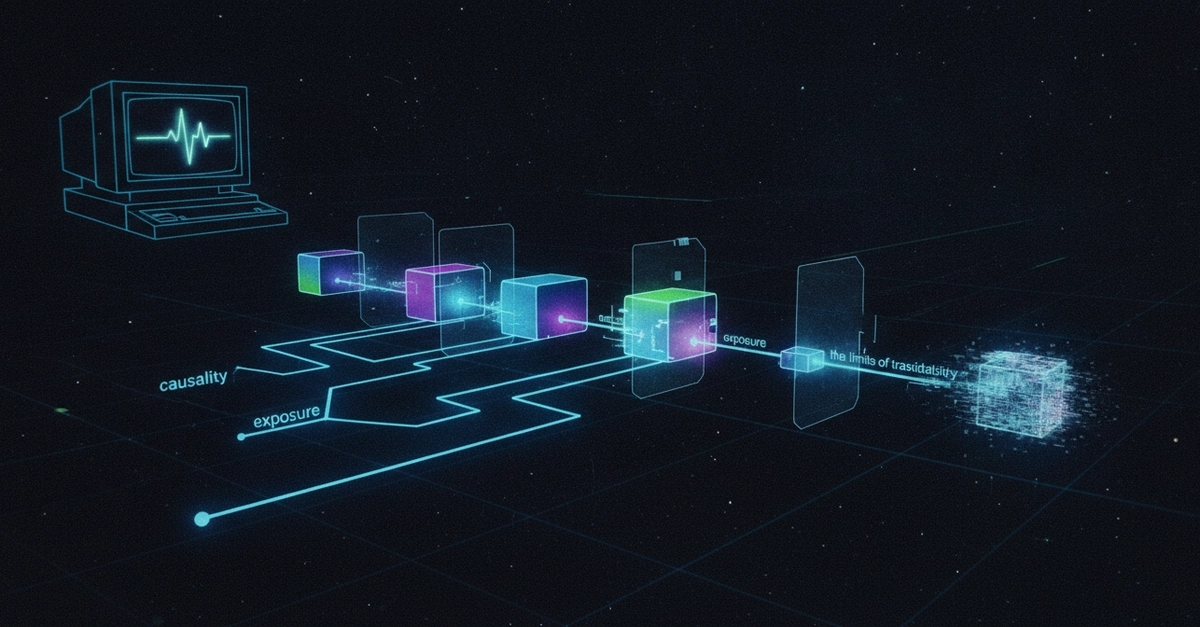
The Fundamental Challenge of Fungible Ledgers
Modern financial systems grapple with a core tension: the need to understand the precise history and dependencies of value versus the inherent design of fungible assets. Fungibility, by definition, treats each unit of an asset as interchangeable. This simplifies transactions and accounting by allowing aggregation – one dollar is the same as any other dollar. However, this simplification creates significant blind spots when systems need to answer critical questions about the origin, movement, and risk associated with specific units of value. Questions like "Which specific inbound transaction funded this withdrawal?" or "How much of the current balance is still tied to a provisional settlement?" become remarkably difficult to answer cleanly.
The problem intensifies when value is not static. When funds are pooled, partially spent, transferred between accounts, converted between currencies, netted against other obligations, batched for processing, or reused across multiple operations, the direct causal links become obscured. Accounting systems aggregate balances precisely because one unit of the same asset is economically equivalent to another. Yet, for critical functions such as risk management, regulatory compliance, reconciliation, understanding provisional finality, and executing compensation claims, preserving these causal relationships is paramount. The very act of making assets fungible, while efficient for standard transactions, actively works against the requirements of detailed value lineage.
Unpacking the Complexities: Pooling, Re-use, and Exposure
Consider the common practice of pooling funds. When multiple customer deposits, platform liquidity, credit lines, or collateral reserves are mixed into a single operational pool, tracing the ultimate source of any given outflow becomes a forensic challenge. A withdrawal might appear to be funded by platform liquidity, but a deeper analysis might reveal it was indirectly enabled by a customer deposit that was then re-hypothecated as collateral for a credit line. These interdependencies are vital for understanding true exposure. If an earlier deposit is reversed (e.g., due to a chargeback or settlement failure), downstream transactions that relied on that initial deposit, directly or indirectly, are exposed to that reversal. Without clear lineage, assessing this cascading risk is nearly impossible.
The issue is further compounded by asset conversion and netting. If a user deposits USD, converts it to EUR, uses that EUR to pay for a service, and then later receives a refund in EUR which is converted back to USD, the original USD deposit's journey is complex. Netting, where multiple obligations are offset against each other, further complicates this by reducing the gross amounts to net positions. A system might see a net zero movement for a specific period, but individual transactions within that period could have significant underlying value flows that need to be traceable for audit or dispute resolution.
Furthermore, the concept of provisional settlement introduces temporal ambiguity. Funds might be available for use or transfer on a provisional basis, but their finality is contingent on subsequent events. If a system cannot track which part of a current balance is provisionally settled versus finally settled, it cannot accurately assess risk. A large withdrawal might be funded by balances that are still subject to reversal, creating a significant operational or financial risk that is not immediately apparent from a simple balance sheet.
The Limits of Traceability in Standard Ledgers
Traditional ledger systems, designed around fungibility, often lack the built-in mechanisms to record and query this granular causal information. They excel at tracking aggregate balances and the movement of value between accounts but fall short when asked to reconstruct the specific financial narrative of a unit of value. This isn't a flaw in their design for their intended purpose, but rather a mismatch when applied to use cases requiring deep value lineage.
To address these challenges, systems often resort to complex, custom-built tracking mechanisms layered on top of standard ledgers. These can involve maintaining separate audit trails, employing sophisticated tagging systems for transactions, or implementing event-sourcing patterns. However, these solutions add significant complexity and cost. They essentially try to re-introduce a form of identity or traceability that fungibility was designed to eliminate. The surprising detail here is not the complexity of these solutions, but how fundamental the problem of value lineage is to the operation of modern financial infrastructure, despite the elegance of fungibility.
The core limitation is that a fungible ledger, by design, prioritizes the state of current balances over the history of how those balances were formed. It's like trying to reconstruct a family tree by only looking at current family photos; you see who is related in the present, but the lineage, the causal connections of birth and marriage, are lost unless explicitly recorded elsewhere. This limitation impacts everything from internal reconciliation processes to external regulatory reporting and the ability to manage systemic risk effectively.
Moving Forward: Towards Traceable Fungibility
The demand for granular value lineage is growing, driven by increased regulatory scrutiny, the complexity of modern financial products, and the need for robust risk management. This is pushing the boundaries of what fungible ledgers can efficiently support. Future ledger designs or enhanced protocols may need to incorporate explicit mechanisms for tracking causality and exposure without sacrificing the benefits of fungibility for everyday transactions. This might involve more sophisticated metadata handling, event-driven architectures, or even novel approaches to distributed ledger technology that can balance aggregate efficiency with granular traceability.
Ultimately, the challenge lies in building systems that can answer not just "how much?" but also "how?" and "why?" – questions that are fundamental to financial stability and operational integrity, but which fungible ledgers were never built to answer directly.