The Evolving Full-Stack Architecture
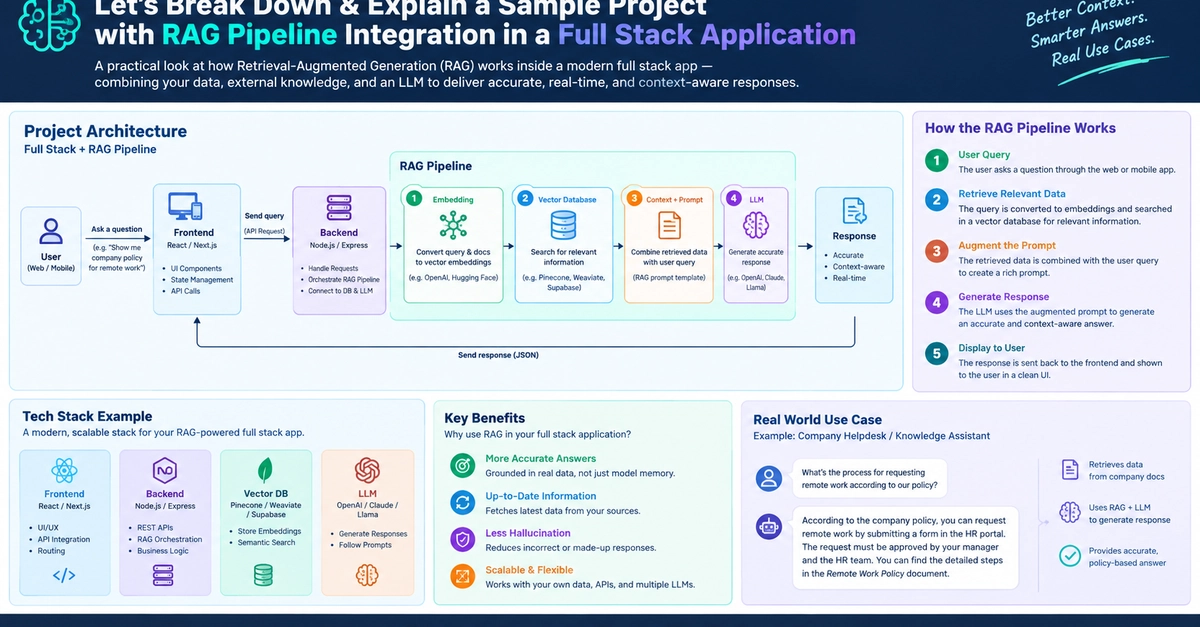
Traditional full-stack applications often follow a straightforward pattern: React for the frontend, an Express API for the backend, and MongoDB as the database. This architecture handles user interfaces, data storage, and business logic efficiently. However, integrating AI capabilities, particularly Retrieval-Augmented Generation (RAG), introduces new layers and complexities. The architecture expands to incorporate specialized services for AI processing, embedding, and vector search.
Consider a standard web application. A user interacts with a React frontend. This frontend communicates with a Node.js (Express) backend via an API. The backend then interacts with a MongoDB database for data persistence. This is a well-trodden path.
Now, let's overlay an AI-powered RAG pipeline onto this existing structure. The new architecture looks something like this:
React
  ↓
Express API
  ↓
RAG Service
  ↓
Embedding Model
  ↓
MongoDB Vector Search
  ↓
Relevant Context
  ↓
LLM
  ↓
Response
This expanded architecture allows for intelligent querying of custom data, significantly enhancing application functionality. We are essentially building an AI assistant that can answer questions based on a specific corpus of knowledge.
Building a Developer Documentation Assistant
The core use case we are exploring is a developer documentation assistant. Imagine a scenario where users upload extensive technical documentation for a particular framework or API. Later, they can ask natural language questions, such as:
How do I refresh an expired JWT?The application must then search through the uploaded documentation, identify the most relevant sections pertaining to JWT refreshment, and feed this information to a Large Language Model (LLM). The LLM, armed with this context, can then generate a precise and helpful answer. This is the essence of RAG: retrieving relevant information before generating a response, preventing the LLM from hallucinating or relying solely on its pre-trained, potentially outdated, knowledge.
The RAG Pipeline Components
Let's dissect the key components of this RAG pipeline:
1. React Frontend
The React frontend serves as the user interface. It handles user inputs, such as uploading documentation files (e.g., Markdown, PDF) and submitting natural language queries. It also displays the responses generated by the LLM. The frontend communicates with the backend API to send these inputs and receive the processed output.
2. Express API (Node.js Backend)
The Express API acts as the central orchestrator. It receives requests from the React frontend. When a user uploads documentation, the API is responsible for processing these files, potentially chunking them into smaller, manageable pieces, and passing them to the RAG service. For user queries, the API forwards the question to the RAG service and then sends the LLM's generated response back to the frontend.
3. RAG Service
This is the heart of the AI integration. The RAG service is a dedicated component responsible for the retrieval and generation process. It takes a user's query and the available data sources (documents) as input.
4. Embedding Model
To enable efficient searching within the documentation, the text needs to be converted into numerical representations called embeddings. An embedding model (e.g., from OpenAI, Hugging Face, or a self-hosted model) takes text chunks as input and outputs dense vectors. These vectors capture the semantic meaning of the text. The process of generating these embeddings is typically done offline or as part of the data ingestion pipeline.
5. MongoDB Vector Search
MongoDB, specifically with its Atlas Vector Search capabilities, plays a crucial role. Once the documentation is chunked and embedded, these vectors are stored in MongoDB. When a user submits a query, the query itself is also converted into an embedding using the same model. MongoDB's Vector Search then efficiently finds the document embeddings that are semantically similar to the query embedding. This is typically achieved using algorithms like Approximate Nearest Neighbor (ANN).
6. Relevant Context
The results from MongoDB Vector Search are the most relevant text chunks from the original documentation that pertain to the user's query. This retrieved information forms the 'context' that will be provided to the LLM. Instead of asking the LLM to answer from its general knowledge, we are giving it specific information to work with.
7. Large Language Model (LLM)
The final piece of the puzzle is the LLM (e.g., GPT-4, Claude, Llama 2). The LLM receives the user's original query along with the 'Relevant Context' retrieved from MongoDB. It uses this combined input to generate a coherent, accurate, and contextually relevant answer. The prompt engineering here is key: instructing the LLM to answer *based on the provided context* is paramount.
Implementation Considerations
Setting up such a pipeline involves several practical steps:
- Data Ingestion: A robust process is needed to upload, parse (handling different file types), chunk, and embed the documentation. This might involve background jobs or scheduled tasks.
- Embedding Strategy: Choosing the right embedding model is critical. Factors include accuracy, cost, and whether it can be hosted locally or needs to be accessed via an API. Consistency in the embedding model used for both document indexing and query embedding is non-negotiable.
- Vector Database Choice: While MongoDB Atlas offers integrated vector search, other dedicated vector databases (like Pinecone, Weaviate, Qdrant) could also be used, requiring an additional service to manage.
- LLM Integration: Selecting an LLM and managing API calls, including prompt construction and response parsing, is essential.
- Scalability: As the volume of documentation and user queries grows, the RAG service, embedding model, and vector database must scale accordingly.
The Value Proposition
This full-stack RAG pipeline transforms static documentation into an interactive, intelligent knowledge base. For developers, it means faster access to accurate information, reduced frustration, and improved productivity. For companies, it offers a way to leverage their internal knowledge assets more effectively, providing instant support and reducing reliance on human support staff for common queries. The ability to ground LLM responses in specific, verified data sources also mitigates risks associated with LLM hallucinations and ensures answers are tailored to the organization's context.