
The Shifting AI Landscape: From Cloud to Local
The era of cloud-dominated AI development is giving way to a new paradigm: frontier AI running on personal and enterprise hardware. This shift is driven by a confluence of factors, including the escalating costs of cloud-based AI services, growing concerns over data privacy and security, and the increasing accessibility of powerful, yet affordable, local compute resources. For developers, researchers, and even end-users, the ability to run state-of-the-art AI models without relying on external servers represents a significant leap towards autonomy and control.
Historically, training and deploying frontier AI models required massive computational power, typically only available through hyperscale cloud providers. This created a dependency, limiting access for many and raising questions about data sovereignty. However, recent advancements in hardware efficiency, model quantization, and optimized inference engines are democratizing access. We are witnessing the emergence of sophisticated AI capabilities that can be deployed and managed entirely within an organization's own infrastructure, or even on high-end consumer devices.
This transition is not merely about cost savings; it's about fundamentally altering how we interact with and leverage artificial intelligence. Local deployment means reduced latency, enhanced security through data containment, and the freedom to fine-tune models without exposing sensitive information. Think of it less like renting a massive, shared factory for your AI needs and more like setting up your own specialized workshop, where you control every tool and every process. This granular control is crucial for industries with stringent data regulations, such as healthcare and finance, and for applications demanding real-time responsiveness, like autonomous systems and interactive gaming.
Enabling Technologies: Hardware and Software Innovations
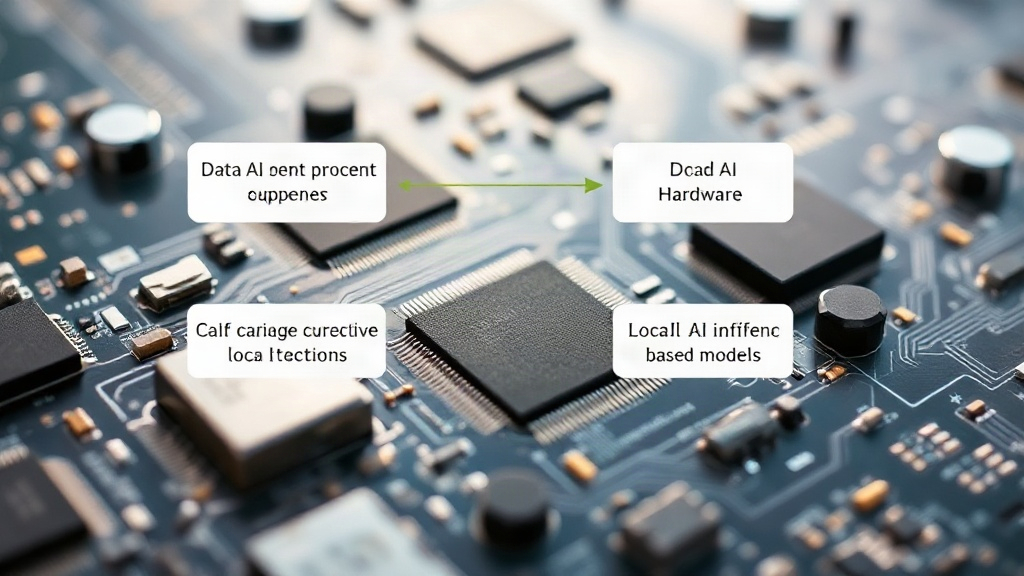
Several key technological advancements are fueling this decentralization. On the hardware front, the performance-per-watt of GPUs and specialized AI accelerators has dramatically improved. Devices that were once considered high-end consumer-grade are now capable of running models that were, until recently, the exclusive domain of data centers. This includes advancements in memory bandwidth, processing cores, and on-chip AI acceleration features that significantly speed up inference tasks.
Complementing hardware improvements are breakthroughs in AI software. Model quantization techniques, for instance, allow for the reduction of model size and computational requirements with minimal loss in accuracy. Techniques like 8-bit or even 4-bit quantization make it feasible to load and run large language models (LLMs) and other complex AI architectures on hardware with limited RAM and VRAM. Furthermore, optimized inference engines and runtimes, such as ONNX Runtime, TensorRT, and specialized libraries for local deployment, are designed to squeeze maximum performance out of available hardware, often outperforming generic cloud-based inference platforms for specific tasks.
The open-source community has also played a pivotal role. Projects like llama.cpp, which enables LLMs to run efficiently on CPUs and Apple Silicon, and various libraries for fine-tuning and deploying models locally, have lowered the barrier to entry considerably. These tools abstract away much of the complexity, allowing developers to focus on application development rather than deep systems optimization. The rapid iteration and community-driven improvements in these open-source projects mean that local AI capabilities are evolving at an unprecedented pace.
Use Cases and Implications Across Industries
The implications of frontier AI on local hardware are far-reaching. For developers, it opens up new avenues for building privacy-preserving applications. Imagine a customer service chatbot that processes sensitive user queries entirely on the user's device, or a personalized health assistant that analyzes medical data locally without transmitting it to a third party. This approach significantly reduces the risk of data breaches and enhances user trust.
In the enterprise sector, organizations can deploy sophisticated AI solutions for internal operations, such as document analysis, code generation, and predictive maintenance, without the recurring costs and data egress concerns associated with cloud services. This is particularly impactful for businesses operating in regions with strict data residency laws or those handling highly confidential information. The ability to maintain full control over AI models and their associated data creates a stronger security posture and a more predictable cost structure.
For creators and researchers, local AI empowers experimentation and rapid prototyping. Fine-tuning models for specific creative tasks, such as generating unique art styles, composing music, or assisting in scientific discovery, can be done quickly and iteratively on personal workstations. This fosters a more agile research environment, where hypotheses can be tested and models refined without the delays and costs of cloud resource allocation. The surprising detail here is not the speed at which these models can now run locally, but the fidelity and complexity of tasks they can handle with just a few hundred dollars of consumer hardware.
Challenges and the Road Ahead
Despite the immense progress, challenges remain. While many models are becoming runnable locally, the absolute cutting edge of AI research, particularly in massive foundational models requiring hundreds of billions of parameters and petabytes of training data, may still necessitate cloud infrastructure for initial training. The energy consumption of running complex models locally, especially on less efficient hardware, can also be a concern, although advances in hardware efficiency are steadily mitigating this.
Furthermore, managing and updating local AI deployments can become complex for large organizations. Ensuring consistent performance, security patching, and model version control across numerous devices requires robust IT infrastructure and expertise. The ecosystem of tools for managing distributed local AI deployments is still maturing. What nobody has addressed yet is the long-term maintenance and support burden for organizations that fully commit to large-scale local AI infrastructure, and how that compares to the operational costs of cloud solutions over a five-year horizon.
Nevertheless, the trend is clear. Frontier AI on your own hardware is not a temporary workaround but a fundamental evolution. It signifies a move towards greater computational sovereignty, enabling a more distributed, secure, and accessible future for artificial intelligence. As hardware continues to improve and software optimizations mature, we can expect to see even more powerful AI capabilities migrate from the cloud to the edge, empowering individuals and organizations alike.