The Problem with Undefined and the Promise of More Types
In TypeScript development, managing potential null or undefined values is a constant challenge. The common approach often involves checks scattered throughout the codebase, leading to what can feel like bureaucratic, yet necessary, type additions. The core insight from fp-ts, particularly its Option<T> type, reframes this problem. Instead of viewing undefined as a simple absence of a value, fp-ts treats it as a broken contract. Every time a function returns undefined without explicit context, it creates a latent bug waiting to manifest. This was starkly illustrated in a real-world scenario where an empty undefined value, returned from a database query within a Next.js Server Action, cascaded through three components that implicitly assumed a value would always be present, leading to a runtime failure.
The fundamental lesson here is that robust handling of potential absence requires a more explicit type system. Rather than avoiding types for fear of added complexity, embracing them provides a stronger guarantee. The Option<T> type, for instance, forces developers to acknowledge and explicitly handle cases where a value might not exist, transforming a potential runtime error into a compile-time consideration. This shift in perspective is crucial for building more resilient applications, especially in contexts where data integrity and predictable execution are paramount.
Beyond Installation: A University for Data Flow
Many developers encounter fp-ts and, perhaps intimidated by its functional purity or perceived complexity, decide not to integrate it directly into their production environments. This is a pragmatic choice for many teams. However, the article argues that the value of fp-ts lies not in its direct deployment, but in the conceptual education it provides. Reading the source code and understanding its patterns can fundamentally alter how developers approach data flow, even when working with vanilla TypeScript, Zod schemas, or within frameworks like Next.js Server Actions. It's akin to attending a university course on a subject; you gain the knowledge and principles, which you then apply in your own unique context, even if you never work in that specific academic field professionally.
The library serves as a rigorous training ground. It exposes developers to concepts that promote clearer, more predictable code. By studying how fp-ts structures data transformations and handles potential failures, engineers can adopt similar mental models. This means writing functions with more honest signatures, where the possibility of absence or error is explicitly encoded. The discipline learned from wrestling with fp-ts's abstractions can lead to more maintainable and less error-prone codebases, even if the library itself remains on the shelf. The goal is to internalize the principles, not necessarily the syntax.
Key Concepts: Option, Either, and Pipe
While fp-ts offers a comprehensive suite of functional programming tools, three core concepts stand out as particularly impactful for developers, even when not using the library directly:
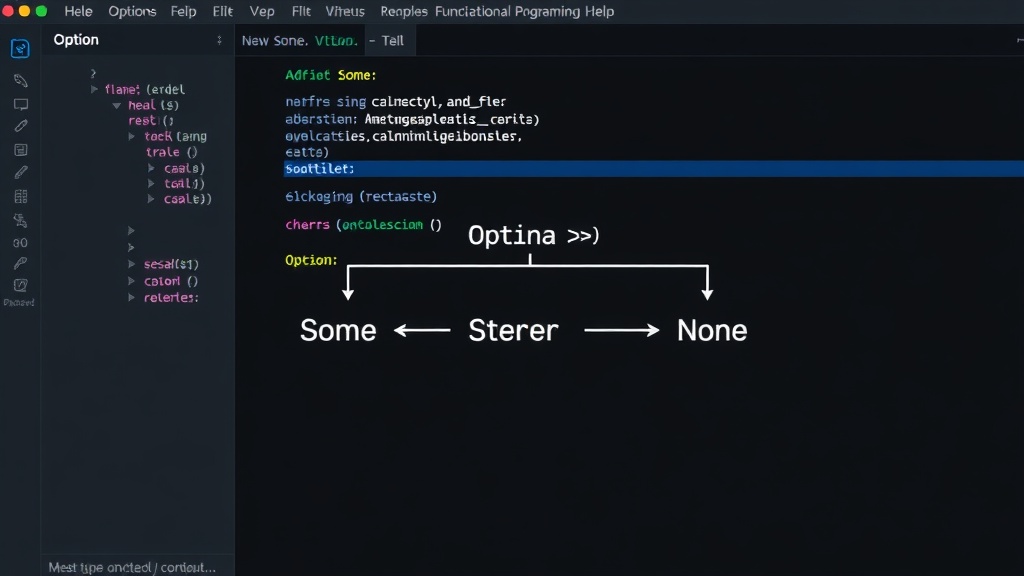
Option<T>: As discussed, this type provides a structured way to represent values that may or may not be present. It forces explicit handling of the `Some(value)` and `None` cases, eliminating the ambiguity ofnullorundefined. This transforms the way you think about nullable data, moving from defensive runtime checks to declarative compile-time safety.Either<E, A>: This type represents a computation that can result in one of two outcomes: an error (Left<E>) or a success value (Right<A>). It's a powerful pattern for error handling that avoids exceptions and keeps error states within the type system. Instead of throwing errors and catching them, you explicitly return anEither, making the flow of potential failures clear and type-safe.pipe: Thepipefunction (or similar functional composition utilities) allows for the sequential application of functions in a readable, declarative manner. It takes a value and a series of functions, applying them one after another. This leads to cleaner, more understandable data transformation pipelines, especially when dealing with multiple steps and intermediate results. It’s particularly useful for composing operations on types likeOptionandEitherwithout deeply nested callbacks or temporary variables.
Internalizing these three concepts can significantly enhance the quality of TypeScript code. Developers can implement similar patterns using vanilla TypeScript features or simpler utility functions. For instance, a custom Option type can be created, or Either-like logic can be managed with discriminated unions. The pipe pattern can be replicated with basic function composition or by leveraging existing utility libraries if not using fp-ts directly. The key is understanding the problem these constructs solve and adopting the underlying principles of explicitness, type safety, and declarative data flow.
Applying Functional Thinking in Vanilla TypeScript
The true power of studying fp-ts, even if you never deploy it, comes from its ability to foster a functional mindset. This mindset can be applied to any TypeScript codebase. Consider the handling of nullable return values. Instead of a function returning string | undefined and leaving the caller to guess or defensively check, one can adopt the Option pattern. This might involve creating a simple utility function that wraps a potentially undefined value into an object like { _tag: 'Some', value: string } | { _tag: 'None' }. This explicit representation makes the function's contract unambiguous.
Similarly, error handling can be improved by adopting the Either principle. A function that might fail could return a union type like { _tag: 'Right', value: T } | { _tag: 'Left', error: E }. This forces the caller to handle both success and failure paths explicitly. This is far more robust than relying on try-catch blocks, which can obscure control flow and make it harder to reason about the program's state.
The pipe pattern, too, can be implemented with basic JavaScript/TypeScript. A simple pipe function can be written that takes an initial value and an array of functions, applying each function sequentially. This leads to elegant data transformation chains, particularly when working with the custom Option or Either types you might implement. For example, processing a list of user IDs, fetching user data, and then extracting specific fields can be chained together cleanly with pipe, making the sequence of operations easy to follow and modify. This approach emphasizes compositionality and immutability, core tenets of functional programming that lead to more predictable and testable code.
The Unanswered Question: When is fp-ts Worth the Overhead?
While the educational benefits of fp-ts are clear, a crucial question remains: when does the overhead of adopting a full-fledged functional programming library like fp-ts, with its learning curve and potential runtime impact, become justified? The article positions fp-ts as a 'university' rather than a 'framework.' This suggests that its primary value is in teaching principles. However, there are undoubtedly scenarios—perhaps highly complex state management, intricate data validation pipelines, or mission-critical systems where absolute predictability is paramount—where the library's robust abstractions might offer tangible benefits beyond education. Determining this threshold, and the specific trade-offs involved, is a decision that teams must carefully evaluate based on their project's unique requirements and their developers' familiarity with functional paradigms.