The Fediverse is Not Mastodon
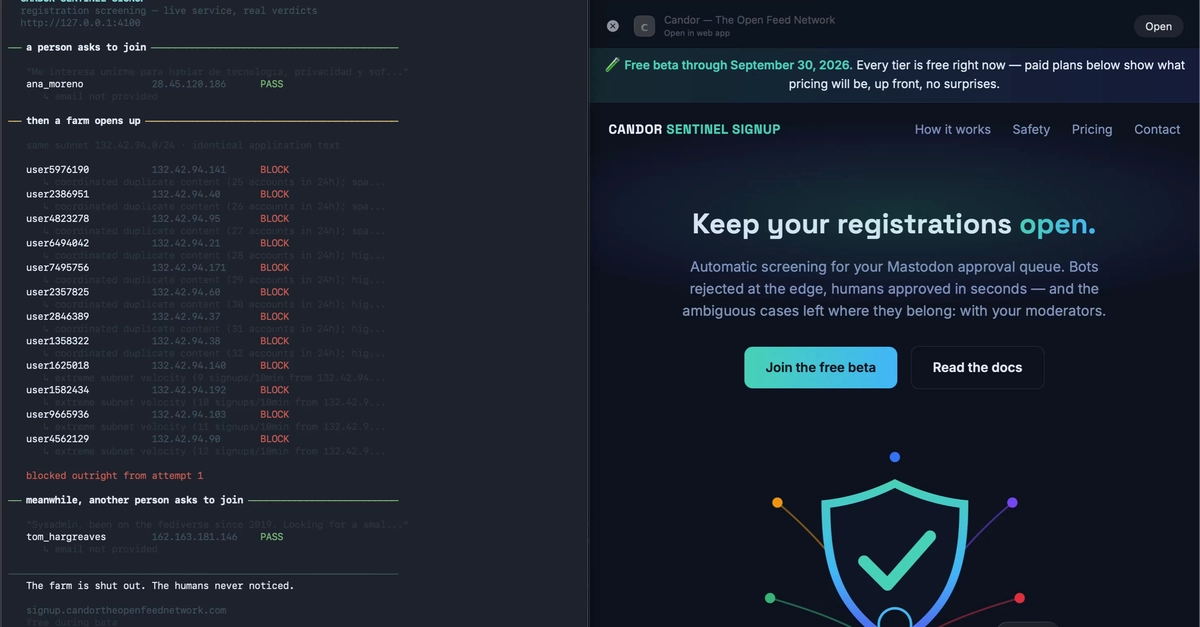
Ronny Cruz, founder of Open Feed Network and developer of Sentinel Signup, recently admitted a critical overreach in his product's claims. Sentinel Signup, a service designed to screen registration queues for Fediverse instances, was launched during a July spam wave. Its purpose was to help instance administrators drowning in fake approval requests by scoring applicants and approving or rejecting them via the admin API.
The product's README included setup instructions that read: "Mastodon: Preferences → Development → New application, scopes admin:read admin:write." This instruction, while functional for Mastodon users, highlighted a fundamental flaw in Cruz's marketing. The product was described as supporting the "Fediverse," yet its only documented and, as it turned out, supported implementation was for Mastodon.
Cruz explicitly called out this discrepancy: "The product says Fediverse. The documentation says Mastodon. Those are not the same word, and the gap between them was a claim I had no evidence for." This realization came after the product's release, underscoring a common pitfall for developers entering decentralized or rapidly evolving ecosystems.
Understanding the Fediverse Ecosystem
The Fediverse, a portmanteau of "federation" and "universe," is not a single monolithic piece of software. Instead, it's a network of independently operated servers that can communicate with each other. Mastodon is arguably the most well-known instance of Fediverse software, but it is far from the only one. Other popular implementations include GoToSocial, Akkoma, Pleroma, Misskey, and Shark, each with its own nuances, APIs, and compatibility layers.
Cruz's Sentinel Signup was designed to interact with these instances through their administrative APIs. The challenge lies in the fact that while the ActivityPub protocol provides a common language for much of the Fediverse's communication, administrative APIs are often platform-specific. A feature that works seamlessly with Mastodon's `admin:write` scope might not exist, function identically, or even be accessible in the same way on Pleroma or Misskey.
This distinction is crucial for any developer aiming to build tools that serve the broader Fediverse. It's akin to building a universal remote control for televisions. You might get it to work perfectly with Samsung TVs, but claiming it controls "all TVs" without testing it on Sony, LG, or TCL models is premature and potentially misleading. The underlying infrared protocols or smart TV APIs differ, requiring specific implementations for each manufacturer.

The Perils of Unearned Compatibility Claims
Cruz's admission serves as a cautionary tale. When a product is marketed as broadly compatible with an ecosystem like the Fediverse, users expect it to work across its diverse implementations. A developer who has only tested against Mastodon, the most popular client, might overlook critical differences in how other servers handle administrative tasks, user management, or API authentication. This can lead to frustration for users on unsupported platforms and damage the developer's credibility.
The founder's honest reflection highlights the importance of rigorous testing and clear communication. Instead of claiming Fediverse-wide compatibility, Cruz could have initially positioned Sentinel Signup as a "Mastodon registration screening tool" or a "Fediverse tool with Mastodon support." This would have set accurate expectations and allowed for phased rollout of support for other implementations. As he put it, "I hadn't earned the right to say Fediverse."
For developers entering federated or decentralized spaces, understanding the nuances of each protocol and implementation is paramount. This requires not just reading documentation but actively testing against a representative sample of the ecosystem. For Sentinel Signup, this means exploring the APIs of GoToSocial, Akkoma, Pleroma, and others to ensure its screening logic and API interactions are robust and adaptable.
Moving Forward: Earning the Compatibility Claim
Cruz has indicated a commitment to expanding Sentinel Signup's compatibility. This involves a deeper dive into the technical specifics of various Fediverse servers. The next steps will likely involve:
- Identifying the administrative API endpoints for other popular Fediverse software.
- Developing adapter layers or conditional logic within Sentinel Signup to handle API differences.
- Conducting thorough testing on each supported platform to verify functionality.
- Updating documentation to clearly reflect the supported instances and their specific setup requirements.
The journey from a Mastodon-specific tool to a truly Fediverse-compatible service is one of dedicated engineering and community engagement. It requires the same level of diligence as building the initial product. By openly acknowledging the gap between his claim and his product's reality, Ronny Cruz has taken the first step toward earning that broader compatibility, a move that should resonate with other developers navigating complex, federated landscapes.