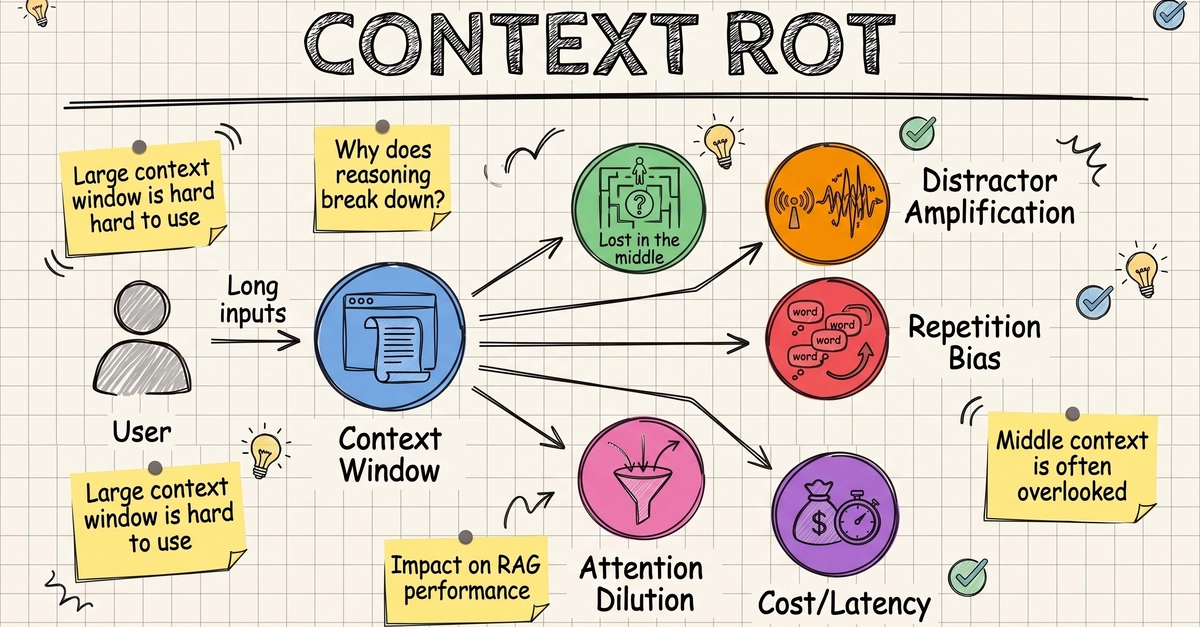
The Illusion of Infinite Memory
If you've interacted with a large language model (LLM)-powered agent for any length of time, you've likely encountered a subtle, frustrating degradation of performance. Instructions that were perfectly understood at the start of a session can be ignored later. The agent might reference irrelevant information or start referencing things it shouldn't. The output might look syntactically correct, but the reasoning quality has plummeted. This phenomenon, where an agent's performance degrades over a single session despite no explicit errors, is known as context rot.
It's not a single problem, but a confluence of five distinct failure modes. These modes combine and compound, becoming more pronounced as more information is naively added to the agent's context window. The common sales pitch of simply increasing context window size offers no true solution to these underlying issues.
Mode 1: Instruction Drift
This is perhaps the most common form of context rot. It occurs when an agent gradually begins to deviate from its initial instructions. Early in a conversation, the agent adheres strictly to the user's directives. However, as the conversation progresses and more turns are added to the context, the agent starts to subtly ignore or misinterpret the original prompt. It might start prioritizing newer instructions over older ones, or introduce actions and behaviors not initially specified. This is like a meticulous assistant who, after a long day, starts forgetting the finer points of their initial brief and improvising based on what's easiest.
Mode 2: Information Bleed
Information bleed happens when previously retrieved or generated information, which may have been relevant in an earlier part of the conversation, starts to inappropriately influence unrelated queries. Imagine asking about a specific technical concept, and the agent, instead of providing a focused answer, starts weaving in details from a previous discussion about a historical event. The agent isn't necessarily hallucinating; it's pulling from its memory but applying it to the wrong context. This is akin to a chef accidentally adding ingredients from yesterday's soup preparation into today's delicate consommé – the ingredients are correct, but their application is disastrously out of place.
Mode 3: Irrelevant Retrieval
This mode is closely related to information bleed but focuses specifically on the retrieval-augmented generation (RAG) process. In RAG systems, agents fetch external information to augment their responses. With context rot, the agent may continue to retrieve and present snippets that were relevant to earlier queries but are now entirely out of scope for the current question. Even if the prompt changes significantly, the agent might still be stuck referencing old documents or data points, leading to responses that are technically accurate based on the retrieved data but completely miss the user's intent. Think of a research assistant who keeps handing you papers from your 2020 research project when you're asking about 2024 developments.
Mode 4: Contextual Amnesia
Contextual amnesia is the inverse of information bleed and irrelevant retrieval. Instead of referencing old or irrelevant information, the agent begins to forget crucial details that were established earlier in the *same* conversation. It might ask for information the user has already provided, or fail to recall constraints or preferences that were explicitly stated just a few turns prior. This is like talking to someone who has a short-term memory deficit – they might remember general knowledge but forget what you just told them five minutes ago. This is particularly problematic for multi-turn tasks requiring statefulness.
Mode 5: Reasoning Decay
This is the overarching symptom that often signals the presence of the other forms of context rot. Reasoning decay is the general decline in the quality of the agent's logical processing and problem-solving capabilities over time. The agent's ability to synthesize information, draw correct inferences, and maintain coherence breaks down. It might start making logical leaps, producing contradictory statements, or failing to follow complex instructions. This is the most insidious type of rot because it's not tied to a single piece of information but to the agent's overall cognitive function within the session. It’s like a complex machine starting to sputter and produce faulty output because its internal gears are wearing down.
Why Bigger Context Windows Aren't Enough
The prevailing narrative in LLM development has often centered on increasing context window sizes. The assumption is that more space equals better memory and performance. However, context rot demonstrates that simply having more space doesn't solve the fundamental problem of how agents manage and prioritize information within that space. These five failure modes highlight issues with attention mechanisms, retrieval strategies, and instruction following that are not inherently fixed by a larger buffer. A bigger context window is like giving a librarian a larger building; it doesn't help if they still can't find the right book or remember which patrons asked for what.
Addressing context rot requires more sophisticated techniques than simply expanding the context. This includes developing better methods for context summarization, selective retrieval, reinforcement learning for instruction adherence, and more robust attention mechanisms that can better distinguish between relevant and irrelevant information over long interactions. Until these challenges are met, even the largest context windows will eventually succumb to the subtle, pervasive degradation of context rot.