Optimizing Nigeria's Aquaculture with AI and Robotics
Fishcluster, a startup focused on revolutionizing aquaculture in Nigeria, has emerged from stealth mode announcing $1 million in commitments. The company deploys a combination of artificial intelligence and underwater robots to provide critical insights into fish pond conditions, a move designed to significantly reduce operational costs and improve yields for local fish farmers. The core problem Fishcluster addresses is the immense inefficiency in fish feed management, which accounts for over 75% of farm expenditures. Without precise monitoring, farmers struggle to determine optimal feeding schedules, leading to substantial waste and underperformance.
The company's technology aims to bring data-driven precision to an industry often reliant on traditional, less efficient methods. By placing AI-powered underwater robots within fish ponds, Fishcluster can continuously monitor fish behavior, feeding patterns, and water quality. This real-time data allows for immediate adjustments to feeding strategies, ensuring that fish consume the appropriate amount of feed and that valuable resources are not wasted. This level of granular insight was previously unavailable to most Nigerian fish farmers, who operate on tighter margins and often lack access to advanced technological solutions.
The $1 million in commitments comes from a mix of investors and strategic partners, signaling strong confidence in Fishcluster's approach and the potential of its technology to transform Nigeria's significant aquaculture sector. The company has already secured pilot programs with four of the country's largest fish farms, a critical validation of its solution. These early adopters will provide invaluable data and feedback as Fishcluster scales its operations. The successful integration with these large-scale operations demonstrates the technology's robustness and its ability to handle the demands of commercial aquaculture.

The Technology Behind Fishcluster's Solution
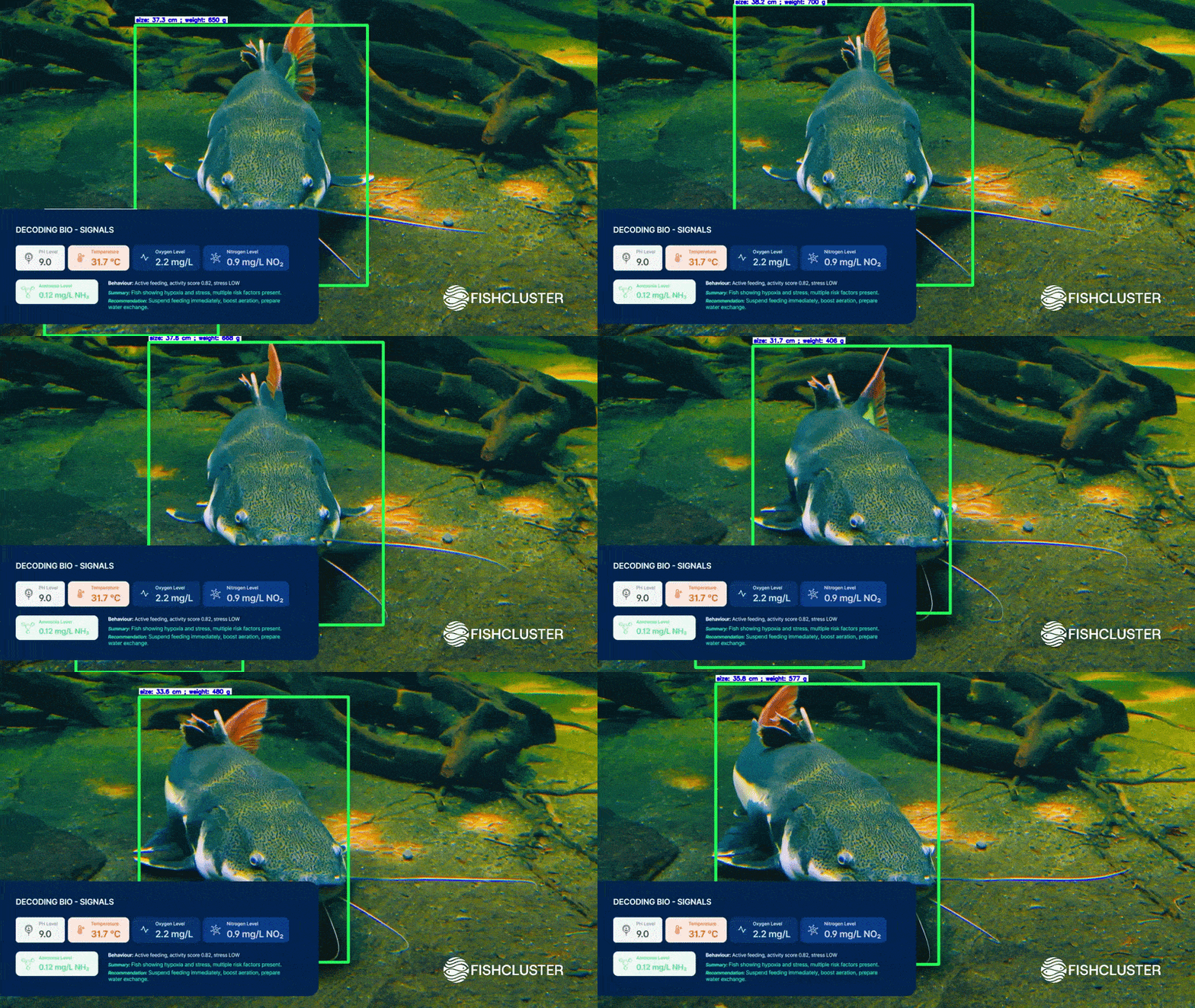
At the heart of Fishcluster's offering are its proprietary underwater robots. These robots are equipped with advanced sensors capable of measuring key water parameters such as temperature, dissolved oxygen, pH levels, and ammonia. More importantly, they utilize sophisticated AI algorithms to analyze fish behavior. This includes tracking feeding activity, identifying signs of stress or disease, and estimating fish biomass. The AI models are trained on vast datasets of fish behavior in various conditions, allowing them to detect subtle anomalies that human observation might miss.
The robots transmit this data wirelessly to a cloud-based platform. Here, the AI processes the information, generates actionable insights, and provides farmers with tailored recommendations. For instance, if the AI detects that fish are not consuming their feed efficiently, it can suggest reducing the feed quantity or altering the feeding schedule. Conversely, if fish are exhibiting healthy feeding patterns and optimal growth, the system can confirm the effectiveness of the current feeding regime. This continuous feedback loop is crucial for maximizing feed conversion ratios (FCR), a key metric in aquaculture profitability.
The implications for feed optimization are profound. Feed represents a substantial portion of operational costs, often exceeding 75% of a farm's budget. Inefficient feeding not only wastes money but also contributes to poor water quality through excess nutrient load, which can lead to disease outbreaks and further losses. Fishcluster's AI-driven approach tackles this head-on by ensuring feed is delivered precisely when and how the fish need it, minimizing waste and its associated negative consequences. This precision feeding directly translates to improved profitability and sustainability for the farms.
Market Impact and Future Outlook
Nigeria boasts one of the largest fish consumption markets in Africa, yet its domestic aquaculture production struggles to meet demand, leading to significant reliance on imports. Fishcluster's technology addresses a critical bottleneck in domestic production: operational efficiency and cost management. By making aquaculture more profitable and predictable, Fishcluster aims to bolster local production, reduce import dependency, and create a more resilient food supply chain within the country.
The company's decision to focus on Nigeria, a market with immense potential but also unique challenges, highlights a strategic understanding of local needs. The commitment from four major farms provides a strong foundation for scaling. These partnerships will not only generate revenue but also serve as crucial case studies, demonstrating the tangible benefits of Fishcluster's technology to other potential clients across the country and potentially other African nations with similar aquaculture sectors.
What remains to be seen is how Fishcluster will navigate the complexities of infrastructure, such as reliable internet connectivity and power supply, in diverse farming locations across Nigeria. Ensuring consistent data transmission and robot operation in varied environments will be key to sustained success. However, the initial $1 million in commitments and the backing of major farms suggest a well-thought-out strategy that anticipates these challenges. The company's focus on a critical cost center for farmers, combined with advanced technology, positions it as a potentially transformative player in African aquaculture.