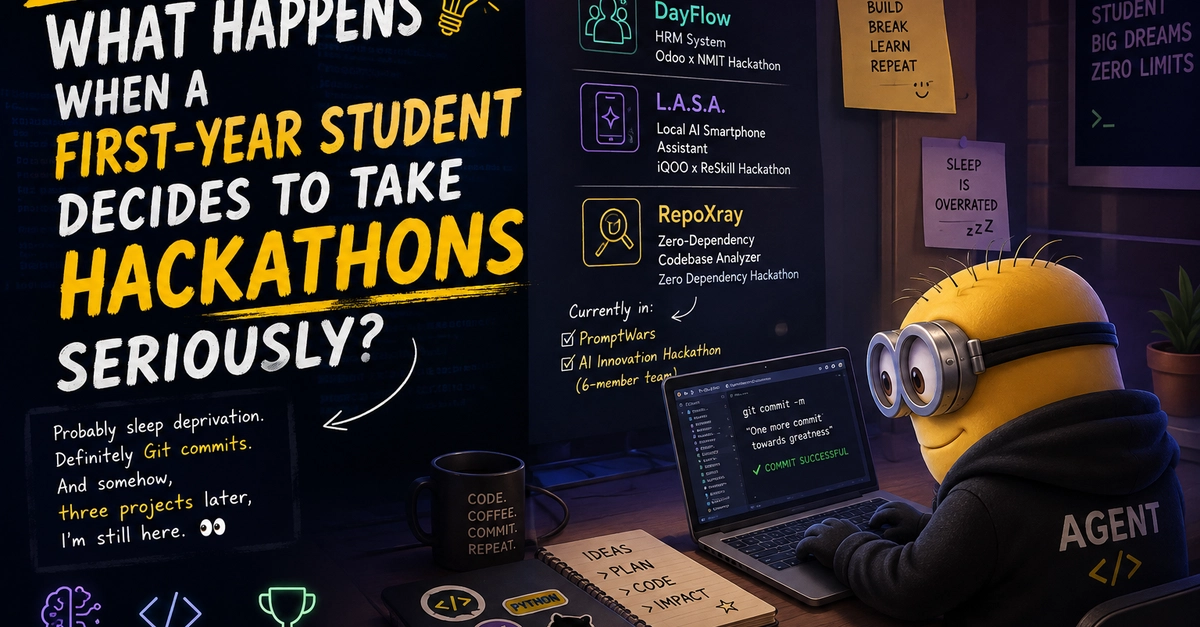
The Hackathon Sprint: A First-Year's Journey
For many, the transition to university involves a steep learning curve. For Kaustubh Negi, a first-year B.Tech student specializing in AI-ML at Yenepoya School of Engineering & Technology, Bengaluru, that curve was accelerated by an immersion into the world of hackathons. Negi, participating in the Kalvium program, discovered that these intense coding events were not just competitions but rapid prototyping grounds, turning nascent ideas into functional projects at an astonishing pace.
Negi's interest spans AI/ML, software development, developer tools, and the practical application of building functional software. Hackathons, he found, provided the ideal environment to hone these skills. The sheer speed at which concepts could be tested and iterated upon offered a tangible way to bridge the gap between theoretical knowledge and practical implementation. This approach led to the development of several notable projects in a short span.
DayFlow: Streamlining HR Workflows with AI
One of Negi's significant projects is DayFlow, an HRM system developed for the Odoo × NMIT Hackathon. The project aimed to explore the potential of an intelligent workforce management system. DayFlow was designed to integrate various HR workflows, suggesting a move towards more automated and AI-driven human resource management. This involved understanding core HR functions such as employee onboarding, leave management, performance tracking, and payroll, and then envisioning how AI could optimize these processes. The team focused on creating a system that could not only manage these tasks but also provide insights and predictive capabilities, making HR departments more efficient and strategic.
The development process for DayFlow involved deep dives into Odoo's modular ERP framework, understanding its extensibility for custom modules. Negi and his team likely grappled with data modeling for employee records, designing intuitive user interfaces for HR personnel and employees, and integrating AI components for tasks like sentiment analysis in employee feedback or predictive analytics for staff turnover. The hackathon environment demanded rapid development, forcing quick decisions on architecture and feature prioritization. This project showcases an understanding of enterprise software development and the application of AI in a business context.
L.A.S.A.: The Local AI Smartphone Assistant
Another compelling project is L.A.S.A. (Local AI Smartphone Assistant), developed for the iQOO × ReSkill Hackathon. This project delved into the realm of on-device AI, exploring how artificial intelligence could be seamlessly integrated into the smartphone experience. Unlike cloud-based assistants, L.A.S.A. aimed to provide AI functionalities that operate locally, enhancing user privacy and reducing latency. The objective was to make AI a more natural and unobtrusive part of daily smartphone usage, moving beyond simple voice commands to more context-aware and proactive assistance.
Building L.A.S.A. would have required an understanding of mobile development platforms (likely Android, given the iQOO context) and the integration of AI models that can run efficiently on mobile hardware. This could involve exploring techniques like model quantization, knowledge distillation, and efficient neural network architectures suitable for edge devices. The challenges would include managing the computational resources of a smartphone, ensuring a responsive user experience, and developing AI models capable of understanding user intent from local data without constant cloud connectivity. This project highlights an interest in the burgeoning field of edge AI and its potential to redefine personal computing.
The Hackathon Advantage: Accelerated Learning and Iteration
Negi's experience underscores the unique value of hackathons for students. They provide a pressure-cooker environment that forces rapid learning, problem-solving, and collaboration. The tight deadlines and the need to produce a working prototype encourage a pragmatic approach to development, prioritizing essential features and efficient execution. This hands-on experience with building real-world applications, often involving complex technologies like AI and enterprise systems, is invaluable for a student early in their academic career.
The sheer volume of Git commits Negi anticipates is a testament to the iterative nature of hackathon development. Each commit represents a step forward, a bug squashed, or a feature implemented. The mention of sleep deprivation is a common badge of honor among hackathon participants, signifying the intense dedication required. For a first-year student to not only participate but to produce multiple complex projects demonstrates a significant commitment and a rapid acquisition of practical skills. This journey suggests that taking hackathons seriously can indeed be a fast track to gaining substantial experience and making tangible contributions to the tech landscape, even at the earliest stages of one's education.