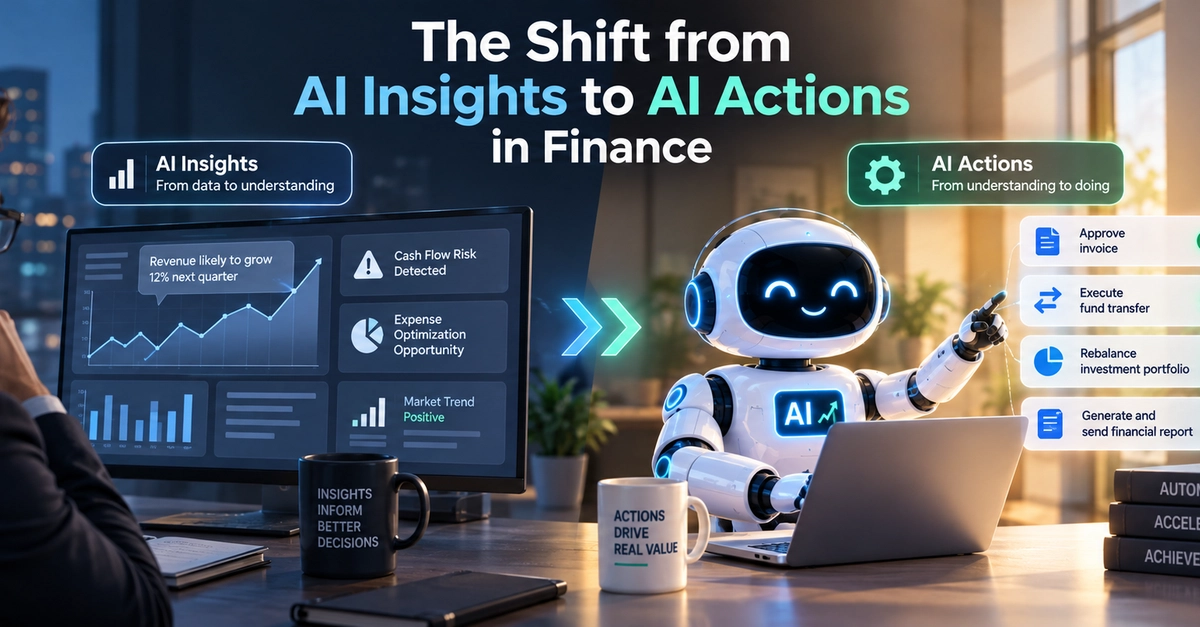
The Generational Divide in Financial AI
For the past decade, the financial technology landscape has largely operated on one side of a critical line, one that many teams haven't even realized they've been standing on. This side is defined by Artificial Intelligence that primarily provides insights – models that predict late payments, dashboards flagging unusual transactions, forecasts estimating future revenue, or risk scores for loan applications. These tools are valuable, working effectively to inform human decision-makers and optimize processes indirectly. They deliver intelligence, but the ultimate action remains with a person.
However, a significant shift is underway. The other side of this line represents AI that doesn't just inform; it acts. This is the realm of AI agents and autonomous systems capable of executing complex tasks, making decisions, and driving outcomes without direct human intervention at every step. This evolution promises a new era of efficiency and capability in finance.
From Prediction to Execution: The Action Layer
Consider the practical difference: an AI that predicts late invoices versus an AI that processes that invoice, initiates follow-up communication, and reconciles the payment upon receipt. The former provides a heads-up; the latter resolves the issue. Similarly, an AI that flags anomalous transactions is useful, but an AI that detects the anomaly, investigates its context, assembles supporting evidence, and routes a fully-formed case to a human investigator is transformative. The underwriting pipeline is another prime example. Instead of just providing a risk score, an AI-driven underwriting system can read applications, extract financial data, calculate ratios, ensure compliance, and generate a documented recommendation, essentially automating large parts of the approval process.
This transition from insight to action is not merely an incremental improvement; it represents a fundamental change in how financial institutions operate. It moves AI from being a sophisticated reporting tool to an active participant in operational workflows. This requires a different architectural approach, one that prioritizes not just data processing and model inference, but also the orchestration of complex, multi-step processes, integration with existing systems, and robust error handling and auditing capabilities.
The Technical Underpinnings of AI Actions
Implementing AI that acts necessitates a sophisticated blend of technologies. It goes beyond traditional machine learning models. Key components include:
- Intelligent Agents: These are software entities that can perceive their environment, make decisions, and take actions to achieve goals. In finance, they can be tasked with managing portfolios, executing trades, or handling customer service inquiries.
- Process Orchestration: AI actions often involve a sequence of steps. A robust orchestration layer is needed to manage these workflows, ensuring tasks are performed in the correct order, dependencies are met, and exceptions are handled gracefully. This often involves leveraging Business Process Management (BPM) or specialized workflow engines.
- Natural Language Processing (NLP) and Understanding (NLU): For tasks involving unstructured data like documents, emails, or customer communications, advanced NLP/NLU capabilities are crucial for extracting relevant information and understanding context.
- Explainable AI (XAI): As AI systems take more autonomous actions, the ability to explain their reasoning becomes paramount, especially in a regulated industry like finance. XAI techniques help build trust and facilitate compliance by providing transparency into decision-making processes.
- Integration Layers: Seamless integration with existing core banking systems, trading platforms, CRM, and other enterprise software is critical for AI agents to effectively perform actions and update relevant records. APIs and microservices architectures are foundational here.
- Continuous Monitoring and Feedback Loops: Unlike static AI models, AI agents need constant monitoring to ensure they are performing as expected. Feedback loops are essential for continuous learning and adaptation, allowing the agents to improve their performance over time based on outcomes.
Why Now? The Catalysts for Change
Several factors are converging to accelerate this shift. Firstly, the maturity of AI and machine learning technologies has reached a point where complex tasks can be reliably automated. Secondly, the increasing demand for operational efficiency and cost reduction in financial services pushes firms to seek more advanced automation solutions. The sheer volume of data generated daily in finance also necessitates systems that can not only analyze but also act upon that data at speed and scale. Furthermore, the competitive pressure from fintechs and digital-native institutions that are built with automation at their core compels traditional players to adapt rapidly.
The expectation from customers is also evolving. Users now anticipate instant responses and seamless digital experiences, which can only be delivered through intelligent, automated systems. The regulatory landscape, while often seen as a barrier, is also beginning to adapt, with a growing focus on AI governance and explainability, which are themselves drivers for more sophisticated and auditable AI action systems.
The Road Ahead: Challenges and Opportunities
The transition to AI-driven actions is not without its challenges. Ensuring data privacy and security, maintaining regulatory compliance, managing the ethical implications of autonomous decision-making, and addressing the potential impact on the workforce are significant hurdles. Building trust in AI systems that take actions requires rigorous testing, transparent processes, and clear accountability frameworks. The technical complexity of integrating these systems with legacy infrastructure can also be substantial.
However, the opportunities are immense. Financial institutions that successfully navigate this shift can achieve unprecedented levels of efficiency, reduce operational risks, enhance customer experiences, and unlock new revenue streams. They can free up human capital from repetitive, rule-based tasks to focus on higher-value strategic activities, innovation, and complex problem-solving. This move from insights to actions represents the next frontier in financial technology, promising a more intelligent, agile, and responsive financial ecosystem.