
The Fields Medalist's Unexpected Pivot
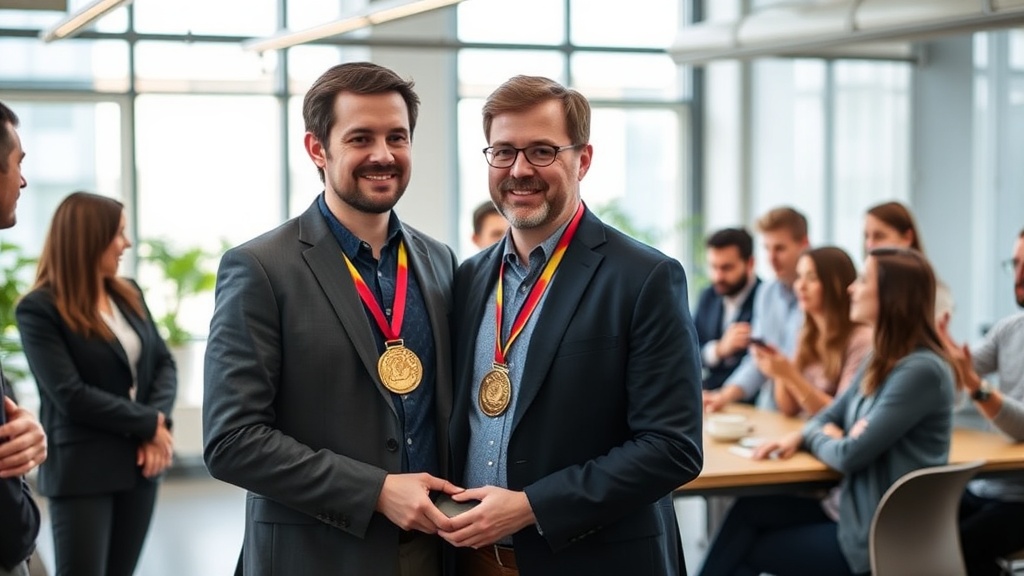
The mathematics community, and indeed the broader scientific world, is still processing the seismic announcement made this week by Jacob Tsimerman. Fresh off receiving the Fields Medal, the quadrennial award often likened to a Nobel Prize for mathematicians, Tsimerman revealed his intention to leave his university post for a position at OpenAI. This move is particularly striking because it comes not from a researcher struggling to secure academic funding or tenure, but from an individual at the absolute pinnacle of his field. His decision suggests a profound re-evaluation of the future of mathematical research and its place in an increasingly AI-driven world.
Tsimerman's Fields Medal was awarded for solving a problem that had remained intractable for nearly four decades. This achievement alone would cement his legacy. However, his subsequent declaration at the same press conference where he accepted the award has cast a long shadow over the traditional academic path. His pronouncement, "The math profession as we know it now, I don't think it will exist the way it exists right now," is not the statement of someone leaving for greener pastures; it is a stark assessment from a leading figure that the very landscape of his discipline is undergoing a fundamental transformation.
Academia's Shifting Ground
The implications of Tsimerman's move extend far beyond a single career change. For decades, the theoretical sciences, including mathematics, have relied on academic institutions as the primary incubators of foundational research. Universities provide the environment for deep, often abstract, inquiry, fostering the kind of long-term, high-risk, high-reward work that doesn't always align with immediate commercial pressures. However, the rapid advancements in artificial intelligence, particularly in areas like automated theorem proving, symbolic regression, and AI-assisted discovery, are beginning to challenge this paradigm.
AI systems are increasingly capable of performing tasks that were once the exclusive domain of human mathematicians. These include generating proofs, discovering complex patterns in data, and even formulating new hypotheses. While these tools are often developed and refined within academic labs, their rapid commercialization and deployment by AI companies like OpenAI present a new dynamic. The concern is that the frontier of mathematical discovery might increasingly lie with organizations that possess vast computational resources and specialized AI talent, potentially siphoning away the brightest minds from universities.
Tsimerman's statement suggests he perceives this shift not as a minor evolution, but as a fundamental disruption. It raises the unsettling question for many academics: if the tools and the talent are migrating to industry, what will be the future role and relevance of traditional academic mathematics? Will universities become primarily consumers of AI-generated mathematical insights, rather than primary producers? This is a scenario few in academia have been prepared for, and Tsimerman's defection to OpenAI is a powerful signal that the time for preparation is now.
The OpenAI Angle
OpenAI, a leader in AI research and development, has been strategically positioning itself at the forefront of scientific advancement. The recruitment of a Fields Medalist like Tsimerman underscores a clear objective: to integrate cutting-edge mathematical expertise directly into their AI development efforts. This isn't simply about having a brilliant mathematician on staff; it's about harnessing profound mathematical insight to unlock new frontiers in AI capabilities, potentially accelerating the development of more general artificial intelligence or enhancing the safety and alignment of existing systems.
The specific mention of OpenAI's "safety team" is also noteworthy. As AI systems become more powerful and autonomous, ensuring their alignment with human values and preventing unintended consequences becomes paramount. Tsimerman's background in abstract mathematics could be invaluable in developing formal methods for AI safety, creating robust theoretical frameworks to understand and control complex AI behaviors. It suggests a recognition by OpenAI that tackling the deepest safety challenges may require a more profound, perhaps even abstract, mathematical approach than previously considered.
This move by Tsimerman can be viewed as a strategic play not just for him, but for OpenAI. It signals a maturation of the AI industry, moving beyond pure engineering and into the realm of fundamental scientific exploration. By attracting talent from the very apex of theoretical disciplines, companies like OpenAI are not just building better products; they are attempting to redefine the process of scientific discovery itself. The sheer scale of computational resources and the focused, mission-driven environment of a leading AI lab offer a different kind of intellectual challenge and potential impact compared to the traditional academic setting.
Broader Implications and Unanswered Questions
Tsimerman's departure from academia for industry is more than just a high-profile hire; it's a symptom of a larger trend. The immense computational power and data-handling capabilities of modern AI are beginning to provide tools that can accelerate or even automate aspects of scientific discovery. This is particularly true in fields like mathematics, physics, and biology, where pattern recognition, hypothesis generation, and complex modeling are central to progress.
The immediate impact for the academic mathematical community is a sense of unease. If individuals at the very top of the field feel compelled to seek opportunities in industry, it could exacerbate the existing challenges of retaining talent and funding fundamental research within universities. The competition for brilliant minds has always been fierce, but the nature of that competition is changing. It's no longer just about prestige or tenure; it's about access to resources, cutting-edge tools, and potentially, a more direct pathway to impacting the future of technology and science.
What remains to be seen is how this trend will play out. Will it lead to a bifurcation of mathematical research, with industry focusing on applied and AI-driven discovery, while academia continues its foundational work with fewer resources? Or will universities find new ways to collaborate with, or even leverage, the AI tools and resources now emerging from industry? Tsimerman's decision is a powerful indicator, but the full story of how AI will reshape scientific disciplines is still being written. His move to OpenAI is a compelling chapter, one that suggests the future of high-level scientific inquiry may increasingly be found not in ivory towers, but in the labs of leading technology companies.