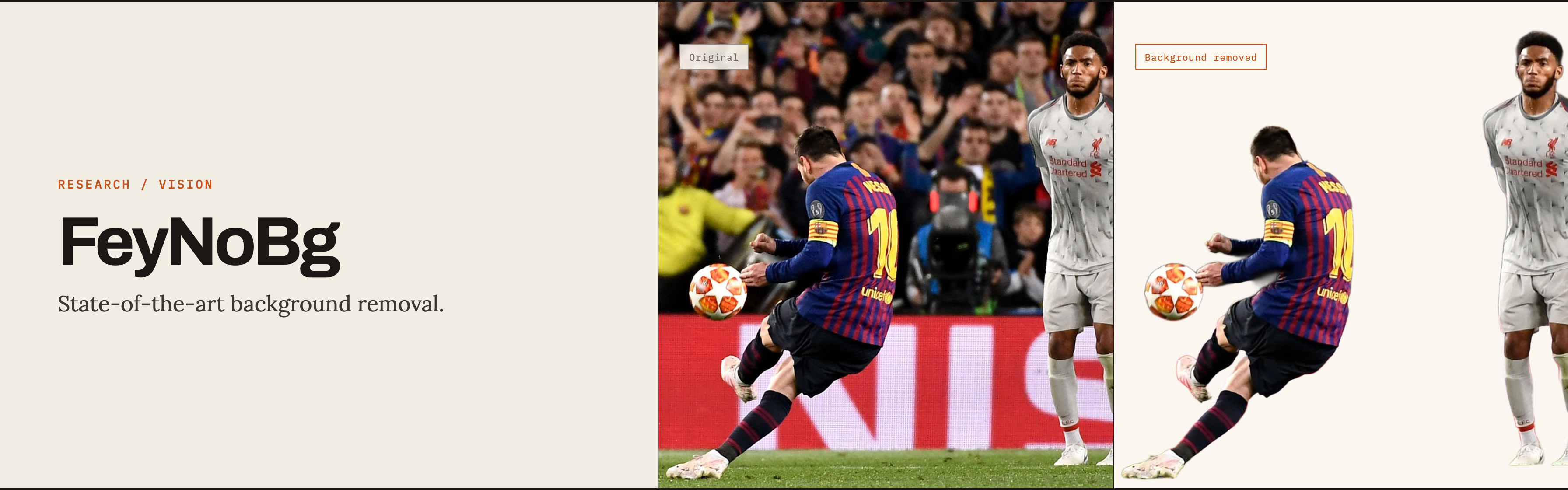
FeyNoBg: A New Open-Source Contender in Image Background Removal
FeyNoBg, a new project recently showcased on Hacker News, introduces an open-source solution for automatic background removal from images. Developed by Fey, the library and accompanying model aim to provide developers with a flexible, self-hostable alternative to proprietary APIs and services. This release signals a growing trend toward open-source tooling for complex AI tasks, empowering users with greater control and transparency.
The core of FeyNoBg is its trained model, designed for efficient image segmentation. Background removal, a common task in image editing, e-commerce, and content creation, typically involves identifying and isolating the foreground subject from its background. While many commercial solutions exist, they often come with API costs, data privacy concerns, or limitations on customization. FeyNoBg seeks to address these pain points by offering a downloadable model and a Python library that can be integrated directly into existing workflows.
Model Architecture and Training
FeyNoBg's approach centers on a deep learning model trained for semantic segmentation. The specific architecture is not detailed in the initial announcement, but such models typically employ convolutional neural networks (CNNs) to process images and output a mask that delineates different objects or regions. The availability of the training library suggests that users can not only leverage the pre-trained model but also retrain it on custom datasets or fine-tune it for specific domains. This is a significant advantage for applications requiring highly accurate segmentation of particular subjects, such as specialized product photography or scientific imaging.
The library itself is presented as a user-friendly Python package. Developers can install it and then use its functions to process images. The process generally involves loading an image, passing it to the FeyNoBg model, and receiving a segmentation mask as output. This mask can then be used to composite the foreground onto a new background, make the original background transparent, or perform other image manipulation tasks. The emphasis on a local, self-hosted model means that processing can occur entirely on the user's infrastructure, which is crucial for applications dealing with sensitive data or requiring high throughput without incurring per-API-call fees.
Key Features and Developer Benefits
FeyNoBg offers several compelling features for developers:
- Open-Source Model and Library: Full access to the code and trained model allows for inspection, modification, and integration without vendor lock-in.
- Self-Hostable: Run the model on your own servers for enhanced privacy, security, and predictable costs, irrespective of usage volume.
- Training Library: The included library enables users to retrain or fine-tune the model on custom datasets, tailoring it to specific needs.
- Ease of Integration: Designed as a Python library, it should integrate smoothly into existing Python-based image processing pipelines and machine learning frameworks.
- Performance: While specific benchmarks are not provided, the aim is to offer a performant solution suitable for various applications.
The decision to open-source both the model and the training components is a strategic move. It fosters community contribution, allowing other developers to identify bugs, suggest improvements, and potentially contribute new features or optimized versions. This collaborative approach can accelerate the development and adoption of the technology, much like successful open-source projects in other domains.
Comparing FeyNoBg to Existing Solutions
The landscape of background removal tools is diverse. Services like remove.bg, Adobe's Photoshop, and cloud provider AI services offer robust solutions, but often come with subscription fees or per-use charges. These can become prohibitive for applications processing millions of images, such as large e-commerce platforms or social media sites. Furthermore, these services may have limitations on image resolution, file types, or the ability to customize the segmentation process. For instance, if a business sells highly specific items, a generic model might struggle with subtle details or unusual shapes, necessitating custom training that commercial APIs rarely permit.
FeyNoBg enters this market by offering a middle ground: the power and flexibility of a custom-trained model without the prohibitive costs or vendor dependencies of commercial APIs. Developers who require fine-grained control over the segmentation process, need to process images offline, or have strict data privacy requirements will find FeyNoBg particularly appealing. The ability to train the model on specific product types, for example, could lead to significantly higher accuracy than a general-purpose model.
Potential Use Cases and Future Development
The immediate applications for FeyNoBg are numerous. E-commerce businesses can automate the creation of product images with transparent backgrounds. Content creators can easily remove backgrounds from photos for social media posts or marketing materials. Developers building augmented reality applications can use it to isolate subjects for virtual overlays. Researchers in computer vision can leverage the training library to experiment with new segmentation techniques or datasets.
What remains to be seen is the performance ceiling of FeyNoBg. How does its accuracy compare to state-of-the-art commercial models on diverse datasets? What are the hardware requirements for running inference and, more importantly, for retraining the model? The open-source community will likely play a critical role in answering these questions through rigorous testing and contributions. The success of FeyNoBg will hinge on its ability to balance ease of use with powerful customization, making it a go-to solution for developers seeking control over their image processing pipelines.