The Core Problem: Divergent Feature Definitions
Machine learning models require features—derived data points that capture specific aspects of the raw data. A common and costly problem in ML workflows arises from the need to compute these features for two distinct purposes: training the model and serving predictions in production.
Consider a feature like avg_order_value_30d, crucial for a fraud detection model. Typically, this feature is calculated during the batch training pipeline, which runs nightly over historical data stored in a data warehouse. The SQL query might look something like this:
-- training pipeline, run nightly over history
SELECT
  o.order_id,
  o.customer_id,
  o.created_at,
  AVG(o.order_value) OVER (PARTITION BY o.customer_id ORDER BY o.created_at RANGE BETWEEN 2592000 -- 30 days in seconds
                 PRECEDING AND CURRENT ROW) AS avg_order_value_30d
FROM orders o
WHERE o.created_at >= CURRENT_DATE - 30
This calculation is performed once and the resulting features are stored, ready to be joined with the training dataset. The process is straightforward.
The Production Serving Challenge
The problem intensifies when the same model needs to score new, live data in production. For real-time fraud detection, the model needs the avg_order_value_30d for a specific customer at the moment a new order is placed. This requires a different computation pattern.
A naive approach would be to replicate the training logic in the production serving environment. However, this leads to significant issues:
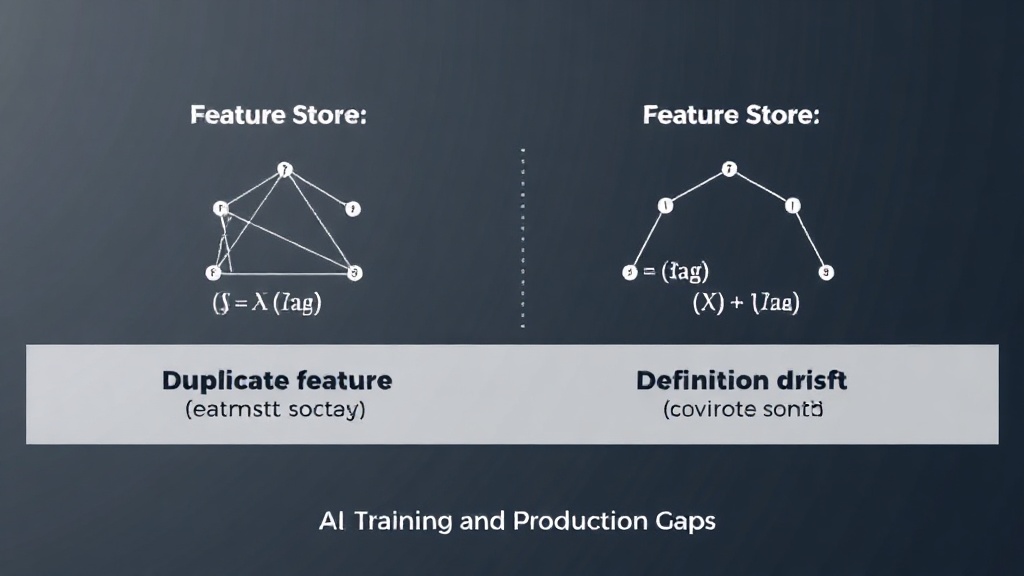
- Duplicate Computation: The same feature logic is implemented and executed in two entirely separate systems (the batch training pipeline and the real-time serving system). This is inefficient and doubles the engineering effort.
- Definition Drift: The most insidious problem is definition drift. The SQL query in the warehouse might be updated to refine the
avg_order_value_30dcalculation. Meanwhile, the code in the production service, which might be written in Python or Java, remains unchanged. When the model is retrained on data with the new definition, but scores live data using the old definition, predictions become inaccurate. This drift can be subtle and hard to detect, leading to silently degraded model performance.
The excerpt highlights a specific instance where a single feature calculation broke in just eight lines of code, illustrating how easily these definitions can diverge and cause problems.
Introducing the Feature Store
A feature store is designed to solve this exact problem by acting as a central repository and management layer for ML features. It bridges the gap between offline training and online serving by ensuring that features are defined, computed, and served consistently.
At its core, a feature store separates the definition and computation of features from their consumption. It provides a unified interface for data scientists to define features and for ML pipelines (both batch and real-time) to consume them.
The architecture typically involves:
- Offline Store: This is where historical feature data is stored, often in a data warehouse or data lake. It's used for training ML models. The feature store manages the ingestion and transformation of raw data into features for this store.
- Online Store: This is a low-latency database (like Redis or DynamoDB) that stores the latest feature values for real-time serving. When a prediction request comes in, the feature store can quickly retrieve the necessary features for the given entity (e.g., a customer ID).
- Feature Registry: A central catalog that stores metadata about features, including their definitions, transformations, owners, and versions. This registry is key to preventing definition drift.
When a data scientist defines a feature, say avg_order_value_30d, they register it in the feature store. The feature store then manages the computation of this feature. For training, it can generate the historical dataset from the offline store. For serving, it ensures that the latest value is available in the online store. If the definition of avg_order_value_30d needs to be updated, it's done once in the feature store's registry. This single update propagates to both the training data generation process and the serving logic, eliminating definition drift.
The Benefits of a Feature Store
Implementing a feature store offers several compelling advantages:
- Consistency: Guarantees that features used for training are identical to those used for serving, eliminating the risk of definition drift and improving model accuracy in production.
- Efficiency: Avoids redundant computation of features across different pipelines. Features are computed once and reused, saving compute resources and engineering time.
- Collaboration and Discovery: The feature registry acts as a central catalog, making it easier for teams to discover existing features, understand their lineage, and avoid recreating work.
- Faster Iteration: Data scientists can iterate on models more quickly, as they don't need to worry about the complexities of feature engineering for both training and serving environments. The feature store abstracts these complexities away.
- Scalability: Feature stores are built to handle large volumes of data and high-throughput serving requests, crucial for production ML systems.
The problem of feature definition drift is akin to building a house with two different blueprints: one for the foundation and another for the walls. Even if the builders are skilled, the resulting structure will be unstable. A feature store provides the single, authoritative blueprint that ensures consistency from the ground up.
The Evolving Landscape
Feature stores are becoming a foundational component of mature MLOps (Machine Learning Operations) practices. Companies like Tecton, Feast (open-source), and Vertex AI Feature Store from Google Cloud offer managed solutions. However, the core principles remain the same: centralize feature definition, manage computation, and ensure consistent access for both training and serving.
If you are running ML models in production, especially those requiring real-time predictions, the risk of feature definition drift is a silent performance killer. A feature store is the most robust solution to this pervasive problem, ensuring that your models perform as expected, whether they are learning from historical data or making decisions on live streams.