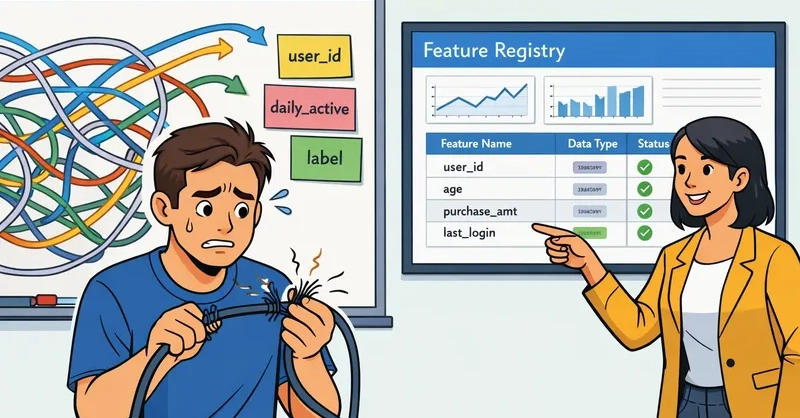
The Problem: Unmanaged Feature Sprawl
The symptoms are familiar: models that suddenly fall over after a schema change, a dozen near-duplicate features named user_ltv_v1, user_ltv_final, user_lifetime_value, and onboarding that requires rebuilding features from scratch for every new model. These outcomes are manifestations of weak governance. There's no single source of truth for feature definitions, no version history tied to compute logic, and no automated validation before a feature reaches production.
This lack of control slows experimentation, increases Mean Time To Recovery (MTTR) for incidents, and introduces avoidable compliance risks. In essence, organizations are building complex machine learning systems on a foundation of sand, where individual components (features) can change or disappear without warning, impacting the entire structure.
Why Feature Governance Matters
Effective feature governance is not just about tidiness; it's a critical enabler for scalable, reliable, and compliant machine learning operations. It addresses several core challenges:
- Reproducibility: Without a clear definition and versioning of features, reproducing model training runs or debugging production issues becomes an archaeological dig.
- Collaboration: A central registry acts as a shared language and understanding for data scientists, ML engineers, and analysts, reducing redundant effort and miscommunication.
- Quality Assurance: Automated checks and defined review processes ensure that features meet predefined standards before deployment, catching errors early.
- Compliance and Auditing: For regulated industries, understanding the origin, transformations, and usage of every feature is paramount. A governed registry provides this audit trail.
- Efficiency: By making features discoverable and reusable, teams can accelerate the development of new models, shifting focus from feature engineering to model experimentation and deployment.
Designing a Feature Registry Schema and Metadata
A feature registry is more than just a database of feature names. It requires a well-defined schema that captures essential metadata for each feature. This metadata acts as the source of truth and enables robust governance.
Key metadata fields should include:
- Feature Name: A clear, unambiguous, and standardized name.
- Description: A human-readable explanation of what the feature represents and its business context.
- Owner(s): The individual or team responsible for the feature.
- Version: A mechanism to track changes to the feature's definition or computation logic. Semantic versioning (e.g., major.minor.patch) is often suitable.
- Data Type: The expected data type (e.g., integer, float, boolean, string, timestamp).
- Data Source(s): The origin of the data used to compute the feature (e.g., specific tables, APIs, event streams).
- Transformation Logic: A reference to the code or query used to compute the feature. This could be a pointer to a Git repository, a SQL query, or a specific function.
- Compute Environment: Where and how the feature is computed (e.g., batch, streaming, online).
- Freshness/Latency Requirements: How up-to-date the feature needs to be for its intended use.
- Statistical Properties: Expected range, mean, median, standard deviation, null percentage, etc. This is crucial for monitoring and validation.
- Tags/Labels: For discoverability and categorization (e.g., PII, domain, model applicability).
- Lineage: Upstream dependencies (data sources, other features) and downstream consumers (models, reports).
The schema should be extensible to accommodate future needs and specific organizational requirements. Think of it as the blueprint for every piece of data that feeds your models.
Workflow: Propose, Review, Approve, and Retire Features
A robust feature registry needs a defined lifecycle and associated workflows to ensure quality and control. This is where governance truly takes shape.
Propose
A data scientist or engineer identifies a need for a new feature or an update to an existing one. They initiate a proposal, typically through a ticketing system or a dedicated interface within the feature store/registry. This proposal includes all the necessary metadata as defined by the schema.
Review
The proposal enters a review phase. This involves:
- Technical Review: ML engineers or senior data scientists assess the proposed transformation logic for correctness, efficiency, and adherence to coding standards.
- Domain Review: Subject matter experts ensure the feature's definition and business context are accurate and relevant.
- Data Quality Review: Analysts or data engineers check the proposed data sources and expected statistical properties.
Automated checks, such as linting for transformation code or basic statistical validation against sample data, should be integrated here.
Approve
Once reviews are passed, the feature is formally approved. This triggers actions such as:
- Registering the feature and its metadata in the central registry.
- Tagging it as production-ready.
- Potentially triggering automated deployment pipelines for feature computation.
Retire
Features that are no longer needed or have been superseded by newer versions must be gracefully retired. This process should involve:
- Identifying consumers of the feature to ensure no downstream systems are affected.
- Archiving the feature's definition and compute logic.
- Marking the feature as deprecated in the registry, with clear information on its replacement if applicable.
This structured lifecycle prevents the accumulation of stale, unmaintained features that pose a silent risk.
Quality Gates: Tests, Lineage, and Monitoring
Beyond the proposal and approval workflow, continuous quality assurance is vital. This is achieved through integrated testing, comprehensive lineage tracking, and vigilant monitoring.
Automated Testing
Before a feature is approved and deployed, and continuously thereafter, automated tests must run:
- Unit Tests: For the transformation code itself.
- Integrations Tests: Ensuring the feature can be computed correctly using its defined data sources.
- Data Validation Tests: Checking if the computed feature's statistical properties (e.g., range, distribution, nulls) conform to expectations defined in the registry. Schemas can be enforced here.
- Backfill Tests: Verifying that historical computation yields consistent results.
Lineage Tracking
Understanding data lineage is critical for impact analysis and debugging. The registry should capture:
- Upstream Lineage: Which raw data tables, streams, or other features feed into this feature.
- Downstream Lineage: Which models, dashboards, or other features consume this feature.
When a source data schema changes, lineage allows immediate identification of all affected features and models. Similarly, if a model behaves unexpectedly, tracing its feature inputs through lineage can pinpoint the root cause.
Monitoring
Once deployed, features require continuous monitoring:
- Data Drift: Tracking changes in the statistical distribution of the feature over time and comparing it to its training distribution.
- Concept Drift: Monitoring the relationship between the feature and the target variable (if applicable and observable).
- Operational Metrics: Latency of feature computation, success/failure rates of feature serving.
- Freshness: Ensuring features are updated according to their defined latency requirements.
Alerting mechanisms should be in place to notify owners of significant deviations.
Driving Adoption and Measuring Feature Reuse
Implementing a feature registry and governance framework is only effective if it's adopted across the organization. This requires a strategic approach:
- Executive Sponsorship: Clear support from leadership emphasizing the importance of governed data and features.
- Training and Documentation: Providing clear guides, tutorials, and training sessions on how to use the registry and follow the workflows.
- Developer Experience: Making the process of proposing, registering, and consuming features as seamless and integrated as possible into existing tools and workflows (e.g., IDE plugins, notebook integrations).
- Highlighting Successes: Publicizing instances where the registry prevented incidents, accelerated development, or improved model performance.
- Measuring Reuse: Quantifying the impact of the registry by tracking feature reuse rates. A high reuse rate indicates that the registry is successfully enabling teams to build upon existing, trusted assets rather than reinventing the wheel.
The ultimate goal is to shift the culture towards treating features as valuable, reusable assets that are managed with the same rigor as code or infrastructure.
Practical Application: Checklists and Templates
To operationalize feature governance, concrete tools are essential. Organizations can develop:
- Feature Proposal Templates: Standardized forms that guide users in providing all required metadata.
- Review Checklists: Ensuring that all necessary checks (technical, domain, data quality) are performed during the review process.
- Retirement Checklists: A step-by-step guide for safely deprecating and archiving features.
- Onboarding Guides: Templates for new team members to understand the feature governance process.
These practical artifacts democratize the governance process, making it accessible and manageable for all teams involved in the ML lifecycle.